Eugene still severely rent-burdened and ‘getting worse’
5 min read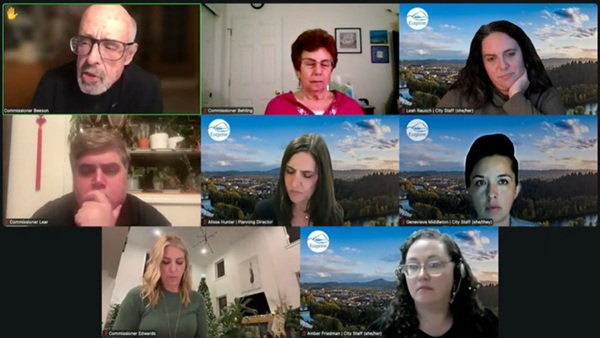
Speaker Eugene continues as a severely rent-burdened city. At the Planning Commission Dec. 2, Senior Planner Leah Rausch:
Leah Rausch We are going to talk a little bit about severe rent burden in Eugene this evening. I’m joined by Amber Friedman from the Planning Division, as well as Genevieve Middleton from the Community Development Division…
So each year, the state requires cities with high rates of severe rent burden to hold a public meeting. Eugene has exceeded this threshold for many years, where more than 25% of renter households experience ‘severe cost burden.’ And that severe cost burden is paying more than 50% of their income on their housing costs.
Speaker Eugene has been identified as ‘severely rent-burdened’ every year since HB 4006 passed in 2018. Associate Planner Amber Friedman:
Amber Friedman Rent burden is the percentage of household income a household spends on housing expenses. So when a household spends more than 30% of their income on housing expenses, they’re considered rent cost-burdened. A household that spends more than 50% of their income on housing is considered severely rent-cost burdened. A third of our renter households are spending half of their income on housing costs; overall, 62% of Eugene renter households experience some level of rent cost burden.
So why do we care if Eugene is a severely rent-burdened city? There are negative economic outcomes. People have less disposable income to spend in our local economy; people have less savings in the bank for unexpected expenses; we see high housing costs can deter potential candidates from relocating; limited housing inventories, making it hard for new hires to find suitable accommodations quickly; an increased risk of experiencing homelessness…
Folks that move to lower-cost areas may have longer commutes to work or school, to health care, grocery stores, etc. and that contributes to less personal time for them and more carbon emissions from driving, an increase of cars on the road causing traffic as well as parking congestion.
Having less money due to housing costs can lead to sacrificing necessities like health care and nutritious food, basic needs like child care, internet access, and transportation in order to pay rent. Rising rents, cost burdens, rent arrears and dwindling resources have led to an increase of rates of eviction. 87% of those court-filed evictions were for non-payment of rent, so an increase of five percentage points since 2023.
Speaker After the cities’ repeated failure to meet state planning goals, the state took over with a series of sweeping mandates. Senior Planner Leah Rausch:
Leah Rausch We’ve shared previously with the Planning Commission how the new Oregon Housing Needs Analysis (or the OHNA) significantly changes how cities will plan for future housing needs within our urban growth boundary.
Eugene will need to support the production of more than 26,000 new dwelling units in the next 20 years to meet this housing need. Eugene saw an average of 965 new units per year over the last decade, and of those, about 100 each year were subsidized affordable housing. To meet our new housing need, Eugene needs to see closer to 1,600 new units each year for the next decade, including closer to 700 each year that are affordable to households with the lowest incomes.
We are now also required to meet our housing need, not just through overall production, but also by affordability.
Speaker Planning Commissioner Ken Beeson:
Ken Beeson (Planning Commission) We last heard about this two years ago, and I was kind of looking back at that. I find myself as I go through this material wanting some more context, or wanting some perspective. I have this sort of a sense that we’re just not making, as a city, we’re really not making a lot of progress. Are we moving in a direction where a smaller percentage of people are rent-burdened in our community? I have a feeling that it’s kind of growing. I don’t know why I—that one thing that jumped out is the number of evictions this year is substantially (it looked to me) substantially higher than just a year ago. And I don’t know if you look back even further than just one year, but if we’ve been doing this seven or eight years, is there a trend?
Speaker Responding to Commissioner Beeson, Leah Rausch and Genevieve Middleton:
Leah Rausch I wouldn’t say we’re seeing a lot of positive progress. We’re seeing an increase in cost burden for renters.
Genevieve Middleton We recently published the 2025 Eugene Springfield Consolidated Plan, and in that plan, we noted that some trends that have changed between the five-year plan previous to this one, that we have seen an increase in housing cost burden and severely housing cost burden since the previous five-year plan.
So your question of, ‘Is it getting worse?’ Yes, it’s getting worse. And is the number of low-income and and extremely low-income households growing? Yes. That number is growing.
Ken Beeson (Planning Commission) I sort of feel like it would help if we could connect some of the dots a little bit. We’ve talked about the Oregon Housing Needs Analysis and that we need 26,273 new dwelling units in the next twenty years—a pretty big bite, I think. It’s going to take some some work to do that. And it would be good to be able to kind of watch how that’s going.
Speaker Leah Rausch:
Leah Rausch We have our growth monitoring data dashboard on the Planning Division’s website that is currently reporting, ‘How are we doing compared to that 20-year need.’ So we do have a place for that, and those dashboards are available.
Speaker Commissioner Diane Behling:
Diane Behling (Planning Commission) Maybe the answers are in the dashboard. I went to Commissioner (Jason) Lear’s wonderful groundbreaking yesterday, so I know that there are affordable housing units under construction. And how are we doing?
I personally would like to know, (1) projects that are open currently, and of the ones in the pipeline, (2) how many are in that pre-construction phase and (3) how many are under construction. Those are kind of the three major categories, I would think. That would be very interesting and very helpful. And thank you for all your work, all of you.
Eugene Planning: Great, we can get you those numbers, thanks.
Speaker Eugene planners report that trends are moving in the wrong direction, as Eugene holds its annual meeting to report that our community is severely rent-burdened, and to explain the consequences.
For more, see American Community Survey data on the U.S. Census Bureau website and the OHCS Equity Indicators Dashboard, which provides recent rent burden data for Oregon cities with a population of 10,000 or greater.