David Rovics: I no longer exist on YouTube Music
5 min read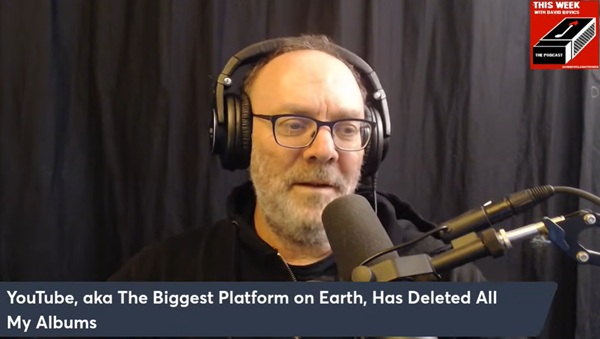
Speaker You can hear David Rovics every Tuesday at 8 here on KEPW 97.3 Eugene’s PeaceWorks Community Radio. The Portland singer/songwriter recently spoke about his experiences with YouTube Music.
David Rovics YouTube, aka the biggest platform on Earth, has deleted all my albums, 50 of them altogether, several of which had been there since YouTube Music began, along with all of the albums, they disappeared all of the comments and all of the evidence that these songs had ever been heard millions of times.
As an artist on YouTube Music who puts out albums, I no longer exist. If it could happen to me because of my allegedly controversial political viewpoints, it could happen to you because of yours.
I’m an independent artist, like millions of others in the world, putting out self-released recordings, that is, recordings that are not released and promoted by a record label other than my own little one person label.
I have never had anything remotely approaching a hit, or what they would call commercial success, but among musicians who have their music up for streaming, I’m easily in the top 10% of most streamed artists, usually within the top 5%. All the pop stars are well within the top 1% of most streamed artists.
There’s a very steep curve happening here, and I don’t mean to overinflate my importance in the scheme of things. I’m just trying to say that I do have an audience.
My songs are streamed millions of times every year on YouTube, millions of times a year on Spotify, and less on other platforms because there are really only two main platforms in the world outside of China.
I asked Gemini (Google’s AI chatbot) to explain the impact on an artist’s future career if their music is removed from YouTube Music. I excerpt here Gemini’s response, which was very clear and very accurate to the best of my fairly significant level of knowledge on this subject.
‘The removal of his solo albums from the ‘David Rovics – Topic’ music streaming platform would have a significant and strongly negative impact on potential audience growth, particularly within the mainstream digital music ecosystem. Here’s an analysis based on the context:
‘Loss of the digital highway. One context snippet likens major streaming platforms to the infrastructure for our lives. and a second home. Being removed from a platform is like disappearing, similar to how being off Facebook can feel like disappearing from the virtual world. YouTube Music/Premium is a highway for millions of global listeners and the removal eliminates the path of least resistance for new casual listeners to discover and consume his full album catalog.
‘Hindrance to discovery. The topic channel is the primary source for music distribution on YouTube’s dedicated streaming service. Its removal stops the platform’s algorithms from suggesting his catalog to listeners who might enjoy political, folk, or similar genres, severely limiting organic discovery through the YouTube Music’s ecosystem.
‘Erosion of market share. Losing a major global platform like YouTube music represents the loss of a key segment of the overall music streaming market, which is crucial for modern audience growth.
‘Forced friction. New listeners must now go directly to his website. Patreon, Substack, Bandcamp where he faces shadow-banning issues or other less dominant streaming platforms . This added friction prevents casual users from encountering his music, which directly impacts the potential for mass audience expansion.’
To provide a little more context about what all this stuff means, every month, artists who are on Spotify get an email from Spotify telling us of the… new listeners. Those are often people who got to a song of mine because they were listening to another left-wing artist, and the algorithm thought they’d like to hear me, or a particular song of mine. As Gemini explained: ‘This recommendation phenomenon will no longer be in play with my music on YouTube music anymore.’
According to my research on this sort of thing, it is so rare that an artist has their entire catalogue deleted by a platform for reasons unrelated to copyright infringement.
There are no examples available aside from mine that I can find. If anyone reading this or listening to this knows of one, please let me know.
Once other people understand what has just happened to me, and what could happen to anyone else who gets on the blacklist, I hope that soon I will not be alone in speaking out against what they’ve specifically just done to me.
I received my first notification from YouTube that my channel was being demonetized for the next 90 days to punish me for posting a Houthi army press release, which I thought was an interesting thing to share with people, given that the U.S. was at that time actively bombing Yemen. After one or two more of these 90-day suspensions of monetization in January 2025, YouTube informed me that my channel would now be permanently demonetized and that it had no recourse.
I contacted the YouTube customer service people to confirm that this was indeed the case, and not a mistake.
At the same time as this was going on, YouTube was regularly deleting videos, specifically if they involved me singing my Song for the Houthi Army or my song, I Support Palestine Action. It seemed they would wait for someone to report the video and then delete it.
This is my only way to understand their process for deciding which videos to delete on YouTube, because of the way it has thus far involved getting rid of some renditions of these songs while leaving others on the platform.
YouTube’s explanation for which rules I was violating that had led to my channel’s permanent demonetization was supporting criminal organizations, which is a broad concept that, under both British and U.S. law, includes the Houthi army and in the U.K., the British nonviolent direct action group Palestine Action as well.
In the U.K., verbally expressing support for proscribed organisations like them is a crime punishable by up to fourteen years in prison, as this violates Section 12 of the U.K.’s Terrorism Act of 2000.
In the U.S., verbally expressing support for proscribed organisations may be legal under the First Amendment, but earning income from praising proscribed organisations, at least by my understanding of the law, is a different matter legally.
In any case, for whatever reason, never fully explained, my channel was demonetized and certain videos of certain songs continue to be randomly disappearing.
When this happens, I get two emails from YouTube, one explaining that this song violated the rule against supporting criminal organizations and has therefore been taken down. And another one telling me that my channel has been permanently demonetized.
One of the other chatbots I consulted about having my entire catalog deleted by YouTube Music, was confident that because this sort of action is so unheard of and appeared to be so obviously political in nature, surely the artist targeted in this way would benefit by getting lots of media publicity.
So far anyway, I can report that that chatbot’s assumptions were false. This is often the case with AI as with humans.
Speaker You can hear David Rovics every Tuesday at 8 p.m. right here at 97.3 Eugene PeaceWorks Community Radio.