Follett Foundation hosts talk on wisdom councils
10 min read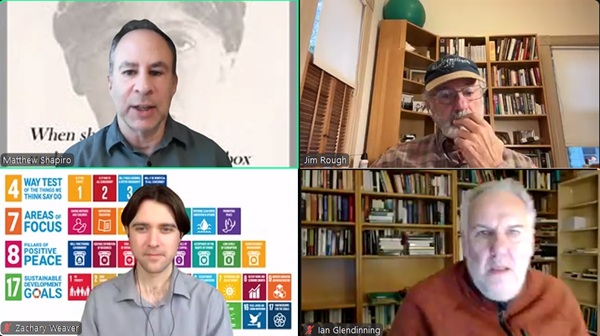
Speaker The Mary Parker Follett Foundation is sponsoring a series of talks on Follett, a management consultant to Teddy Roosevelt and influential author on organizational theory. Speaking Dec. 6 on how wisdom councils support Follett’s vision, Jim Rough:
Jim Rough I want to talk about how we can really actually realize her vision of democracy. And this is a big deal. I mean, the real problem here is: How do we get to that democracy? And I have a breakthrough strategy, I think. But I need that question in order to be heard. I need somebody to ask that question. Otherwise people don’t think that big.
So how do we get Follett’s vision of democracy to actually happen here in the United States, soon, in time? Because this is not an intellectual exercise in my mind. It’s about how to get there.
Her vision, mostly centered around the book, The New State, she describes a particular kind of conversation, and then she describes a particular kind of democracy, and she also talks about leadership and how maybe that can happen. But the ‘how to get there’ is really fuzzy. How do we get to that, that creative, collaborative, totally participative vision of democracy?
And then I want to share a little bit of my story, because I started independently discovering some of these same, these elements, as you all have, I think. In my journey, I ended up naming the quality of conversation and the quality of democracy, and then an eight-step project for how to get there.
And bottom line, most people don’t have solid vision in mind. They’re talking about democracy, which has something to do with voting and representatives and all that stuff, and that’s not what she’s talking about. She’s talking about co-creating the collective will. That has to happen. We have to come to this, we have to transform our system, because otherwise, it’s toast. It’s really toast. I think we’re getting the first indicators now.
So I’m looking for the rare people who can hear, and that we can get started, have a working project to do that. And maybe the Mary Parker Follett Foundation can host that, or maybe Braver Angels or maybe Indivisible or maybe Rotary or maybe, you know, I mean, there’s the prospect of how do we get this into being?
And so that’s kind of the angle that I’m coming from. So my request to you is, is really to own the problem. Own it. How do we get there?
Mary Parker Follett describes some kind of conversation that is transformational, so some of her quotes on conversation—there’s lots of them—she beautifully talks about it.
She says: ‘I go to a committee meeting in order that all together we may create a group idea, an idea which will be better than any one of our ideas alone, moreover which will be better than all of our ideas when we add them together.’ Yes, she’s talking about a creative process.
And she says: ‘Unity, not uniformity, must be our aim. We attain unity only through variety.’
News flash: This is huge. Everybody wants to talk about agreement. It’s not agreement. It’s unity that we’re after. And you’ve got to get there. You need people with differences of opinion in order to have breakthroughs. That’s how we get to unity. That’s how we get to ‘We the people.’
That’s how the founders actually did it, in my mind, 250 years ago. They got to unity. We needed a process of thinking which we’re calling choice-creating, co-creating the choice, to get to unity-with, through a creative process.
‘When we each enter into the conversation in our full selves, we are necessarily transformed and the collective is necessarily transformed.’ and she’s talking about that.
‘When the conditions for collective thinking are more or less fulfilled, then the expansion of life will begin.’ This is so beautiful. It’s like we haven’t started living yet because we are in a system that denies that possibility. Our system is not only destroying the planet, but it’s destroying our people.
How do we begin the expansion of life? Well, it begins with the quality of thinking and the quality of conversation. And this is the magic sauce: that we can facilitate. It’s about facilitation.
And then she talks about democracy. ‘The very essence and substance of democracy is the creating (of the collective will)’—it’s creative process. We don’t have a creative process in our system, what we call democracy. It doesn’t exist.
—‘the creating of the collective will. Without this activity the forms of democracy are useless and the aims of democracy are always unfulfilled.’
‘Our legislators are supposed to enact the will of the people, our courts are supposed to declare the will of the people, our executive to voice the will of the people… But there is no will of the people.’
And this is huge. I mean, they had a system for their brief moment where they knew they had to have everybody in the conversation and it had to be creative and collaborative. But they left us with a system where this creative having to have everybody on board is not part of our system. It’s not there. We’re just stuck with voting, and that’s ‘the will of the people.’ I’m sorry. That’s not what we’re talking about.
And then she said: ‘Loyalty to a collective will which we have not created, and of which we are therefore not an integral part, is slavery.’ I mean, she’s pointing to how degrading our system is.
So how do we get there? How can the people co-create the collective will? That’s why I think it’s important to have choice-creating, to co-create the choice, and the word ‘choice’ actually, it’s a richer word. The roots mean ‘to taste,’ not to cut away. So I think choice-creating works as the word for the conversation.
And then Follett’s form of democracy, where we co-create the collective will, also needs a name and an identity. And so, okay, I’ve chosen wise democracy because what we’re talking about is a level of wisdom that is needed for us at the collective level. I mean, you can have all the wise people in the world be in our current system, and we’re not going to get collective wisdom from that.
Follett’s way to get there—educating and empowering and practice—encounters the collective action problem. We need everybody. Everybody has to be in this zone of thinking. So it’s really about facilitation, I think, recognizing that facilitation is a holistic model of change where, when you facilitate a meeting, for instance, everybody in the room now is in this higher quality of thinking.
And so we want a particular quality of thinking, whole different layers of thinking, that we aren’t doing. And if it’s possible to facilitate the nation into one ongoing call it ’MPF-quality conversation’ where all the people reach unity as ‘We the people,’ the end result is people in unity. And when they’re in unity, it’s like, Oh, that’s actually the ultimate authority. There’s no higher authority.’
So we saw people come together and often they would come to the same answer, no matter what problem they worked on. They would come to the answer that our system is the problem, not our people.
The wisdom council process is really about how, using a series of randomly-selected small groups of people, dynamically facilitated to be in the spirit of Follett’s conversation, it can happen. And the magic sauce here is facilitation.
In other words, we don’t have to educate everybody in the room. You just facilitate in a certain way and the group goes to its highest level instead of its lowest common denominator. The group experiences the best of each of us, and the group is changed. There’s a new we. There is a we, that we become a we, and each of us is in a new life. It’s a new way of hanging out together.
We can dynamically facilitate each small wisdom council with random selection, but that series of wisdom councils and community gatherings can facilitate the national conversation, in the spirit of choice-creating.
So we structure the wisdom councils to be ongoing every month or so. It’s a wisdom council process and we provide ways to help the wisdom, the ‘We the people’ conversation, to be ever more inclusive and ever more approximating the spirit of Mary Parker Follett’s conversations and democracy.
Speaker Follett Talks host Matthew Shapiro:
Matthew Shapiro You read Follett and you said, ‘Here’s my response.’ Have you thought about how she would respond to your response? The circular response, as she calls it. What would she say to you in response to some of what you’re proposing?…
She might say that the only way people actually appreciate and understand the idea of democracy as we’re talking about it is by experiencing it. And they experience it at what she would call ‘the motor level.’
Just a block outside my house, we have a speeding issue here. Cars speed through. It’s not a megasocietal issue. It’s an issue right here. And to the people on the block, it might seem impossible and intractable, and thus presents a perfect opportunity for learning how to create a will in common and by enabling or of supporting or facilitating experiences of co-creation at the micro level, only in that way—in the home, in the neighborhood, in the school, simple little what we would call ‘little issues’—then we can finally learn how to learn what it is we’re capable of, and have faith that it can be done at the state level, at the national level, at the global level, as Follett ended her book. But it would have to be have to be grown organically, and that experience has to be fostered and facilitated everywhere.
Speaker From Democracy in a Box, Zachary Weaver:
Zachary Weaver We can add the wisdom council process and that can inspire and influence people to practice this at the micro level. Because what’s beautiful about the wise democracy process is that it can be adopted by any group, any system. You could do that at the neighborhood level. We could have the process running at the national level and we could have it running in many other smaller places on whatever problem that group can own.
Speaker Ian Glendinning:
Ian Glendinning You used the word ‘quality’ quite a lot, and ‘MPF-quality conversations,’ I think, was the language you used. Is the word ‘quality’ the word that she used in The New State or wherever else she wrote about this, or is that something you’ve brought to it? I’m just interested in that.
Jim Rough It’s curious. I assume she used it, but maybe she didn’t. I use it to distinguish, you know, what she’s saying. But I’m also infused with the spirit of Robert Pirsig. And as you know, Pirsig talks about the‘Metaphysics of Quality.’ And in my judgment, that’s what Follett is talking about: How do we transition to the ‘Metaphysics of Quality?’ So that is what this is.
Ian Glendinning Well, that is music to my ears, because I run the Robert Pirsig Association.
Jim Rough That’s fantastic!
Ian Glendinning It just jumped out at me when you started using the word because I, like you, associate it with Robert Pirsig. And you made this point about the sort of the local immediate issues where you can get people, at least, where they can see a tangible connection between them thinking about a solution and something they could solve. And then learning the process so you can do the same thing for these bigger problems as part of the wider democracy.
I’m all for supporting that process. Most of my work is at the more abstract level, the philosophy behind this. So when you picked up on quality, I instantly thought ‘Metaphysics of Quality.’ And that’s interesting.
Jim Rough That’s funny. The wisdom council process is about transforming to the kind of democracy that Mary Parker Follett is describing, which is not our current system. I’m talking about the Metaphysics of Quality.
And when we’re in that world, the wisdom council process is about a different nature of democracy, a different nature of capitalism, a different nature of culture. It’s a transformation of our world of being. And I’m sorry to talk in such big language, but that’s exactly what I think it is.
But we’re going to convene these small gatherings. And we facilitate it in the spirit of choice-creating. And what happens is at some point, there’s a transition out of the system where we realize, ‘Wait a minute, we’re actually in charge here.’
At first we’re just meeting and proposing things actually. When first we say ‘the will of the people,’ there’s an articulation of the public will for the first time. What we’re doing is we’re creating a new voice, a voice of the public will. But as it gets going, as more and more people get involved, we realize, ‘Wait a minute, we’re actually all the people. There’s no higher voice, there’s no higher authority than us. We’re actually we the people.’
Speaker The latest Follett Talk explores facilitated conversations as a way to implement Mary Parker Follett’s vision for a new American democracy.