County recognizes acclaimed deflection program manager Clint Riley
13 min read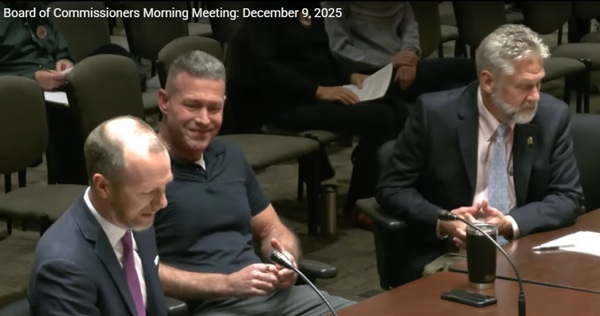
Speaker Lane County commissioners recognized deflection program manager Clint Riley. Dec. 9, County Administrator Steve Mokrohisky:
Steve Mokrohisky (Lane County, administrator) We have with us Clint Riley. You all know Clint. He retired as captain of the Lane County Jail a couple years ago. And we asked Clint to spearhead the development of the new Lane County Behavioral Health Deflection Program. So Clint serves as the deflection program manager leading this effort.
Measure 110 essentially decriminalized drug possession. There was an attempt to refer that to the ballot. Lane County stepped in and said, ‘You know, as opposed to just complain about one or the other solution, why don’t we actually bring our own solution?‘
We did that. We sat with our law enforcement/public safety partners and actually designed what we felt would be a really workable, outstanding program, and then brought on board the person that we needed to lead that effort. Having witnessed countless people affected by substance use disorder and addiction, cycle in and out of the jail, and having seen what it took for some of them to break that cycle, Clint built a program here along with us that is an inclusive recovery program, as inclusive as any recovery program in the state of Oregon, and we believe is really, actually, leading the state.
The program allows participants to build a pathway to recovery that can work for them, and offer them the best chance of success at what is one of the hardest things to accomplish—recovery. For anyone who has dealt with recovery themselves or has family or friends, you know this.
Through Clint’s efforts, more than 100 community partners and all local law enforcement agencies are participating in supporting people who are choosing recovery.
I’ll just make a note that, you know, Clint and our district attorney spent a lot of time in preparation before we launched this program, going and meeting with all of the law enforcement agencies throughout Lane County. Of course, we think about the Eugene Police Department and Springfield Police Department, but we have 10 rural cities and state police and the Sheriff’s Office. They met with all of them to begin to build that trust that this program could actually work, because the program being successful requires trust from law enforcement.
So, notably, Clint sought out and found a housing provider, Reveille Foundation, so that participants who did not have stable housing could be safe and truly have a chance to obtain sobriety, instead of being forced into the most basic survival mode that many had been in previously.
That was a key component that that Clint and the team had the wisdom to say, ‘You know, we really have to have a place where we can stabilize folks to get them ultimately into treatment.’
We know that Housing First works. We know that’s a model that is an evidence-based practice. And we knew that that was a gap in the system.
Clint has been, for those of us who’ve worked with Clint, we know that Clint has been and continues to be an advocate, along with District Attorney Chris Parosa (who’s been an incredible leader himself in this work), for widening the criteria far beyond the minimal state requirements to ensure the program serves as many people as possible.
And actually, to date we’ve had, 34 people have successfully completed the program. I know several commissioners, if not all of you, have been to a graduation. That happens—we’ve had several graduations—on Fridays. It’s hard to attend one of those and not leave having shed a tear because you see what individuals have gone through to get to that place.
It’s a very rigorous program to ultimately graduate from and have the charges against them dropped, and incredible support and partnership and accountability from law enforcement, from peer support folks. So 34 people successfully graduated. Another 60 are currently underway.
And Clint would tell you that he didn’t build the program by himself. And that’s true. But what Clint is too humble to say and to acknowledge is that we couldn’t have built this without him. He’s the catalyst. And you always need a leader, right? You can develop a program, but you need the champion and the catalyst to really build that lasting change in our community with continued investment from the state.
I will note that we got word from Multnomah County and Washington County that they’re actively looking at modeling around what Lane County is doing here, because they’ve heard what’s happened here. We have some folks who have worked with those, including our newer County Counsel (Rob Bovett) here, who share information about what’s happening in Lane County and that’s really impacted these other agencies.
So you see that this is not having just an impact in Lane County, in the lives in Lane County, but actually across the state, because we’re serving as an example of what’s possible when you do this type of work.
So Clint’s commitment to compassion, collaboration and recovery focused solutions was recognized this fall by Serenity Lane. We’re proud to share that Clint received the Serenity Lane 2025 Community Leadership Award, and really proud to recognize Clint.
Speaker Director of Lane County Community Justice and Rehabilitation Services, Greg Rikhoff:
Greg Rikhoff (Lane County) We really do have a remarkable individual, and I don’t want to simply repeat the tremendous words of the county administrator, but there really is an individual here with vision, with grit and and diplomacy.
At that international conference, a lot of time was spent on how do you even get law enforcement engaged, how do you help officers understand and get them trained to be able to deflect individuals? that given given Clint’s rapport and his vision for working with law enforcement, his commitment to going to every shift change, for all those shift briefings in every corner of the county, that tenacity and that grit and resolve, you know, you get to the graveyard, get to, you know, all of the shifts throughout the time.
And, you know, officers know if this is the latest fad—the flavor of the week—or if this is something that might be real. And the chance to prove that this is going to work is something that that they were willing to give Clint, in large part because of his career, but also what he did bring to the table, the exceptional work.
And the remarkable partnership with (Lane County District Attorney) Chris Parosa can’t be left unstated. He really has been a tremendous partner to this program. But he’s a partner in large part because of Clint, because he saw it was worth the values there: the respecting engagement of law enforcement, the collaboration with the municipal courts. Municipal courts are active partners in this, and that is a one-off. We’re not seeing that anywhere to the level that is here.
The tremendous housing partner—people are remarkably jealous of the housing component and what Reveille is able to do, with us and for us. But that was on Clint’s shoulders and that was creating a deep and respectful relationship with Reveille.
We’ve been saying the best in the state. Now that we have a chance to go out there and see this on a national scale, and we see that the national experts putting on the conference send people to our dashboard, send people to Clint, want folks to contact us—we spent a significant time of the conference just having people walk up to us and say, ‘You’re the people we have to talk to.’ And that that really and truly is Clint.
So, he is humble. He’s hating this. But here’s a human being who has worked for the county in many different capacities, and he’s always been saying, ‘There’s got to be a better way. There’s got to be a way we can make a difference in people’s lives.’
One hundred different agencies have been part of our treatment portfolio. They’re coming in large part because they trust what we’re doing, and in large part because they trust the individual behind that work. And that’s Clint Riley.
Speaker Clint Riley.
Clint Riley I am hating this. I do work much better than I take recognition. So thank you both. I appreciate it. And I’m going to say, I had a small part in this. There’s so many partners that were part of this, including the two of these guys right here (Steve and Greg). Thank you. Thank you.
Speaker Commissioner Pat Farr:
Commissioner Pat Farr I won’t spend a lot of time, Clint, because I know you don’t like the accolade that naturally comes with the work that you do and the way that you perform the work that you do. But what you’re doing today is just a reflection of what built up to your ability to do the job as well as you are today.
Historically, you’re way out ahead of the curve. And I first met you when Dan was the jail commander, and got to know you then. You helped me arrange for numerous public tours of the jail. And your humble nature explained the workings of the jail in ways that people came in with a certain mindset and left understanding exactly what you had brought to the job and the tremendous influence that you have on people’s lives.
And that’s what it’s all about, Clint. You change people’s lives. You do. You change people’s lives.
One last little story, I’ll say, is that, well, you and I made a presentation at the Oregon Board of Psychiatric Physicians a couple of years ago, and it was my presentation. I invited Clint to come and talk to me. They didn’t listen to me at all. They wanted Clint, and they carried him out literally on their shoulders after the presentation, because of the just description of the work that you were doing prior to the deflection work, which was, in effect, deflection work. It was very similar work that you were doing inside the jail facility.
Finally, you helped produce a video that I took to National Association of Counties, their annual meeting. And it was a video that we were going to present to the Health and Human Services Committee. They decided that they’d present it to the general assembly. Well, we got there, and Steve and I asked you and I were sitting there and I was waiting for the video to come on the general assembly, and they showed it during lunch. So everybody’s having lunch and the video is up. Oh my gosh. People should be watching this.
And I got a call saying, ‘Do you know that that video is on national feed right now?’ So you were on from New York City to Los Angeles. You were on TV that day and and really we got a great deal of accolade for that. The work that you do gives legitimacy to the entire program. And it’s because of the heart and the history that you bring to it.
Thank you so much for your ongoing service. Thank you for your your past service and your ongoing service. Clint, I’ll salute you.
Speaker Commissioner Heather Buch:
Commissioner Heather Buch Thank you for all your hard work. You know, legislators and policymakers do their best to create the best programs they can for our limited amount of resources. But policy is only as good as the people who are actually able to implement it on the ground.
It is clear that our deflection program is excellence, and that is because you personify excellence.
What you’re doing each day is, you know, so impactful to not only the individuals that go through the program, but to the families and all the people that surround those folks each and every day. It absolutely changes the way that our community actually comes to the county to, you know, really get our services and expands the way that they think about the county in a very positive light. And a lot of people don’t know what we do.
And so this is just another way to express, you know, how we as a county care about our community and how we want to give back, and you give back over and over again. Thank you so much.
Speaker Commissioner Lori Trieger:
Commissioner Laurie Trieger I think you know how much I respect you and the work you do. And the value of this program (and others have said it), we are a model for the state. And as the administrator said, the way this program came about was in that push-pull of people seeing a problem and trying to address it through a ballot initiative.
But it’s a complex systems problem. So the legislature tried to make some adjustments. and I imagine that will continue. We will keep having the policy discussion of what is the best way to really address the root causes of why people end up in an interaction with law enforcement, who are then good candidates for deflection.
So this is just one piece, but it’s an enormous pie, and we are making such a difference not only in the individual lives, but informing those policy conversations, because we get to show what happens when you resource a program, and we get to show what happens when you resource a program that has been thoughtfully created, not reactively created.
And so I can tell you, I had some difficult conversations with some of our legislators who wondered what was taking us so long to stand up our program. And I said, ‘Well, it’s not that it’s not stood up, it’s that it’s in development because we’re trying to build trust and get buy-in from all the parts of the system, because without that, we know it’s not going to work.’
The spokes are all the different law enforcement entities, the nonprofit organizations, the folks themselves who are interacting with the program, their family members, their counselors, all of it. So without a really strong and sturdy hub for those spokes to go in and out from to keep that wheel turning, and you’re that hub, it wouldn’t work as well as it has.
So you’re right, you haven’t done it alone. We all get that. We all appreciate that. But you are that hub.
And as for the graduations, I just want to encourage everyone in this room or watching, those are open to the public, and I’ve been to a handful of those as well as our Treatment Court. There’s a very different feeling to each of them. They’re both wonderful. They’re what I call the ‘this is why’ moments. I leave those rooms going, ‘Oh, this is why we do this work.’
To watch those folks share what it felt like to, in many instances, one for the first time, have a graduation ceremony for the first time in their life. Many of the folks in this program haven’t graduated, completed anything successfully. So just giving them the experience of that day.
But all the work that led up to it and the opportunity you have created in the relationships that you’ve built in the community to allow people that experience is phenomenal. Thank you.
Speaker Commissioner Ryan Ceniga:
Commissioner Ryan Ceniga Well, I’ll start by putting a little pressure on Mr. Rikhoff.
I still remember when we were in your office talking PSCC (Public Safety Coordinating Council) and as I was leaving, you said, ‘But we do have some good news. We have locked down Clint Riley to run our deflection program.’
And I still remember because I sat there and I got chills and I told you that. I said, ‘That is great news.’
Clint I think you know, I’ve been a huge fan of you since before I became a county commissioner. And I would go through the jail and just see the way you ran it and the respect that was everywhere in that jail really shows me and everybody what kind of a leader you are, and that means a lot when you’re starting up a new program like this, that really, has amazing potential. And I mean, you’ve taken it beyond where we thought it could go.
And that’s because of you and the leadership you share. I mean, perfect example—being there at shift change. I mean, seeing those things, that’s huge for the people that want to strive to produce a great program for a leader that they respect. I mean, they want your respect, and that’s because you give everybody that kind of respect.
So, I just want to say I appreciate everything you do. And I look forward to where this is headed, and I am really glad that you are in that seat, I really am. So thank you.
Speaker Commissioner David Loveall:
Commissioner David Loveall Okay. How much time can you bear this now, Clint? Any more? Are you about to your limit?
I echo all the comments that my colleagues have said, but, you know, our mantra and our mission statement for Lane County is, ‘We improve lives.’ And some of those people are so deeply invested, and some of those, very few of those people, are so deeply immersed in doing that that we don’t notice them, but we can’t imagine life without them.
And Clint, you’re that person that reminds me of someone who’s so deeply immersed in improving people’s lives. And as I was thinking about this award, I just wrote down some words that kind of typified what I’ve heard people say about you. And these are also the words that I want to speak to.
You’re a doer. You’re a tip-of-the-spear leader. You’re an inspirer and a heart-invested, on-the-ground servant in the face of difficulty. You are a warrior of good who snatches people from the very fire. With your drive and perseverance, you continue making your yesterday jealous.
And in the words of Mr. Rikhoff, so I admonish you, to keep making those watching us, and you keep making them remarkably jealous. So thank you for your service. We appreciate you very much and salute you.
Speaker During employee recognition Dec. 9, Lane County commissioners praise Clint Riley.