Meet Lane County’s emergency shelter providers: Gabe Piechowicz
14 min read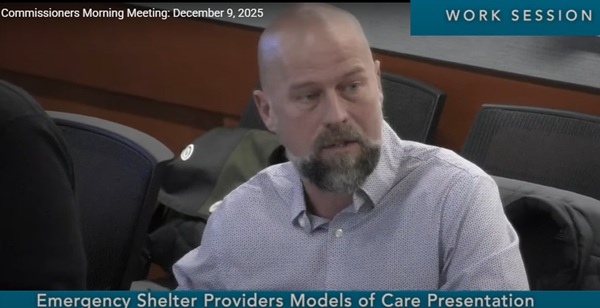
Presenter Lane County commissioners met with emergency shelter providers Dec. 9, and we’re featuring them individually. Today, the county’s Homelessness and Community Action Manager James Ewell introduces the executive director of Everyone Village, Gabe Piechowicz.
James Ewell (Lane County) We have shelters in the Eugene Springfield area. We have severe weather sheltering in Florence and Oakridge and Veneta. We have just shy of 1,200 shelter beds total as of last month, 2025. Eighteen total providers, and then we have 48 total shelter sites…
So with that, I will turn it over to the folks that are the experts in this work. I will start here, I think, just to my left with Gabe, if you’re good with kicking us off.
Gabe Piechowicz (Everyone Village) So, basics: Everyone Village, West Eugene, we’ll turn four years old on Jan. 2. So we’re pretty young as things go.
And we came into the ecosystem of shelters in a unique way: through private business enterprises’ interest. Certainly more from the conservative, right-leaning leadership of West Eugene businesses and industrial sector saying, ‘Hey, we want in and we want to contribute and be part of the solution.’ And we came into existence exclusively to start a ‘safe sleep site,’ if you all remember that term back in the day.
So it’s three and a half acres donated by the Rexius Company to start. And then Greg Steiner, who’s the owner operator of Harcourts West Realty, purchased a 3,500 sq. ft. warehouse adjacent to the acreage that Rexius gave. So in one week, two private business owners said, ‘Here, we’re in, we’re committed. We’re putting skin in the game.’ Very interesting choice to pick me to do it. Um, but here we are.
So 70 individual tiny wooden structures—we call them cottages of hope—are what folks live in, folks coming straight from street to village in West Eugene.
We also added in the last year 10 medical recuperation tiny homes. All those tiny homes were built by, at this point, local high school students, through the Team Oregon Build program that we help to bring into existence across the state with (Gov. Tina) Kotek’s support two years ago.
That core basic sheltering activity of stabilizing and putting inside something that’s warm and dry and safe, what’s happening around that at the village, which just describes our site in general, is two workforce development programs, upwards of 17 paid part-time positions at all times on site, available to clients.
Mental health behavioral care is on site via CAFA, one of our partners, and PeaceHealth, Volunteers in Medicine provide the medical support on site.
And then we have, in the center of all that, a real heavy hand on an educational enterprise for folks as they enter the story. And I’ll wrap up here so we can talk more about this later.
We self-manage waitlists—to James’s point—a very long waitlist. We manage the tension between an existing waitlist via applications we closed a long time ago because our waitlist was like hundreds and hundreds, with close partner referrals. We’re also trying to use the triage model that you all use, in our best way of: Folks who are most vulnerable, exposed, let’s get you stabilized before something really awful happens.
And we feel like that educational enterprise piece has been missing from the solution set the entire time. And so we’re adding it in now, and I’ll share more about that later. But that’s an overview of the village out in West Eugene, just off of Bailey Hill and West 11th.
James Ewell What do you see as the strengths of your shelter model or models?
Gabe Piechowicz We work well together as an ecosystem of providers, and we’re all— because we’re receiving All-In funding at this table—have to be low-barrier emergency, every single one of us. We all have that same metric. If you’re 18 or older, can do your activities of daily living and are literally homeless, we must let you in at this table. So there’s all that’s the same gate to get in, so to speak.
They’re all different realities, more or less, in so many important ways at the different shelters. But we find that sometimes (for reasons that we won’t talk about today) it’s not working out, and we’ll get a phone call: ‘Hey, we don’t want this person to go back to the street. That’s against everything we all stand for in this room. Let’s see if they would find a better way forward at your shelter.’
And we do those warm handoffs to keep people from returning back to the street when they’re just not finding a way to do well inside a particular shelter. So I just wanted to point that out. That’s a great expression of our teamwork here at this table, and we’re really proud to be a part of this network.
Things that make Everyone Village distinctive or unique: We have the same contractual obligations that everyone on this table through our county contracts. Ours comes through the city consortium, as you know, but it’s the same stuff. We are required 24/7 staffing. We do not do that. We have staff on site Monday through Friday, nine to five. We have an on-call phone for evenings and weekends. And the last time the on-call phone was used, it’s a very long time ago because of these two reasons that are distinctive of the village.
The underpinnings of what we do and how we do it are based on two truths that we believe in at the village that we see producing great outcomes with our folks. We call our clients villagers. We call ourselves villagers too. Reciprocal accountability: That’s holding each other to be the best version of ourselves at all points in time, recognizing two truths are always present.
The best version of myself is different at 8 a.m. than it is at 10 p.m., and the best version of yourself is different than mine. But nonetheless, we’re going to do this at all points in time because this is healthy adult relationship and this is the auspices of what makes a good life.
It can’t be a one-way give-take show. That’s, we never do that in our personal lives, because it doesn’t work. We shouldn’t build or pin a system on that kind of transaction. So that reciprocal accountability, believing the best in someone and then saying, ‘No, you’re going to be the best version of yourself today.’ And then what’s critical in that?
That happens at the village, which spins that wheel really intriguingly out in West Eugene is when it goes up the ladder of hierarchy. What does it look like when someone who moved in yesterday—and is definitely still high—has the space to hold me accountable as the leader of the shelter?
And that vulnerability is the ingredient that drives that reciprocal accountability, always appropriate and above board, but it unlocks codes and lives that are really profound and leads to a really great reduction of recidivism, which, if we’re not all caring about recidivism, we’re not caring about the right things in this room. That’s what’s really pinning the problem down. That’s still the biggest gear in the system.
The second thing, really quickly that I’d like to share is a distinctive or unique feature of the village, is our strong belief that if you do not have purpose and meaning in your life, you’re going backwards and you’re stuck. And we want people, as you said, we want people to move forward in healthy ways and find that path for them so they can begin doing some amazing things in their lives and for their community.
And we own that value tangibly with the workforce development positions on site. Folks can be gaining employment. We’re great partners with the Chamber of Commerce, which many of you are, and the internship programs they created for our folks to get moving. And then that reciprocal accountability and meaning and purpose sort of start touching each other in a life and magic happens.
And this is what I’ll close with on this part. It’s a double ‘so-that.’ The first ‘so-that’ is that someone comes to the village from the street so that they can regain flourishing. Huge ‘so-that’ win.
But that ’so-that’ only leads us to the ultimate ‘so-that’ at Everyone Village in that that regained-flourishing human will be growing and giving back to their community. Because that’s this, right? It has to lead to that. These folks are part of the answer to the problem we seek to help them grow and move out of.
I think we would all agree the housing and homelessness problem is so stinkin’ big and heavy, if we do not all lift at the same time on three, we’re not getting it off the ground. And that includes everyone that’s a client in shelters and believing that they are actually part of the solution to the bigger problem while they’re getting help.
Because it’s totally true: I can help you while I’m being helped at the same time. And so we compel and convict our folks to do that.
Those are some key things to share about the village.
Presenter Gabe told of his early efforts to gain the neighbors’ trust.
Gabe Piechowicz So, four years ago, Arlen Rexius gave me the keys to three and a half acres. And Steiner bought the warehouse. And then I called the city and said, ‘Hey, I got some stuff you might want to partner with. And they said, ‘Who are you?’ and they gave me a map. And in the middle was the Rexius property.
And it had a huge circle around it had all the West 11th businesses that are adjacent, huge multiowner apartment complex, HOA neighborhood, low-income Churchill Estates, and all the businesses on that back eddy of streets in there. You guys are all familiar, I’m sure. And they said, ‘Everyone in that circle must give you your blessing to try or you’re not trying Gabe because we do not know who you are.’
And I went around and everybody gave me the same answer the first time around. What they were seeing in their brain was the traditional paradigm of shelter activity in a neighborhood—that’s been largely covered from places like Portland and Seattle, and even locally at times. And so I went back around a second time because I’m like, ‘I don’t want to give the land back.’ That sounds like a really bad idea.
And so all I could think of was playground days: ‘I’m going to triple dog dare you. If you let us try, not only will it not detract from your neighborhood, within two years we will increase your property values.’ Yes, I pulled that out of you-know-where.
However, we have done it. So one of the things that is a unique feature of the village is I say it like this on tours, which we do all the time at the village, we don’t exist to serve our clients. That’s not why we’re there. We exist to serve our entire community, to do our part, to make our community the healthiest, strongest, most flourishing version of itself possible.
We do that by the work we do at the village, like these amazing humans do at their shelters. But the way we think about it is: How does the shelter itself flip itself inside out to be a resource value-add back to its neighborhood and larger community? And we’ve, as I noted, done that miraculously.
What does that look like? That looks like we’re intentional about what’s happening around our shelter in the neighborhood. What’s happening as our shelter is big—like, 80 souls on site, 15 staff, 45 community partners, 28 dogs, 46 cats and 100 chickens (I’ll tell you that later).
What is that impact on our neighborhood or part of it, and then the broader context of Eugene and Springfield, and then intentional on serving the shelter exists to serve its community, to be a viable, flourishing community and neighborhood member.
We volunteer every year at Churchill High School, which is a few blocks away, by doing a whole village cleanup Saturday with other partners in the area. We’ve gone in the past to distribute winter coats and supplies at the beginning of the school year for those middle school students.
In our back eddy of streets off West 11th, we still to this day—in fact, it was what I saw this morning. Folks come in with RVs and tents and they set up unsanctioned camps. City comes through and moves all that along, and oftentimes, as you all know, pretty heinous messes left behind.
We just clean it up. It’s our part in the neighborhood. We’re good at it. We have the gear, we understand what that takes, and then that resource value-add back isn’t just a service model.
And hear this clearly. It’s not the staff, it’s the villagers and the staff together, serving as a village whole out to the community.
We have at the front of the village a public resource for our neighborhood in West Eugene, a state-funded recycling center where customer experience is expedited instead of the reverse, can slow process. We’re very quick with the way that we do it. That’s a resource value-add back to our neighborhood.
We are going to open in late January, Primary Care Medical Clinic at Everyone Village in partnership with PeaceHealth and Volunteers in Medicine.
Once we work the service model out, we’re going to go to Churchill Area Neighborhood Association in early spring. You know, we’re going to say? ‘We’re here to share. We’re here to share the blessings of the larger communities given to us. Don’t wait ten weeks for your appointment. Don’t go to Riverbend ER where it’s all gummed up already. Come in your neighborhood and see the doctor if you really need to. We want to share. We want to serve you back.’
So here’s the synopsis of all that. Even though everyone ultimately gave me their blessing, this is how they phrased it. And one was a really staunch business property owner nearby the village, he said, ‘Just to see you fall flat on your face, I’m going to let you try, fool. Go right ahead. You think you can do this? Go right ahead.’
Last summer we had—we have a huge partnership with the University of Oregon School of Architecture. There’s a huge educational enterprise, inducement for middle school, high school and college students here at the village all the time. U of O does classes in the Welcome Center, like, they bring the prof—it’s crazy.
Anyways, they were partnering with us, and we did the front entryway and really spruced up the front of the warehouse that was purchased for us by Greg Steiner, painted, we had done all that cleanup work, stayed at that cleanup work. Messes don’t last long in that neighborhood because of the service that we provide to that neighborhood.
And so one hot summer day, Joseph and I are sitting in front of the Welcome Center, it’s the start of a Friday, and this business owner, real surly fella, oh, man, he comes shuffling up.
And he’s like, ‘What’s up? Hey, do you remember that I come poking around a few years ago? So I got, you know, I got my real estate guy. He’s a real smart fella, and he can tell market increases and he can even tell, like the value of crude improvements I made to my building. But you know, it’s more than that and not a little bit.
‘And I’m here to tell you, I think you all did it. I think you’ve improved the safety, livability and curb appeal, to be honest with you, of the neighborhood. Thank you very much. The medical clinic is awesome. I can’t wait to see that open. Please don’t go anywhere. Please continue to serve and grow in the way that you have. We love that you’re a part of this neighborhood, and you’ve really improved it in a tangible way that is actually now benefiting my bottom line as a business and property owner in the area.’
We’re very proud of that. It’s not easy to do, but also that pride then flows through the story. And folks who long have been discounted: ‘You can’t contribute. You’re not going to help. Look at you. You’re a hot mess on wheels.’ Those very people are going out and serving our neighborhood and our business owners like that, with us learning those tools, getting the teamwork aspect to make that happen. And then they’re getting that compliment too, and when you see that, it’s like magic happens, it unlocks a code and a life.
Collaboration with partners: Everyone Village has a somewhat known reputation as a partnership Shangri-La. One of our angles and intentionality is bringing new partners and more leadership and service and workers onto the board of the sector itself.
So we have really brought University of Oregon School of Architecture, Pivot Architecture, middle school students across the state, high school students, college classes are really a huge part of our team at the village.
And so how we collaborate, we flip over every rock and get everybody in on the game that we possibly can. And we’ve grown quite an amazing bevy of leaders, young especially, that are now learning to lead as a part of the solution set and response to the crisis, which is amazing.
Another great way that we collaborate (and this is going to segue into that funding cut issue that you requested to hear about, which I’m glad you did), we just took heavy cuts across the board from the state level, down through the county and the city and now to us here on the ground.
And one of the ways we collaborate, we created with that group, Joseph led a self-sufficiency outcome matrix that is tracking client engagement data that’s outside of direct housing outcomes, because we know part of that state funding cut was case management off the board, less funded and supported time to work with folks on their specific housing journey.
So then how do we hold each other accountable? How do we then track what good work is happening with these obtuse and kind of wacky cuts at times? And so that great work has been adopted by the county, is now being used across the shelter ecosystem. So that’s a great way to serve the broader network through collaboration.
We are now (after the state cuts and reductions to our budget), we’re $29.35 a night per person for our shelter, which is a razor-thin wire.
And our outcomes are growing and improving still to this day. And then the partnership capacity and the opportunities in front of us are just coming in hot, like it’s stacking up around us. And that’s evidence to us at the village that our particular model, while it’s very cost-effective, also is allowing us through all these partnerships to take that all these relational inputs are offsetting the reduction of financial inputs, allowing our operations to go forward unhindered, which is crazy and amazing and miracle-ish.
And also we have growth opportunities that I just shared, which is just a really remarkable outcome given the times that we’re in. And so that’s how we’re navigating the funding cuts that we have right now: Very well, I would say.
Presenter Lane County commissioners met with local emergency shelter providers. You’re listening to Whole Community News, with reporting on boards and commissions, neighborhoods and nonprofits, preparedness and public comment on 97.3, Eugene’s Peaceworks Community Radio.