
Parents: Here’s how 4J can save Family School and save money
10 min read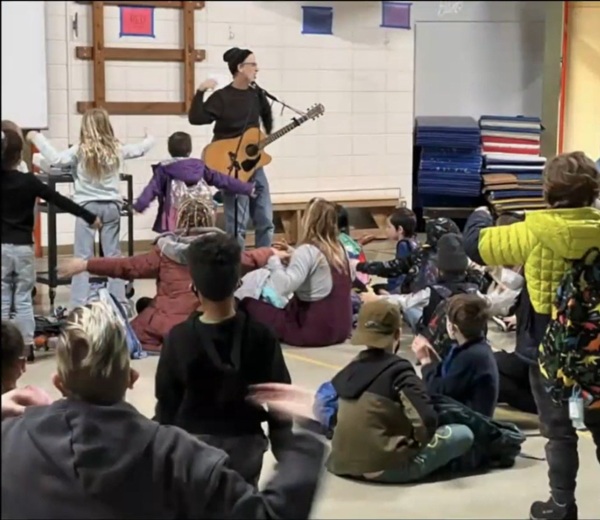
Speaker With the 4J School District facing a $30 million shortfall, parents spoke on behalf of the Family School. Dec. 10, Blake McWilliams:
Blake McWilliams My name is Blake McWilliams. I’m actually a new Eugene resident as of about a year and a half ago. And I’m also a parent of two students at Family School. I’m here because Family School is more than just another program. And as I’m sure you’ll hear from other folks tonight, we’re kind of here to advocate for that.
Family School is one of the most successful models in the district for supporting the whole child. Closing it would not simply relocate students. It would dismantle a learning community that is working and flourishing.
Family School provides something that’s increasingly rare: a stable, collaborative learning environment where families are directly engaged in classrooms, where teachers have long-term relationships with students, and where children who might struggle in larger, more traditional settings thrive.
This is not theoretical. You can see it in the attendance data, the behavioral outcomes, and the academic growth of our students. When a model is producing strong results with fewer disciplinary issues and higher parent participation, it deserves to be strengthened, not eliminated.
I also ask you to consider the cost. Closing Family School would disrupt about 100 students, many of whom rely on its structure, its relationships, and its consistency. The research is clear: School moves like this hurt performance for 12-18 months.
Eliminating Family School doesn’t reduce need. It shifts the burden to other schools that are already strained. This is not a cost-savings measure. It redistributes challenges.
More importantly, Family School aligns deeply with the district’s stated values around equity, engagement, and student-centered learning. If we close a program that embodies these values simply because it is small or different, we send a message that innovation is expendable.
Instead, I urge you to partner with us. Family School families are eager to collaborate, to be part of solutions, and to help build a sustainable path forward. Give us the opportunity to work with you rather than lose something that has served this district and its children so well.
Colocation and other options are available. You have levers that you can pull. Please choose the option that protects students, strengthens families, and preserves a model that works. Please keep Family School open.
Speaker Joey Carlson:
Joey Carlson We all know the district is facing big numbers. The students presented about the $30 million shortfall. Presentations tonight from the superintendent outlined a little over $7 million dollars, proposed cost cuts of about $2.3 million that we’ll say, ‘That’s the easy part. The first $10 million.’ Tougher decisions are coming in January. We all know it.
I struggled really hard on how I present information and not sit here and sound like Ben Stein. There’s a lot of numbers. I think Matt Brown and I would have a great time talking. But there’s really some high points and some things that stuck out to me.
So Family School is a smaller program. It only represents 0.75% of the student body of 4J that makes it, has always made it—I have a ten year history of sitting on this side of the table—it’s always made it kind of a potential target when it comes to cost cutting, cost savings. The low enrollment, high cost per student is a really easy place to look.
The interesting thing I found today was in looking in the overall budget expenditure for Family School. So it was presented that there’s about a $500,000 shortfall of or overspend for Family School, compared to budget.
When you look at the numbers, I said we had 0.75% of the 4J population. Our budget, even with that overspending, is only 0.769% of the overall expenditure budget. We’re talking 0.019% difference of alignment of the cost spent for Family School versus its percentage of student population.
It’s a really small piece. That’s two students. We have three on the waitlist right now. Incoming funds in the district, that comes out to about $14,500 per student. The target spending for 4J to make the district work is a little under $13,000, based on what was ratified in policy in July of this year.
What are the options to help the district find a way to overcome that shortfall in spending? If we return back to a colocation like we’d traditionally been, before moving up to Crest (Drive) 10 years ago, based on savings of utilities, custodian facilities, reduction of a secretary, reduction of a half-time FTE for an administrator, that takes that $500,000 number to $221,000. That’s 15 students. If we’re in a building that’s more accessible, that’s an easy thing to overcome.
I really hope that we have an opportunity to protect our program, protect the results we have over those 15 students because it brings a big value. $1.2 million would be lost based on the attrition rate of students leaving 4J if our program were closed. The survey that was done has 84 of our 110 students that would leave the district. So in an effort to save $500(,000), you lose $1.2 million. That’s not the math that any of us are looking for, and I think we can all have a better choice.
Hailey Lessel Hi. I’m Hailey Lessel. I have four kids at Family School, ages, grade one, two in two, and one in five.
My child did not function regularly, one of my second graders, in neighborhood schools. These are all of his referrals that he got in kindergarten. Some of these are for something as simple as walking out of the classroom when he felt unregulated, to having a meltdown, or having some type of emotional outburst that didn’t fit the cue to other, bigger things.
Of course, his main education was tablets. They couldn’t get him to sit in a classroom, so he was on a tablet. By the time he left kindergarten, he had no education. He’d actually been struggling with just the ABCs and D’s.
They told me not to push him too hard at home, because he was already struggling so hard at school, and they thought that it would make it worse. He would repeatedly bang his head on walls to the point of injury, which is something he never had at home and never had in preschool.
Even, he would get lost at the school where they couldn’t find him, and I would have to go and find him for them at school. Not only that, he would say at home, ‘I don’t feel safe at school,’ to the point of throwing up. Some days I had him at gastroenterologists, trying to figure out what could have been wrong with my child that wasn’t wrong before.
Last year, he got a write-up the first day at that school, and I said, ‘I can’t do this again. I’m not going to go through this another year. I’m going to pull him. We’re going to leave the district.’ One of the educators recommended Family School to me.
We went and met with the principal and immediately they bonded and we knew we were at home. I transferred all my kids over that same week, and at that point he had only gotten two referrals last year. Majors and minors, just two. He no longer elopes. He no longer self-harms. His stomach issues are completely healed.
And he has a sister who came into that school at a second-grade reading level in fourth grade, and she is now at level.
This is not just my story. This is many of our kids’ stories. This is my story right now. But I am a parent PPC (Parent Policy Council) member and this is what I hear from all my other parents who, this is what they’re scared of. They will not transition into their neighborhood schools.
Well, I know that when we go to Fox Hollow or we go to Lane School, you guys lose us too. And I had begged for him to be placed somewhere else. Somewhere he felt safe. I had been with Della Thomas. I’d been with all the people I was supposed to, and he never felt safe until we got here. He never felt like he belonged until he got here. And now he has a place. Don’t take that from him.
Valerie Munthe My name is Valerie. I am a parent. I had two former 4J students who were not very successful in the public school system. And then I have one current student in 4J. She is a Family School student.
The bottom line here is that Family School for many of us is not a preference. Our families are not passive recipients of what is being told to us that is available. And we had the honor of having Miss Dr. (Miriam) Mickelson to our school last week during our council meeting, and that was when she broke the news to us, the very, very difficult conversation.
And the thing that I wanted to highlight here is we have countless testimony on the impact that Family School has made on our students, and we wholeheartedly believe in its message and in its program, and also wholeheartedly believe that this is a program that needs to be emulated and echoed to all corners of 4J School District. And as we can see from my colleagues and my fellow parents, that this is not the case.
And that’s why we have all found community at Family School. I want to say that we recognize the district’s financial issues and the financial realities, and we know it’s difficult. You know, it breaks my heart to hear about things like the color guard being cut for a regular neighborhood school. That blows my mind.
But this is exactly why you have this cohort of parents here before you today who want you to hear our voices, but also to hear that we are here because we want to partner with you. We want a cohesive collaboration with 4J School District. We are not going to take closure of our school laying down. We are going to come up with solutions.
One of which is we would like to ask the board to reconsider and rescind the decision to not allow alternative schools to cohabitate in neighborhood schools. I think now more than ever, the district needs to abandon what’s considered more traditional means and address things in a more efficient manner.
Speaker: Beth McWilliams:
Beth McWilliams So I’m going to end us this evening still talking about Family School, but on a very specific piece of the puzzle here, which is volunteerism.
My name is Beth. I have two kids at Family School, and I really want to highlight one of the things, and maybe the most important thing, that sets Family School apart from other programs and what makes it, frankly, in my personal and professional life, something I’ve never seen before, which is a level of commitment to the mission and to the organization itself from everybody involved for the betterment of each individual child.
It’s really beautiful at Family School. Volunteer volunteerism is not an add on or an optional thing. It’s a core part of how we operate. It’s how our students learn and it’s how our teachers are supported. Families contribute in classrooms every single day, whether that’s outdoor education, indoor education, literacy support, handouts, snacks, activities.
Teachers at Family School count on this, and they’ve consistently said that these volunteers allow them to offer instructional depth and individualized attention that they would never be able to do if they weren’t sure that they had that many other hands in the room.
The volunteer culture is also one of the reasons that we can serve such a huge range of learners. So we serve students with disabilities, students with sensory and behavioral needs, students who are high academic achievers or intellectually gifted.
Families work with the teachers one-on-one, so we can really figure out what makes the most sense for this individual child and then for this classroom that this child’s learning in. It’s really rare. It’s so collaborative. It’s so meaningful. And the kids feel it. I know they do.
It’s kind of the wraparound sense that most communities are trying to offer in districts with this level of engagement, where problems can get solved more quickly. If there are issues going on, we’ll know about it, because we’re all watching the kids. We all have a sense of who they are. They know who we are.
So the district benefits directly from this. According to the National Clearinghouse of Data, they would pay us $35 an hour for what we’re doing, and we would do it for free (happily, I promise you). And we all tried to look at numbers for what this actually equals, and our most conservative guess—this was us being like ultra-Family School, like, ‘Let’s not say anything that’s not true,’ because that’s who we are—conservatively, we think there was about 6,000 hours recorded in volunteer time last year, and if we were paid our very well deserved $35 an hour, that’s $210,000 that we saved the district in helping these kids achieve incredible things.
You don’t have any issues with behavior test scores, anything. We’re doing quite a bit there, and I know I’m out of time and I’ve got so much more written, but really, I can’t put into words the passion we feel for this school.
Speaker Family School parents ask 4J to look beyond the student-teacher ratio, and to consider that closure will send many families out of district, losing more money than 4J hoped to save.