Lane County to skip unsheltered point-in-time count this year
8 min read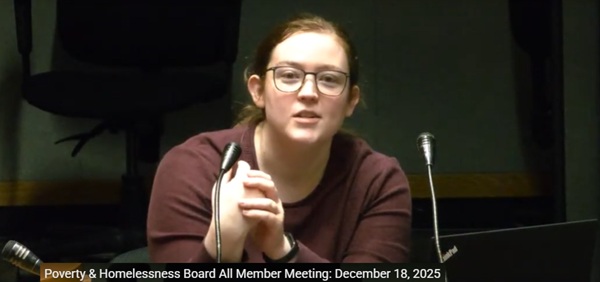
Speaker Lane County discusses whether to conduct its point-in-time or PIT count this year. At the Poverty and Homelessness Board Dec. 18, James Ewell:
James Ewell (Lane County) I’m coming to the board today with a proposal to actually not do the point-in-time count this year, but I’m going to give some background, for new members. And just a reminder for folks of how we have been doing the PIT count and share what our methodology has been and what it would have been this year.
So, as a refresher, the point-in-time count is an annual count of households that are experiencing homelessness in a community, and it is required by HUD of Continuum of Cares (CoC) on an every-other-year basis. And this year is an off year. So we wouldn’t be required by HUD to conduct the PIT.
And we also recently learned that the state of Oregon actually doesn’t require even an annual PIT count. So there’s no requirement put in place on us this year to conduct the PIT count for the last four years, and, it again was approved this year by HUD. Our methodology was going to be to utilize the Homeless By Name List or the HBNL which is populated via HMIS (Homeless Management Information System) paired with targeted street outreach surveys in the community. What we’ve seen—oh, I’m getting ahead of myself.
The HBNL is made up of data entered by 150 different participating projects that are operated by 30 total agencies, and that includes rapid rehousing projects, street outreach projects, food banks, meal sites, and then general social services like our access centers.
So for the last four years, as I mentioned, we had paired that HBNL data with the in-person street outreach efforts. And what we have seen is that usually greater than 95% of those folks that are counted are folks that are already on the HNBL, so they’re already are in our system.
So we’re just not seeing a ton of numbers with the in-person counts. And I think that’s really a testament to the robust nature of our HMIS system and of our community services, and that we’re really connecting with the folks that are experiencing homelessness in our community. And HUD obviously recognizes that as well, as they have approved using that methodology for the last few years.
So this year, as you all know, there’s a lot in flux right now regarding the CoC (Continuum of Care) application, which means the time that we could spend on the PIT count would be reduced.
We also this year have seen a reduction in street outreach teams. And so there may not be the same amount of folks available to do that in-person count. We will continue to utilize the street outreach teams that we have who put data into HMIS on a daily basis. And I think it’s important to note, and I think many people recognize, that the PIT count is just one way of determining how many folks in your community are experiencing homelessness. And with it being that point-in-time or that one day, I think an argument can be made that it’s nowhere near as accurate as an ongoing HMIS system where people are being added on a daily basis.
So, all of that to say, I’m coming to the board to look for a vote to approve us not doing the PIT count this year. What we would do instead is we would issue a press release that would be highlighting our Tableau dashboard, our public Tableau dashboard, which shares all of the data that comes from the HBNL and really has far more in-depth data than the PIT count offers.
So it can, you know, it can talk about, you know, specific demographics and inflow and outflow and all of those things. So we would still be sharing with the community, you know, a count of households experiencing homelessness in our community, but it would be via just the HBNL and not those in-person targeted outreach efforts.
But of course, the outreach teams that are are out doing those services anyways are also adding people into the system. So folks would be captured that way anyways.
We have also, you know, we’ve talked with our city partners and with other folks that we know use the PIT count data as a part of their planning and of their communications. And, we have heard from those partners that they would support moving forward with that plan, but ultimately want to bring it to the PHB for your approval.
Speaker Commissioner Pat Farr:
Commissioner Pat Farr James, if you can help me to either confirm or correct some of my perceptions regarding our historical use of the point-in-time count, the PIT count. My perception is that we’ve always done a very extensive count. Historically, we’ve put large teams of staff and volunteers throughout the county going into some relatively inhospitable places from time to time to really try to dig down and get as accurate as we possibly can. Is that a good perception?
James Ewell (Lane County) It is. And the last few years we went from using community volunteers to using the robust street outreach teams we had, just because of the relationships, and that’s what they do on a daily basis. But, yes, what you said is accurate.
Commissioner Pat Farr And you describe the relationship because the teams, which I was on some of the teams, quite often the people that you encounter aren’t ready to, they don’t trust people who are counting and don’t know why they’re doing it. And so the street outreach teams have already developed a bond of trust in many cases that helps with that.
Then even though we were thorough, my perception is that we never did get everybody. We’re always undercounted. And I always looked at what: How are we versus last year? As opposed to: How are we versus what the numbers really are. Is that…?
James Ewell (Lane County) Yeah. And that goes back to what I was saying about the nature of the PIT count being a one-night count. I mean, it’s, you know, you’re yeah, you’re going to have a much more accurate number when you’re counting folks throughout the year through the HBNL. So yeah, I think that more folks are captured that way than we could ever do in a one-night count.
Commissioner Pat Farr That confirms what I’ve always thought about it. Then the other thing is that I’ve always my perception has been that we’ve been a little bit more thorough in trying to be more accurate than is typically the case nationwide in jurisdictions. That’s my perception. How do you—how does that match?
James Ewell (Lane County) Yeah, I think that’s accurate and Amanda or Carly. Feel free to jump in and Carly’s ready.
Speaker Homeless Management Information System Supervisor Carly Walker:
Carly Walker (Lane County, HMIS supervisor) We do a really great job, and in no way do I want the takeaway to be the PIT count is a waste of time, or we shouldn’t do it anymore. Given all the things that are happening right now, there are other ways to get really close that make it okay to skip this year.
I don’t think we necessarily need to go to an every-other-year count moving forward. But there are other factors that mean this year’s count may not be as thorough anyway, like: the lower outreach teams. We’ve also lost a few programs that were participating that were bringing in unique clients, and I don’t know that we’re going to be able to capture them in the same way. There’s just—there’s a lot of factors.
And so I don’t know that it will be as accurate as a regular count anyway. What we have done in the last few years is to do that measurement James mentioned: Who’s on the PIT count, versus who’s in HMIS? Are they close? And we’ve really proven that they’re close.
So that’s what makes me feel comfortable that we can skip a year and be okay. I wanted to acknowledge a couple of things, though, which is that we always undercount the rural areas by more than the metro area. That will be true this year. There’s not really a way around that. And also like, we’re not doing a perfect survey of the entire county. There’s just no way for us to do that.
So I want to acknowledge that too. Just like for the rural areas, we are going to undercount you by a little bit more. And just to have acknowledged that, in past years, I think we’ve captured up to 10% of a rural areas count from the PIT count rather than that 5%. So I just wanted to make that clear.
Commissioner Pat Farr And that supports my perceptions that I’ve developed over 13 years or so. Yeah. And, you know, it’s evolved significantly. The one thing that has evolved and I don’t think I’m inaccurate in this, our data tracking is far more sophisticated than it was thirteen years ago or two years ago for that.
Carly Walker Providers can really attest to that. They do a lot. We help them a lot. The burden is quite high, so we’re able to do a lot just leveraging the funding requirements we already have because we have providers on the call.
I want to make one really clear distinction. We are still doing the sheltered PIT counts and the housing inventory counts. We’ll still have that information about how many PSH (permanent supportive housing) beds did we have on that night and how does that compare to previous years? So we’re still doing those parts.
Those are also requirements annually. So we’ll be doing this sheltered PIT count and the housing inventory. But we just won’t be doing that unsheltered count and be using the by name list to estimate that number.
Commissioner Pat Farr And once again, that supports my perceptions that I’ve developed through the years, which have evolved through the years. And I still worry that the numbers that we report, which are used for certain allocations, that that it may not work in our favor to be as accurate as we have been. So that being said, I support the recommendation by staff that we use existing data from the system to provide the reporting this year, so I am in support of that.
Speaker The Lane County Poverty and Homelessness Board agrees to skip the point-in-time count of unsheltered homeless persons in the county this year.