McKenzie $5.5M ADU program could be template for future wildfire recovery
10 min read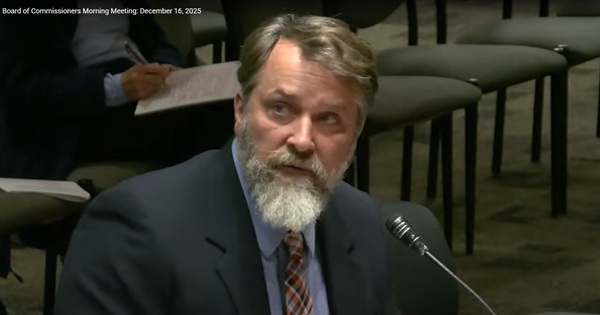
Speaker Five years after the Holiday Farm fire, the Upper McKenzie Valley gets a visit from the governor and $5.5 million for accessory dwelling units. During public comment Dec. 16, Tabitha Eck:
Tabitha Eck: Hello, my name is Tabitha Eck. I’m the executive director of the McKenzie Community Land Trust. And I wanted to thank you all very much as officials, elected officials, but representing the county, which for our region, of course, you are our elected officials, our elected body, and have been a huge part of the recovery of the McKenzie River valley.
We had a chance to celebrate last week with the ribbon cutting of our Rose Street Neighborhood. (Commissioner) Heather (Buch) was able to join us, as well as our partners at Northwest Oregon Housing and Community Services, as well as elected officials, not the least of which was our governor.
It was lovely to have her down and for her to see the work that’s happening in the valley, and for her to take a moment and really see what it takes for a community to rebuild itself.
And that is a grand, horrible, wonderful experiment we’re all navigating right now as five years past the Holiday Farm Fires there’s so much to celebrate, but also so much to do. And I know we’re not unique in small communities, rural communities impacted by fire, but that unincorporated nature of 50 miles without a government to help us, aside from you folks at the county, it’s notable.
And so you can can see where we’ve struggled with the recovery, but you can also see where when a community comes together, we can truly make things happen. Impossible things. And so much of the rebuilding upriver has been done by volunteers and nonprofits and special districts with volunteer boards. And it’s extraordinary what people have come together to make possible upriver, and you all were a part of that.
The day I believe that recovery monies came to your hands, you sent $800,000 of that to our project, the Rose Street Project. It would not have happened without you folks sending those funds and supporting those efforts. And now we have six homes standing and ready for families in this new year.
As you’re going through these processes (and some of these recovery efforts feel like they’re forever in coming—the wheels turn slow), I would ask for you to think of us at the (McKenzie) Community Land Trust as an opportunity, as a way to maybe help facilitate recovery in a new way, that pairing of private and public and nonprofits.
And we didn’t exist right after the fire. We were started by community stakeholders, locals who wanted to help the community rebuild itself. So I think a community land trust might be an asset to you all as you’re looking: How can we infuse these recovery monies? How can we support the the community?
Maybe there’s a project that we can help bridge the gap for as a land trust, whatever is for our community’s benefit, we can be a part of supporting and we appreciate your support in the years to come. We’re in it for the long haul. Thank you so much.
Commissioner David Loveall Thank you, and thank you for those kind words… Our county administration item is a contract for purchase and placement of multiple (multiple, I love that word) affordable housing accessory dwelling units within the McKenzie River Valley in the amount of $5.5 million.
Speaker To discuss a federal grant of $5.5 million dollars, Long-Term Disaster Recovery Manager Matt McRae:
Matt McRae So a little bit of background on the funds that we’re using. These are community development block grant funds for disaster recovery. They come through the U.S. Department of Housing and Urban Development. As I know we’ve all talked about, these are relatively administratively burdensome dollars. We can do a lot with them, but there’s a lot of work required to make them move and to track all of the requirements that come with these dollars.
The HUD announced the award to the state in November of 2021, $422 million dollars statewide. HUD approved a statewide action plan to use those dollars in September of 2022. And then you’ll recall just last year in February or this year in ‘25, in February, we had a public hearing in this room to talk about the potential uses for the $17.5 million dollars for affordable housing development. And we had proposed $5 million for ADUs, $5 million for manufactured homes, and $5 million for what we were calling cottage clusters.
And so I’m coming back to you today on just that ADU piece. This is the follow-up. We received support generally for that concept, and we’ve done a lot of work between then and now to think through this program and what it looks like. And then you all received that almost $17.5 million dollars from Oregon Housing and Community Services in March of 2025.
So the goal here is to site approximately 20 ADUs upriver in the Holiday Farm Fire-affected area. The boundaries of the program are slightly outside of the Holiday Farm Fire, because we want to make sure that we’re able to use properties that weren’t affected by the fire. Households that might have a little more stability, not be rebuilding.
The total budget we’re seeking to authorize here is $5.5 million dollars. We’ve been working with the McKenzie Valley Long-Term Recovery Group, who has done outreach on this program. They’ve engaged a number of property owners who are interested in siting an ADU on their property.
Twenty-five have shown an interest, and so we’ll have more conversation with those property owners about what the details of this program to make sure that they’re prepared for this program. They’ve also done, the long-term recovery group, have also done screening on these properties to make sure that people can get insurance, to make sure that their sites are compatible with the land use requirements, and to begin the environmental assessment process.
The program would have an affordability period. So a property owner who gets one of these ADUs would be required to make sure that that unit, that ADU, is rented out at an affordable rate for households at or below 80% of area median income for a period of eight to 10 years.
And importantly, and one of the questions that you all have raised is: How does this work? And the homeownership part, the part for the property owner is, the unit is provided to the property owner through a forgivable loan. So they’ll take on a loan that will begin as soon as the unit is ready to be occupied. It will be for the full amount of the unit and the improvements.
And then if they have a 10-year forgivable loan, that loan will be forgiven by 1/10th each year until at the end of that affordability period, it then is handed over and in full property of the property owner for them to rent however they like.
I think that’s one of the bigger questions that you all had. So I expect there may be some questions following up on that after.
So, just for program criteria, we’re talking about units that are 900 sq. ft. or less as required by state law. Again, two acres: They have to be a two-acre sites or more, again, as required by state law, in residential zones.
The priority will be for tenants who are wildfire survivors. But then once we have met the need for wildfire survivors, these will be available to other people who are looking for affordable housing options in the area.
And I mentioned that they’ll be rented to low- or moderate-income households, and I just put the table there for reference for folks who are interested. I’m just going to call out one number. These are small units. So maybe a two-person household is most likely a household income of $58,700 would be 80% of area median income.
And then a few things about the long term management, which I think are important. And I didn’t mention this at the outset, but I will remind you all, we don’t have a template to work from. There’s not a program in the U.S. that has used these funds to do this kind of program. So we’re doing a lot of figuring this out, which is part of the reason it’s taken us a while to get here to you.
But here’s the way we have this set up: The property owner serves as the property manager. They’ll collect rent. They’ll conduct the regular maintenance and repairs. They’ll be responsible for all the on-site regulars.
There is a rental coordinator—in this case the McKenzie Community Land Trust—and they’ll be promoting the available rentals, they’re providing/will be providing screening services for tenants, and for property owners to make sure that the tenants meet the property owner’s requirements and the property owners are a safe place for tenants to be renting from.
They’ll facilitate tenant selection and they’ll monitor, ensure to ensure that the program requirements are being met. And then we also have an asset manager. We’re in conversations right now with a couple of different parties who have indicated a willingness to take on this role of asset manager. They will be managing the forgivable loan and they’ll manage the legal and financial transactions if a loan is paid off, or if a property is sold.
They’ll also be ensuring the documentation is complete if a program participant is not meeting program requirements. And then Lane County is kind of the backstop here, if we have a property owner who’s unable to meet the property requirements, Lane County will be the one that would take enforcement action there.
And then lastly, I want to highlight all the partners who have gotten us here. It is a significant list of partners who have deep knowledge in affordable housing. And I want to call out specifically for individuals. Betsy Hunter with the Long Term Recovery Group, has brought her development knowledge to this project and has been essential in getting us where we are. Leah Cooper and Nora Cronin at DevNW, likewise bringing their expertise to help us figure this out.
And Kimberly Taylor with the Housing Development Center has been instrumental in helping us think about the asset management role. And then lastly, I’d like to thank you as a board for encouraging us to step in to a bit of an unknown with this program. The organizational encouragement to take risks is really important. And I’d also like to acknowledge Steve Mokrohisky for the same. His willingness to encourage us to try new things, is the only reason we’re here in front of you today.
Speaker Commissioner Heather Buch:
Commissioner Heather Buch I appreciate what’s being presented. I want to appreciate we have partners in the audience here with us today. This is actually pretty exciting opportunity, as Mr. McRae had mentioned. ADU development for recovery with funding from the federal and state government is new, but we have that opportunity to do that here. And we know that that increases housing in areas that otherwise wouldn’t have the opportunity. So I’m fully supportive and excited to be able to utilize our new ADU availability in the county to do this.
Speaker Commissioner Laurie Trieger:
Commissioner Laurie Trieger Thank you for the presentation. Thank you. And I see other folks here from upriver, in the room. So thank you, everyone. Thank you, Tabitha, for your remarks this morning. This is a really important moment to be at. I’ll just amplify what Commissioner Buch said, that it’s exciting to be able to use.
I will take this and every opportunity to express my frustration with the restrictions at the state legislative level that the parcel must be two acres. That feels overly generous, in my opinion, to, in the face of the housing shortage that we face and the evident willingness—you’ve got 25 property owners in a very small community ready to step up, so that’s clearly showing us that this is a solution that people are ready to offer up.
Thank you very much. And thank you again for all your hard work and all the relationships you’re building upriver. And I know it’s just tremendously challenging work every time we hear anything about the recovery efforts because it’s so multifaceted. It’s always good to see such great progress, especially in this. This is really significant. Thank you very much. (Thank you, Commissioner.)
Speaker Commissioner Pat Farr:
Commissioner Pat Farr Moving forward with ADUs is a huge step in so many different ways. I agree with Commissioner Trieger’s sentiment that it’s unfortunate that there are restrictions placed upon it by the state through the legislature that make it more difficult to add front doors. And this is an opportunity to add front doors in places where they’re dreadfully needed, but I view it as a step.
I view it as a precedent that we need to scrutinize as we roll this out, because we need to do things like this in non-emergency situations, in many places throughout the county and throughout the state. Otherwise, we’re not going to be able to allow the dense urban growth that’s required in Oregon inside of urban growth boundaries.
If we don’t allow a reasonable number of houses and front doors outside of urban growth boundaries, we constrict the use of land inside of urban growth boundaries for denser growth.
This is one step: a huge step. And thank you for your work and all the work that’s gone into it. But we need to scrutinize it as it goes forward because this is something we need to whip. We need to make sure that people see how good of an effort this is, how well we do with it, and how we need to use this as a template of sorts down the road for more ADUs outside of urban growth boundaries. Thank you.
Speaker Lane County moves forward with a $5.5 million program to create affordable rental housing up the McKenzie Valley.