CleanLane scrutiny draws attention to $5M in unpaid system benefit fees
17 min read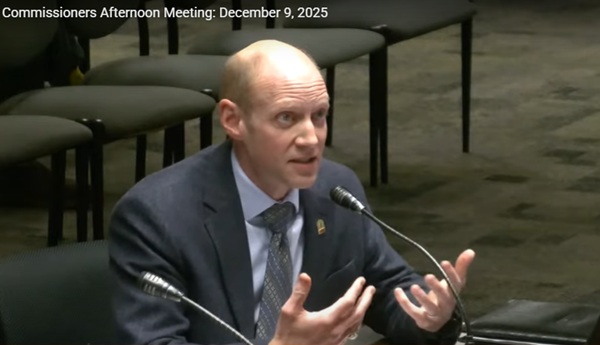
Presenter Oregon’s Land Use Board of Appeals says Lane County can’t use its Goshen lot for a waste-to-energy facility. Perhaps anticipating that outcome, county commissioners on Dec. 16 approved Plan B: Study a site at Short Mountain. Lane County Counsel Rob Bovett:
Rob Bovett (Lane County, counsel) I basically run into a virtual wall where I can’t explore the potential of moving CleanLane to Short Mountain any further without engineering. All the lights so far are green, and we’re kind of at an inflection point. Do we want to continue to explore and pursue shifting to Short Mountain, or not? And that’s what this order really is about.
Presenter Commissioner David Loveall:
Commissioner David Loveall Have we determined that the waste flow is sufficient to even make this project viable?
Presenter Public Works Director Dan Hurley:
Dan Hurley (Public Works, director) We estimated the project at a higher tonnage. And so the payback over time was estimated on a figure that is now significantly less, with the waste exportation going on in Springfield. Right now, we estimate that there’s just about enough tonnage with the existing waste to have to meet. Our minimum threshold was 120,000 tons.
But we have other budgetary issues (as we discussed recently) with the loss of tonnage down to the Dry Creek Landfill by Waste Connections. So we’re not able to build reserves as we anticipated for future development of the landfill.
So that’s an issue we will need to take up with the Board of how we either increase revenues or decrease expenses, or if we can resolve this issue of waste exportation. But currently we’re estimating that we can meet the minimum tonnage.
Presenter From that discussion Dec. 9, County Administrator Steve Mokrohisky:
Steve Mokrohisky (Lane County, administrator) I want to set the context for you, just paint this picture to understand really the broader policy question that we are wrestling with.
So first, Lane County government is recognized by the state of Oregon as the solid waste authority for the Lane County wasteshed. Through this authority that’s codified in Oregon Revised Statutes 459, Lane County is responsible for planning and operating solid waste management systems that align with state recovery goals, as well as comply with Oregon Revised Statutes and administrative rules.
Unlike privately-owned companies, Lane County is required to provide a variety of solid waste related services to the benefit of the broader community, including managing household hazardous waste, offering recycling opportunities at our transfer stations, and providing recycling education to Lane County residents.
Lane County pays for the cost of these services through the system benefit fees that are collected at Lane County transfer stations, as well as at Short Mountain landfill.
Again, we have 15 transfer stations throughout Lane County. We pay for the staffing and the infrastructure and the operations of those facilities to promote a community system of effectively managing our waste.
The alternative would be we could just have haulers and a landfill and pick up the trash and dump it in the landfill. But our community, under the state’s guidance, has said, ‘No, we want a community system to manage the waste.’
So a bit of history. In the late 1990s, Lane County experienced decreasing revenue to the solid waste disposal fund as solid waste haulers began exporting waste to the privately owned Coffin Butte Landfill near Corvallis, Oregon. Does that sound familiar? Because that’s exactly what’s happening today.
And what the Board of Commissioners and our city partners did in response to that to maintain funding for the essential solid waste services, the Board, in 1999 approved an ordinance in May of 1999 to implement the system benefit fee that would be paid by solid waste haulers, irrespective of the disposal location.
We don’t control where the waste goes, so hauler has the right to haul it wherever they want. But we recognize that we have this community system of managing waste that’s really important for our residents and that the state requires us to have.
So that system benefit fee funds, as I mentioned, county waste-related services to the community benefit for all residents, including the transfer stations, recycling services and recycling education, household hazardous waste.
I want to just go back, a time machine back to 1999. We looked at the board meetings in March, May, and August of 1999. The county administrator asked the solid waste manager the status of working with the other city councils on this question. And the solid waste manager said that they had gone through the process with the city of Springfield and the ordinance had been established there.
And they said that they had gone before the City Council of Eugene. The Eugene City Council directed their staff to develop an intergovernmental agreement with Lane County. And there’s now a draft intergovernmental agreement and process.
So the indication, the clear indication, which is further validated in the county, I would say, look at the budget message, because that will tell you every year what was happening at the time. I’d like to read from the county administrator’s budget message from 2000-2001. So the year after.
It says: ‘As the Budget Committee members may recall, the Lane County county solid waste system was in significant jeopardy last year as a large volume of Lane County waste was being transported north to Coffin Butte Landfill. Since then, the Board of County Commissioners have adopted a system benefit charge on garbage hauled out of Lane County.
This fee is designed to cover a portion of the rural transfer sites’ cost, recycling, and special hazardous waste. The current system benefit charge is (again, this was 25 years ago), $17.76.
To date, Eugene and Springfield have adopted resolutions approving the fee on garbage located within their jurisdictions, and waste management staff is now working with the smaller jurisdictions to seek similar resolutions.
Keep in mind this fee is not in addition to our tipping fee, but applies only to garbage hauled out of Lane County. So for now, the solid waste program is once again stable.
In the future, pursuant to the recommendations of Lane County’s independent auditor, we do need to conduct a study to determine whether the post-closure fees we are collecting for Short Mountain are adequate to ensure appropriate closure and post-closure costs. This is an issue that will return to the Budget Committee in future years.
That was in 2000, 25 years ago. Okay, so, in the May 1999 ordinance that the Board adopted, it states, ‘A hauler disposing of municipal solid waste collected within Lane County and disposed of at non-county facilities must remit the appropriate solid waste system benefit fee to the county, based on the number of tons collected within Lane County.’
Springfield, again as mentioned, adopted a similar ordinance in 1999, right after this (or right around this time) that supported the system benefit fee.
Then in 2002, Waste Connections Incorporated and I’ll make a distinction here. We refer to Waste Connections Incorporated as the parent company of several of the subsidiaries. So for context, Waste Connections Incorporated is an international company based in Texas, about $9 billion in annual revenue.
They purchased Sanipac and EcoSort, which were local companies in prior years. And in 2022, Waste Connections Incorporated acquired Rogue Disposal and Recovery, whose assets included the Dry Creek Landfill near Medford, Oregon.
And in 2022, Sanipac and Cottage Grove garbage service began delivering municipal solid waste to EcoSort, and EcoSort began exporting waste to the Dry Creek Landfill.
That was sort of small in the beginning, and what we’ve seen is over the past several years, Waste Connections Incorporated has continued to increase the amount of solid waste collected by its subsidiaries and taken out of Lane County without remitting the system benefit fee that is identified within the county ordinance and the City of Springfield ordinance.
At the end of the day, what we do know again with the Board of Commissioners in 1999 also knew was they were facing an issue with the ability to maintain the community system because trash is being hauled out of county, the funding necessary to support the system is not being remitted.
And so what we have is we have what appears to be a $5 million shortfall in this fund. So the community system of waste management is on the brink of crisis.
And the question is, regardless of how all that shakes out, what are we going to do going forward to stabilize this system? We do believe that a potential solution here is an intergovernmental agreement with the city of Springfield. And we’re in those conversations.
Springfield is, has been and continues to be a wonderful partner, and we continue to engage in those conversations. We just had a meeting last Friday with the assistant city manager and their assistant city attorney. And those conversations are ongoing.
Presenter Also speaking Dec. 9, Public Works Director Dan Hurley:
Dan Hurley We have the best-run waste management system in the state. We hear that from our regulators. The regulators said we have the best-run landfill in the state. We have the highest waste recovery rate in the state. And this system is something we built over decades, and we’re very proud of this system.
But again, it is supported by our fees. You know, we have a lot of innovative systems that we’ve developed over time: Our Master Recycler program that’s trained hundreds of people on best practices around recycling; our innovative battery recovery program with Bi-Mart.
So we have lots of partners in the community. St. Vincent de Paul for our mattress program. And it’s all part of this broader system. So again, this is supported by our fee structure.
So when a hauler goes to the landfill they pay this $112 per ton. So we call this the tipping fee. But it’s actually three different fees that are rolled into one.
The first component is the disposal fee. You know, if we were a privately-run landfill, that would be the rate. And that’s a very competitive rate if you look at private landfills. And that’s because we’re running a system not for profit. You know, we’re not generating revenue for shareholders. This is just to pay for the services at the landfill.
We did add to that fee a component for the Clean Lane Resource Recovery Facility. We were supposed to be building funds for that facility through that portion of the fee.
The second component is the system benefit fee. So, you know, the transfer stations are covered by the system benefit fee. And we have low rates at our transfer stations compared to transfer stations around the state.
You know, we want to keep a low minimum rate so that people use those transfer stations for a couple reasons. You know, we don’t want to be picking up couches and TVs out in the woods. So if we can keep that cost low for residents, that helps the county and maintaining the beauty of Lane County.
The other piece is sort of an equity issue that, you know, folks in the rural areas, you know, may not be able to afford garbage service, you know. In the city they may not be able to afford garbage service. And so the low rates at our transfer stations allow people to self-haul their waste at a low rate.
Another piece is around recycling. So this, you know, subsidizes recycling. A lot of people don’t know that most of our recycling doesn’t make money. Cardboard and metal makes money. But the other streams that we have to collect—and we have to collect these, you know, by state mandates—are at a cost. And so we subsidize that through the fees of the system benefit fee.
And then again, household hazardous waste, special waste. You know, we want to have those that to be free or very low cost so that people take that waste to us. So where it can be handled in the best possible way, and so that people aren’t dumping it down their sinks or, you know, into their gutters, in the roads.
So and that’s just important for protecting the environment, but that service has a high cost to it. We have to transport this special waste, hazardous waste, to hazardous waste landfills that are located out of state or to incinerators that are halfway across the country. And so that’s actually a very expensive program to maintain, but it’s for the benefit of all county residents.
The last portion of the fee, it’s just called the ‘Other’ fee that was implemented many years ago to support the Land Management Division. There are a number of services in Land Management Division that don’t generate permit revenue. So long-range planning—that’s required by the state and assistance to the cities.
And then there was a portion of the fee that helped build up a fund for cleaning up nuisance properties. There was an item around the Poodle Creek property that was such a mess. You know, that was funded, the cleanup was funded out of this pot of money that was built through the ‘Other’ fee.
So and it’s important to when we talk about what the haulers pay at the landfill, that $112 (per ton), and when we’ve done fee increases over the years that the cost that ultimately flows down to residents, the disposal cost is just one part of a hauler’s cost. So for the average residential waste bill, the disposal cost at Lane County is about 20% of of that bill. The other 80% are other hauler expenses. You know, their their employees, their trucks, their their fuel.
And so when we do an increase to our fee, it’s not a one-to-one to what customers, you know, receive as an increase on their bill.
So how does this system benefit fee—and we’ll call it SBF—how does this get paid? So if someone brings their waste to one of our transfer stations, they pay that combined rate. And so a portion of that is the system benefit fee. Solid waste haulers, also, if they’re using the landfill, that gets paid at that time.
It’s supposed to be paid per Lane Code also for areas where this system benefit fee applies. And so in Lane Code that applies to waste generated in Lane County. However, we aren’t able to apply Lane Code within cities and so we, as the county administrator explained, we entered into intergovernmental agreements. And in some cases, such as the city of Springfield, they adopted their own ordinance around the system benefit fee.
So if waste is hauled out of the county where the system benefit fee applies, the hauler is supposed to remit a report saying how much tonnage went out and provide payment at that time. So those are supposed to be due by the 25th of each month. And this is all spelled out in Lane Code Chapter 9.
So this is a rough summary of what we think we’re losing from the system—so we’re looking at over $5 million, as a revenue decrease. We’re going to be in a crisis situation here in Lane County if we don’t get this resolved.
But for next steps, we plan to continue to engage on this topic with the city of Springfield. We met with them just last Friday and explained, you know, the urgency around this, and I hope that we can get to an agreement there.
We are moving forward with trying to collect these delinquent system benefit fees. And then we suggest that in the spring, as we go through the budget process, in particular, that we have some work sessions with the board.
We’re going to have to address this one way or another, by either increasing revenues (and no one wants higher fees) or decreasing expenses by reducing services or, or eliminating services.
So those will be some hard conversations, but we’ll have to have that in the months ahead.
Presenter On Dec. 16, County Administrator Steve Mokrohisky:
Steve Mokrohisky This was happening 26 years ago, in 1999, where haulers were hauling waste out of county—in this case north, to Coffin Butte. And the Board of Commissioners and city councils across the community came together and said, ‘This is a problem. We don’t think that actually waste being hauled out of our county and our inability then to maintain a system, a community system of waste management, is going to work. We need to fix this problem.’
And they fixed it by implementing a fee that now is being collected. So we got to get that issue wrapped up because the community agreed 26 years ago, and I think the community agrees today, that there is a public concern with our ability to manage waste in the community if we don’t have, if we’re not collecting the revenue that is needed for that.
So there’s a broader issue here at play. We’re actively working with that one particular company, Waste Connections Incorporated, and we have work to do there, and it’s going to take a little bit of work on that front, but we remain optimistic that we’ll be able to get that in place and have the tonnage necessary to make the project viable.
Presenter Commissioner Ryan Ceniga:
Commissioner Ryan Ceniga I’m just going to state that I still, I’m not in support of of this order, and I still have a lot of questions about CleanLane.
For one, I don’t think we have enough garbage to feed this thing. So if we fall under that number, we’re going to be liable for that every month for as long as we’re in contract.
And another part is, this doesn’t do anything for our rural constituents at our transfer stations. The transfer station garbage is still not going through this. The people that need help recycling the most are not benefiting from this either. So I’m still 100% opposed to this IMERF.
Presenter Commissioner Pat Farr:
Commissioner Pat Farr I just have a couple of may seem like naive questions, but I want to hear the answers to these, and I think I know the answers.
We have a shortage of county trash going to Short Mountain. So we’re thinking about importing trash. So currently, let me get this straight.
All of Springfield’s garbage is being taken to Jackson County. (That’s correct, Commissioner.) Being hauled two and a half hours each way for the truck (That’s correct.) to Jackson County, all of Springfield’s garbage was generated in Lane County’s, bypassing Goshen and going to Jackson County, crossing three county lines to do that. And if anybody talked to the people at Jackson County, how they feel about that. Anyway, that’s a rhetorical question.
So that’s the reason we don’t have enough trash. That’s the reason we’re not meeting our projections, is because everybody who puts a banana peel in the garbage can which should go someplace else, in Springfield, it gets hauled on a truck bed across three county lines, two and a half hours each way, to Jackson County. Is that happening? (That’s correct, Commissioner.)
And the people of Springfield are, their trash is going, okay. Wow. That is a big deal. Thank you.
Presenter Steve Mokrohisky:
Steve Mokrohisky And there would be no question about the viability of the project if that was not the case. So that’s why we talked about this last week and, for commissioners that are concerned about this issue, we want everyone focused on the issue of the waste exportation.
That is a broad community problem beyond just the particular project that’s being discussed here. And so that is, in my strong opinion, the place that we need to be focusing our energy. And if we focus our energy there and we address that issue of waste exportation, we don’t have a problem with the viability of the project.
Presenter Commissioner Ryan Ceniga:
Commissioner Ryan Ceniga So trash was being hauled out from Springfield before we signed this contract, before this contract was brought to us. So I just want to leave it with that, that we should have known about this problem before we got to this point.
Steve Mokrohisky If the hauling company would have told us, yeah, that would have been helpful. But the data did not indicate that to be the case. Because if you look at the data up until the last year, the tonnage is flat. And it’s not until the last year that we’ve seen a significant ramp up of exportation And again, I’ll just be a broken record here and say that’s the problem we need to fix.
Presenter Commissioner David Loveall:
Commissioner David Loveall Capitalism is what’s cheaper. That’s how it works, you know, and Springfield apparently has found it cheaper to haul in a truck across three county lines their waste. And they’ve done so for a good portion of time as we’ve been going through this decision.
Sanipac sent us the county in 2022 a letter when they bought that landfill in Jackson County, we knew they bought the landfill. We knew they were going to be changing something.
And so I just want the public to know that there’s been some red flags, businesswise, in this whole chain of events that I feel maybe we should have looked at a little harder.
And I want to say that this project continues to frustrate me. It’s clear by our waste flow and the rising cost of this project is not affordable, and it’s not clearly in the best interest to the taxpayers or ratepayers. And I don’t think it’s a clear interest of my constituents in Springfield. They don’t support this.
The original goal of cutting 10% waste volume coming into Short Mountain has been achieved by market reductions, and a few municipalities that are disposing elsewhere at competitive rates—$78 a ton were being charged just for that, in case you want to know that figure, that’s what it is. It’s $78 a ton.
I’m most concerned about our approaches to my district with the city of Springfield, for the preliminary tactics that we’re speaking about, how to recover this waste and what the county believes is back-owed system development fees.
It concerns me, because the black eye that we gave my fair city and the mayor and my city council on the supersiting the stabilization center, that the current conversations would appear to be another strong-arm legal tactic to get Springfield to comply with their decisions, where to dump their waste for best customer benefit.
Further, I’m adamantly opposed to how the contract drifted from shared liability as a public-private partnership to where now we find ourselves as a county on the hook for all of the $74 million costs, with this project gets built or not. How is that a partnership?
And why weren’t those key changes brought back to the board after the 3-2 vote authorized by our county administrator to sign a draft contract? I shudder knowing this would never happen in private business.
A draft contract, a moving target that never has been leveraged or tested or vetted—especially when risking taxpayer dollars of $174 million, including us taking on all of the liability based on all the costs and numbers and fines we’re now locked into, I can’t see how this project isn’t going to cost us at least $3.7 to $5 million more on top of our debt service per year.
I want the public to understand I made a motion for this to be on the ballot before any contracts were signed, and it was rejected by this board. This should have been weighed by our constituents, not justified by what I believe are telling numbers that have always indicated this is not in the best financial interest of the county.
We have hindered development in Creswell because we took our eyes off the ball. We should have been laying a leachate line as our priority instead of this. We’ve now diminished their economic potential for development that was inherently more valuable on the long term and more practical.
Presenter By a vote of 3-2, Lane County commissioners approve up to $1.3 million to learn more about siting the CleanLane facility at Short Mountain.