LUBA again rejects CleanLane site
6 min read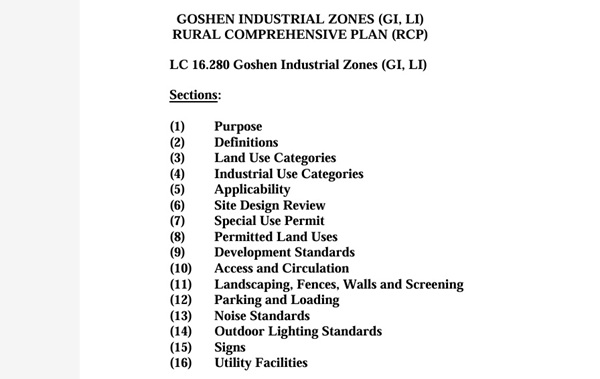
Speaker LUBA rejected Lane County’s latest appeal related to the CleanLane project. Here are some of the oral arguments presented Nov. 18:
Josh Soper My name is Josh Soper, on behalf of petitioner and applicant Lane County Public Works.
This appeal concerns an application for an innovative resource recovery facility in Lane County, and the issues on appeal all relate to the use categorization of the facility.
The first one I want to focus on is the failure to apply the framework in Lane Code for determining which activities at the proposal are primary versus accessory uses.
The second category that I want to focus on relates to the determination that the proposal is not a government facility. If the facility is properly classified as a government facility, it doesn’t matter if it could also be classified as a waste-related use.
Speaker Attorneys for Sanipac and the Lane County Garbage and Recycling Association argued against allowing CleanLane in the light industrial or LI zone:
Mike Connors My name is Mike Connors, and I’m presenting on behalf of the intervenor Sanipac Inc.
The hearings officer denied the application on the grounds that the proposed facility is in whole or in part a waste-related use, which, no dispute, is prohibited in the LI zone.
Consistent with the plain language of Lane Code, the hearings officer determined that the proposed facility has multiple primary uses, and each primary use must qualify as an allowed use in the LI (light industrial) zone. Petitioners don’t contest that interpretation of the code in this case.
The hearings officer determined that the primary uses of this facility include the receipt and processing of up to 225,000 annual tons of solid waste, the transfer of most of that solid waste to a landfill (approximately 64.5%), and the biological decomposition of organic material for the production of methane gas. Consistent with the plain language of Lane Code 16.280 3(A), the hearings officer determined that the waste-related use category ‘most closely describes the nature of the primary uses.’
That’s the language from the code, and therefore the facility is prohibited in the zone.
Hearing officer’s determination is clearly consistent with the plain language of the definition of a waste-related use. That definition includes any uses that ‘receive solid or liquid waste for disposal on the site, or for transfer to another location, or uses that manufacture or produce goods or energy from the biological decomposition of organic material.’ It’s all directly quoted from the Lane Code.
Since the primary uses are specifically included in the waste-related category definition, the hearings officer rejected petitioner’s attempt to classify the facility under the more subjective and open-ended ‘government facility,’ ‘industrial services,’ or similar use categories based on the plain language of 16.280 (3) and this board’s decision in Sarti v. City of Lake Oswego.
Petitioner appears to be presenting a new argument in oral argument today that essentially says, well, if it qualifies as a government facility, then it is allowed, even if it also qualifies as a waste-related use. The hearings officer specifically addressed that relied on Sarti and there’s nothing in the petition or the reply brief that challenges that or even cites that case. So we believe that that has been waived.
The hearings officer specifically found that this clearly qualifies as a waste-related use, and petitioner didn’t challenge that finding. Instead, what petitioner did is challenge a bunch of ancillary findings, rejecting petitioner’s arguments on alternative grounds.
You know, petitioner started this project out with his own change because they repeatedly acknowledged that this is a waste-related use that’s prohibited in the LI zone, and were seeking a new zone. And for reasons that are unclear to us, they changed tack and then suddenly raised an argument that it’s not waste-related. That prior position is very indicative that even petitioner recognized that this clearly is a waste-related use.
Since the hearings officer’s primary basis for the denial was this waste-related use, it’s clearly supported by the plain language of the code and the undisputed evidence in the record. We ask that the board deny the appeal and affirm the hearings officer’s decision.
Wendie Kellington Wendie Kellington. May it please the board, representing Lane County Garbage and Recycling Association:
We concur wholeheartedly in Sanipac’s arguments by not challenging key factual findings, legal conclusions, and preservation failures, the petitioner has provided no basis for reversal or remand and LUBA should affirm the hearings officer’s denial decision.
There is no dispute that the LC expressly states that uses are to be assigned to the category whose description most closely describes the primary use.
There’s no dispute that the LC expressly states that uses with multiple primary uses must have each primary use classified into its applicable category, and be subject to the regulations for that category.
That framework defeats petitioner’s argument (raised for the first time here today) that if the proposed use can be shoehorned into the government service use, that the board should ignore other primary uses proposed in the application that are expressly prohibited in the zone.
Here, the hearings officer, of course, decided that all three primary uses are waste-related and prohibited. Here the facility will receive and process, you know, tons of solid waste. It will transfer most of that waste, about 64% of that waste, to the Short Mountain landfill, and will biologically decompose organic material to create products and energy.
There is no dispute that the proposal fits into categories of specific waste-related uses. The proposal again, it will receive solid and liquid waste from others for transfer to another location. There’s no dispute about that.
There’s no dispute that the proposal will involve the manufacture, production of goods or energy from the biological decomposition of organic material.
The hearings officer did not err, and the Lane County Garbage and Recycling Association respectfully request LUBA deny petitioner’s assignments of error and affirm the decision.
Speaker During rebuttal, Josh Soper:
Josh Soper We agree that the petitioner does not contest some of the things that opposing counsel says that petitioner does not contest. But what we do contest is that they are properly classified as waste-related uses, and that it cannot be categorized as a government facility…
I also want to respond to the arguments about the Sarti case. The way I read that case is that it says that there is an inference in those instances that the more general category does not apply. It is an inference, but it does not conclusively demonstrate.
And that inference is not sufficient for the reasons that we’ve argued both below and in the petition for review, which is that the code explicitly and clearly allows uses that would otherwise be prohibited if they are categorized as a government facility.
And that’s because some of those uses that are provided as examples of government facilities would themselves otherwise be prohibited. And the only way that makes sense is if that government facility category is intended, by the county, to allow uses that would otherwise be prohibited.
H. M. Zamudio (LUBA, chair) Thank you for your argument. That will conclude oral argument. And the statutory deadline for our decision in this appeal is Dec. 3. We’ll ask in advance for an extension to issue the opinion no later than Dec. 24. Is that okay with these parties? (Okay. Yes.) Thank you. And have a good remainder of your day.
Speaker That was oral argument on Nov. 18 with a promise that a decision would arrive by Christmas Eve. The final order and decision arrived Dec. 22 and consisted of one word: ‘Affirmed.’ Days before the decision was announced, Lane County Counsel suggested there would be an appeal. Rob Bovett:
Rob Bovett (Lane County, counsel, Dec. 16, 2025): I think it’s fair to say that whatever LUBA decides will likely be appealed.
Presenter LUBA again rejects the county’s request to build the CleanLane trash-to-energy project in a light industrial zone.