PSL: How to end the current US war for Venezuelan oil
13 min read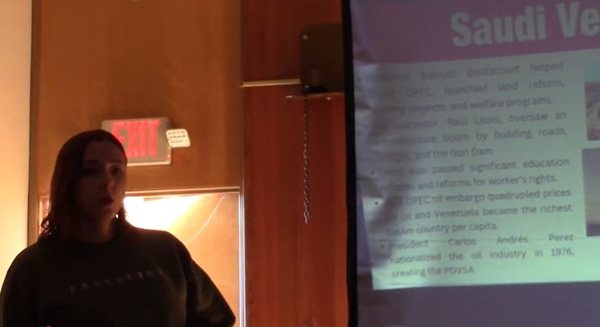
Presenter The Party for Socialism and Liberation shares its analysis of the United States’ escalating war on Venezuela—and what you can do about it. On Dec. 13, KEPW’s Todd Boyle was there.
Unidentified PSL Speaker Sanctions are a form of hybrid warfare. They’re a means of economic extortion designed to choke the life out of any country that won’t bow down to the American capitalist class.
Broadly speaking, hybrid warfare is a combination of conventional and unconventional military tactics intended to destabilize a country and undermine its society. The ultimate goal of destabilization is to prepare the grounds for regime change.
One of the advantages of this hybrid warfare is that it blurs the lines between war and peace. This allows for the actuality of war without the declaration of war. So, for example, the U.S. can target a country for years—even decades, as in the case of Cuba and Venezuela—using a range of aggressive unilateral measures from economic, legal, diplomatic, and informational, without deploying a single soldier and without congressional approval.
The main tool of hybrid warfare is legal, also known as lawfare. As the world hegemon, the U.S. is able to leverage the now-declining supremacy of its currency and the global network of Western-controlled financial and credit institutions to impose unilateral, coercive measures—like sanctions—on any country that it deems a ‘threat.’
But what could possibly threaten the mighty United States? If we look at the countries targeted with sanctions, we see that they are consistently countries that (a) wish to nationalize their resources for their own development, thereby cutting out private foreign capital, and (b) they seek to develop through a socialist path. This inevitably incurs accusations of authoritarianism. And lastly, (c) they wish to engage in cooperations with countries the U.S. already considers threats, like China or Russia.
It also just so happens that they almost are always countries of what is known as the Global South. So the U.S. is constantly threatened by ‘developing’ countries in the Global South that want to exercise their sovereignty and wish to freely associate with other sovereign states.
In 2016 following a risk management review, Citibank became the first financial institution to act on the order by closing the accounts of Venezuela’s central bank and the Bank of Venezuela.
The next year, President Donald Trump announced that his administration would be launching a ‘maximum pressure campaign’ against the country, starting with its oil industry. The U.S. Treasury imposed sanctions against state-owned company PDVSA in August of that year.
In January 2019 it imposed an embargo on oil exports as well. Aside from severe fuel shortages, the combined result of these measures was a drop in Venezuela’s GDP of more than 65% between 2014 and 2019 as well as hyperinflation.
The next target of the sanctions was the mining sector, with sanctions levied against Venezuela’s state-owned mining company Minervén in March 2019—a major blow for a country that holds the world’s second largest certified gold reserves. And since Venezuela was using gold reserves to pay for essential goods like food, fuel, medicine and other imports, this led to severe shortages in those areas.
Up next were the country’s finances: the embargoes against Venezuela’s public banking system. In April of 2019, the U.S.Treasury blacklisted Venezuela’s central bank, limiting transactions and banning access to U.S. dollars. With additional sanctions, several Venezuelan bank accounts in international financial institutes were closed, while the country also lost access to credit, and since then more than $8 billion in Venezuelan assets remain frozen in accounts controlled by banks in the United States, Portugal, Spain, Britain, France and Belgium, including almost $2 billion in gold.
In January of 2019 (just as they recently did with Edmundo Gonzalez), the Trump administration recognized Juan Guaido as Venezuela’s interim president. That time around, however, this blatant violation of another country’s sovereignty was not merely symbolic. Guaido was given control of bank accounts and assets belonging to the country, including Citgo, a Houston-based oil company that is majority-owned by the Venezuelan government and worth around $10 billion. Guaido would use these stolen funds to finance a failed coup attempt.
Maria Corina Machado is a right-wing Venezuelan opposition leader who was awarded the Nobel Peace Prize in October of this year, despite the fact that she was directly involved with violent coup attempts in Venezuela in 2002, 2014, and 2019. She also has ties to the Likud party in Israel, the party of Benjamin Netanyahu. Machado is a fervent supporter of the ‘Israel’s genocide against the Palestinian people.’ She anxiously is waiting for her chance to sell out the land, resources, and people of Venezuela to American capitalists.
Maria Corina Machado We will open Venezuela for foreign investment. I am talking about a $1.7 trillion opportunity, not only in oil and gas, which is huge. And you know that there are opportunities because we will open all oil upstream, midstream, downstream to all companies, but also in mining, in gold, in infrastructure, power. You know, Venezuela has 2,800 kilometers of pristine Caribbean coastline ready to be developed. So this is going to be huge. We will bring rule of law, we will open markets, we will have security for foreign investment and a transparent, massive privatization program that is waiting for you.
Unidentified PSL speaker So we’re going to start from the beginning: Postcolonialism. In the 1950s, after the overthrow of the military dictatorship (military dictatorships that were very common at this time due to again American destabilization in the region), in 1958, they established a constitution in Venezuela which was guaranteeing each major party (Acción Democrática, COPEI, and URD) participation in the governance.
It created a legislative, judicial and executive branch, and all parties agreed to a social democracy that was built on a moderate, progressive democracy, a mixed economy and gradual social reforms.
This led us to a period that is known as the Saudi Venezuela period. This is a period in which an oil boom takes place, and President Romulo Betancourt helped to found what is now known as OPEC, which are the oil-producing countries like Saudi Arabia, Iran, etc. and they launched land reform, housing projects, and welfare programs with this money.
His successor, Raul Leoni, then oversaw an infrastructure building nice roads, schools, bridges and what is now today known as the Guri Dam. Leoni also passed significant education reforms and reforms for workers rights.
In 1973, there was an oil embargo due to Israel that quadrupled prices for oil and Venezuela then became the richest Latin American country per capita. President Carlos Andrés Pérez then nationalized the oil industry in ‘76 and created what is known as the PDVSA.
However, beneath the surface of what was known as Saudi Venezuela, the social democracy was held together by a thread. This thread was oil rents, not taxes, and this created an insanely dangerous dependency. Capitalism began to flourish with low taxes, lucrative public contracts and easy credit as Venezuela’s bolivar, the currency, was pegged to the U.S. dollar and the state’s only job was really to just redistribute the oil money.
So if that oil money had ever faltered, the contradictions would eventually explode. And of course, that’s exactly what they did, because on Feb. 18, 1983 a mountain of hidden foreign debt came due just as the oil prices plunged. The state was then forced to devalue their currency and overnight. Venezuelan purchasing power went down by 75% and the first major crack in Venezuela social democracy had struck.
Now in 1989 Carlos Andrés Pérez was reelected on a left-wing populist campaign. He took that left-wing populism, rode it to the success of the presidency, and immediately—10 days into his presidency—he sold out to the IMF, which is the International Monetary Fund, the leading contributor to which is the United States.
We own the majority stakes in the IMF, and by taking a $4.5 billion loan from them, it came with strict austerity conditions to it, forcing him to cut spending, slash public subsidies, and ‘liberalize the economy,’ which essentially just translates to privatization.
Gas prices because of this rose by 100% and public transit fares increased by 30%. So working and poor people who make up the majority of Venezuela’s citizenry found it almost impossible to get to work or to afford food.
And this led us to what is known as El Caracazo. This was the response on Feb. 27, 1989: a spontaneous, massive uprising that erupted in chaos in Caracas, sparked by fury over the fare hikes.
The state’s reaction was brutal. President Pérez denounced the protesters as criminal hordes, specifically using that language, then declared martial law, and unleashed the military. And when the smoke cleared, an estimated 3,500 Venezuelans, mostly from the poor neighborhoods, were found dead, and to this day it is argued that it’s anywhere from 3,500 to 10,000 because they are still to this day finding mass graves from this uprising.
This became the defining rupture in what was known as the Puntofijo Path from 1958, and its promise of shared prosperity was buried in those streets after El Caracazo. The state had revealed itself not as a protector or a liberator, but as a violent guardian of elite interests against its own people. And now comes the Bolivarian Revolution.
Unidentified PSL speaker The Bolivarian Revolution originates with Simon Bolivar, who was an Enlightenment-era Venezuelan thinker and military strategist who liberated a wide variety of states in Latin America from Spain. He was informed by Enlightenment values, so he believed in anti-slavery, education for all, land reform, and Indigenous rights.
And there’s a broader history here of popular uprisings against colonialism and against imperial domination. From like ‘58, all through the ‘50s, ‘60s, and ‘70s, there had been a history of guerrilla movements against the bourgeois dictatorships, the military dictatorships, because even from the beginning, the democracy in Venezuela was very fraught and only really represented large moneyed interests.
Guerrillas in those various movements formed a mutual pact, called the Revolutionary Bolivarian Movement, where they would take those Bolivarian values and modernize them. And since many of the guerrillas that were fighting at that time were of a Marxist orientation, that made up the broad majority of the core leadership at the beginning of the revolutionary movement, which shaped a lot of the early platforms and policies.
In February 1992 revolutionary forces had taken control of several cities, it was led by this revolutionary fighter (Hugo Chavez) and he had spent many years forming this broader coalition of guerrilla fighters. However, when he went to overtake the capital, he actually laid down his arms and asked his comrades to also lay down their arms to stop the bloodshed.
This launched him into national consciousness. They became wildly popular in Venezuela nationally. He was very, very little-known before this. But after this time, he became incredibly popular so that when the special election came about, every single candidate in the mainstream election, every single candidate guaranteed that they would release Hugo Chavez. He was so widely beloved.
So after two years, he was finally released from prison and launched the Fifth Republic movement, which is the electoral shape that the Bolivarian Movement took at this time. He actually won the popular election with 60% of the vote. Pretty, pretty incredible. I mean, when was the last time the American president with that kind of success?
And in 1999, they were able to ratify the new Bolivarian Constitution, which made a wide variety of popular promises a reality, such as: land reform, literacy campaigns, political education, and free speech protections, as well as Indigenous protections, food insecurity, the list goes on.
This was the start of massive campaign against the Bolivarian Revolution and there were several very high-profile coup attempts and moderately successful attacks on that project, but what’s important to underscore is that all of these attempts were overturned by the broad popular support of the vast majority of Venezuelan people, because that’s what the Bolivarian Revolution is led by.
Unidentified PSL speaker Venezuela holds some of the world’s largest natural gas reserves, second-largest in the Americas. About 90% of natural gas production occurs in association with oil reserves, and 35% of it is actually reinjected back into oil fields to enhance crude oil extraction.
Hydroelectric power supplies 70% of their needs. It’s a renewable form of energy and it’s fairly cheap to produce compared to fossil fuels. This water power comes mainly from the Caroni River, which contains four dams, one being the Guri Dam, which is the third-largest energy generator in the world. Relying on this resource is really important to Venezuela because it allows them to sell more oil.
And since they generate more hydroelectricity than they consume, they can actually export the surpluses to their neighbors in Colombia and Brazil. And they also can use it to produce and export huge amounts of iron, steel, and aluminum.
But unfortunately, oil income goes from 71% going to the state in 1993 to only 36% of it going to the state by 1999. PDVSA (Petróleos de Venezuela, S.A.) leaders were actually keeping 64% of the profits for themselves and leaving basically nothing to fund social programs for the people.
In 1999, Hugo Chavez takes office after the Bolivarian Revolution. And he takes control of the PDVSA, creates democratic communal councils so that the people have a say in how their resources are being used and begins funding more social programs.
With all this potential success, what happens? Well, beginning with Obama, the U.S. begins imposing sanctions, as we have already heard before, and they expand. They are expanded by both Biden and Trump, but they really increase dramatically under the Trump administration.
In March 2025, Trump signs Executive Order 14245, which imposes a 25% tariff on any country that buys Venezuelan oil, making it pretty much impossible for Venezuela to access any international markets. They want us to believe that they impose these sanctions due to illegal activity like drug trafficking, but they present absolutely no proof of that.
The U.N. and every other independent agency have all confirmed that Venezuela is not a major producer of drugs. What is true is that Venezuela has vast amounts of natural resources and holds the largest proven oil reserves in the world. This is what they’re really after.
Between September and October of this year, the U.S. military has bombed multiple small fishing boats off the coast of Venezuela and Colombia. And since then, the U.S. military has been accumulating troops, naval and air forces and air forces in the Caribbean, signaling towards military intervention.
And surely enough, on Dec. 10, 2025, Trump uses the U.S. military to seize an oil tanker off the coast of Venezuela, even though 70% of U.S. citizens oppose the war on Venezuela. This regime continues using our tax dollars to fund these types of atrocities all over the world.
Unidentified PSL speaker People from Venezuela are, in fact, coming to our country. And this is not a problem. The problem is why they have to come. Because a lot of these people are forced to flee here. The U.S. imposed sanctions, interventions and economic practices that we have recently just discussed have made it impossible for a lot of working-class, and especially poor people, to survive in their home country.
The U.S. placed an embargo on oil exports in Venezuela’s public banking system, which blacklisted the entirety of the country from accessing international financial institutions, meaning that no citizen anywhere in the world could access any bank—just for the crime of being Venezuelan, by the way.
Foreign financing and international trade has been shut down with Venezuela, assets abroad have been confiscated and a loss of more than $35 billion dollars. Now the quality of life is also being affected due to this, because there is an increased hyperinflation which affects the cost of living, deterioration of their public services, and attacks on their education and healthcare systems by the U.S..
There is a fall in formal employment, employment, wages, social security and there is a massive increase in poverty due to the crippling nature and purposeful, mind you, nature of this.
Venezuelan migrants are not here to steal your jobs. Venezuelan migrants are not here to eat your dogs. They are not here to harm you. They are here because we have forced them. We have given them no other option. And now we seek to destroy what they were forced to leave behind.
You may be asking like, well, what does this matter? What can I do about it? I’m all the way here in Eugene, Oregon. Well, we can do a lot of things, actually. We’ve been doing a lot of things.
Presenter The PSL, the Activist Coalition of Eugene Springfield, and many human rights groups are conducting monthly actions, building up to a general strike May 1st. The next action will be January 19th.
Unidentified PSL speaker Jan. 19, Feb. 16, March 16, April 1, leading up to the general strike on May 1. There are going to be multiple actions all throughout the city, throughout Lane County. There’s going to be some in Portland and Salem. Wherever you are in this country, there will be a Day Without An Immigrant visibility actions.
And on May 1, this general strike will be happening. We encourage you to participate because right now, people from Venezuela, from Mexico, from Cuba, from all of these places, people are being kidnapped for the crime of being brown and in the wrong place at the wrong time. And it’s our duty as working-class people in this country to protect them.
There are plenty of ways working-class people can fight back, but our biggest weapon is withholding our labor. Without us to do the real work, your empire will crumble. We will defeat you—with a general strike.
Presenter As the Trump administration escalates its hybrid war with Venezuela, Eugene, Oregon, starts organizing. You can join an action each month leading up to a general strike on May 1, 2026.
Field recordings by Todd Boyle for KEPW News. You can see the complete event on Todd’s YouTube channel.