MLK Day March: Beyond Toxics to promote community conversation on resiliency
9 min read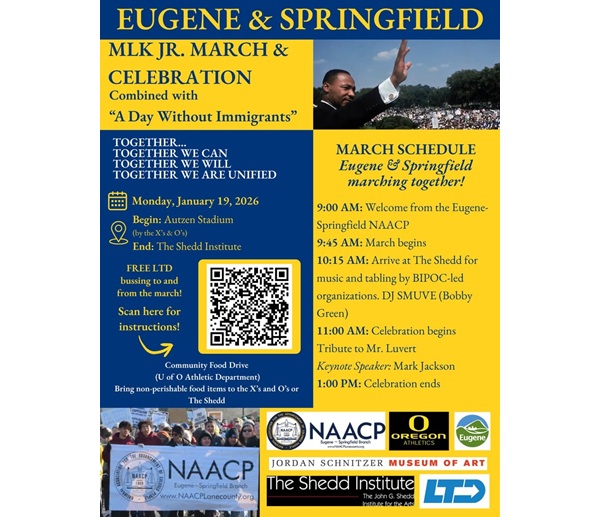
Jana Thrift Hello, this is Jana with KEPW-LP 97.3 FM broadcasting from Eugene, Oregon and simulcasting online at KEPW.org. Today we’re here with Eric Richardson, and he works with Beyond Toxics, and he is going to be a part of the MLK celebration coming up Jan. 19, and he’s going to tell us all about it.
Eric Richardson Yeah, right on. The NAACP in Eugene, Springfield puts on this celebration since the mid-‘80s. And so Beyond Toxics will be there participating and trying to interact with the community around the Plan for a Resilient Oregon, which is the governor’s state-sponsored activity.
So we’re trying to just hear from community and be able to relay what we’re hearing back to the governor’s office so that they can really plan looking ahead for what Oregon looks like, when it comes to resilient communities. And so we’re asking community to give input on that.
And so we’ll be at the march, just interacting with the crowd, being there with some volunteers from Beyond Toxics trying to do that. And then we’ll also be tabling, at the end of the march at the Shedd Institute, right before the program that happens at the march.
Jana Thrift Nice, nice. So tell me, where do people go to be a part of showing up where it’s going to begin at?
Eric Richardson Yeah. So the march is going to start at Autzen Stadium, the north side of Autzen Stadium, right there on MLK Boulevard. And they’re going to start at 9 a.m.
So we’re asking folks to gather at 9 and then, during from 9 to 10, there’s going to be a food drive so we’ll have a truck parked there.
We’re asking to load up that truck with donated food. So and then at 10 a.m., the folks are going to start the march, commence the march and march to the Shedd Institute, crossover to DeFazio bridge and then go to High Street and to the Shedd Institute.
And so during 9 a.m. to 10 a.m., that’s when the Beyond Toxics volunteer crew will be working the crowd, really looking to do intercept surveys. We’ve got 10 questions that we’ll be asking the community.
And I can go through some of those questions, like, we’ll be talking about natural hazards that you’ve experienced. We’ll be asking about major strengths that we feel like our community or household has when it comes to natural disasters or emergency preparedness.
And then we’re going to ask people what they think a resilient community looks like just at one-liners and whatnot. So these will just inform the plan going forward.
And then we’ll also have a dot survey, and that’s a board that has several statements and participants will be able to place their dot next to the statement that best reflects their attitude or their sentiment. And so we’ll be able to report that activity back to the governor’s office as well.
So, it’s called A Plan for a Resilient Oregon. You can look it up online. The governor came out with this as an official policy of hers a couple months ago. And so Beyond Toxics is one of the 25 statewide forum members or more, there may be more than 25, but statewide organizations that are participating in this plan.
Jana Thrift Yeah, it’s very interesting, the idea of a resilient Oregon. And are you familiar with, like, what are the concepts that they’re trying to relate to as what they see as resiliency?
Eric Richardson Yeah, I think this time we’re talking about really grassroots systems: the energy systems, the basic needs, and, you know, emergency is the most classic scenario where there’s some type of crisis.
And what is it going to look like for us to be able to have access to our basic needs? And that is being the most basic resiliency that you can do is saying, ‘Okay, how are we going to feed people’ in a crisis when the distribution systems go down, when the neighborhoods, you know.
And so we’re just looking at really creating hyperlocal, I think, awareness around resiliency. And I think what we’re trying to talk about is building this whole idea of collective impact. So, so that agencies and organizations really are looking out for one another and looking for those cross-sections where we can share resources and lighten the burden to provide those resources.
Jana Thrift Yeah, that makes a lot of sense, that that the cross communication between all these different places would be a key thing to have in order if you’re trying to make sure that when something, God forbid, went terribly wrong, that we would be prepared to, ahead of time, to know what that will look like and how people will be able to function efficiently and across the board.
Eric Richardson Yeah. And resiliency crosses all bounds, you know, because we’re talking about systems. What does our education system look like when we talk about a resilient education system, you know?
So right now we’re going through budget cuts. We’re going through all these things. So what does it look like to make sure that even though we are in a catastrophe, an education system with the budget cuts, what does it look like to be resilient in that time and to continue to provide the services that are needed without the traditional flow of revenue and finances?
And sometimes that’s going to take an increase in volunteerism, an increase in philanthropy, perhaps, new models of doing things and so there’s a lot of interesting work ahead to reach a new, sustainable, resilient future.
Because a lot of these things are changing in front of our eyes, we may not consider them as emergencies, but they in the long term, they are very critical changes happening right now.
Jana Thrift Yeah, that’s very interesting for you to point out that, you know, just the budget cuts alone bring up the the point that we need to figure out how our systems can be resilient enough to survive, if if these resources that we’re used to being able to have to support things go away. And how crucial what an important task.
And the Jan. 19 MLK March is a beautiful event to honor MLK, and it happens every single year. And it would be really great to have people show up out there for this particular year, just, you know, listening to the different things going on in our nation. It seems like the words that he shared are more poignant than ever.
Eric Richardson Yeah, you know that I haven’t even really been able to focus on some of that. And I think that that’s part of the symptom of what’s going on in our world is that is that we don’t focus enough on some of our elders and some of the words and wisdom that has been laid down before us.
And so, yeah, I think this is an opportunity to go back and reflect on some of the words Dr. King was imparting on us. And a lot of what, I think we’re missing, is a part of this whole idea of connecting the sanctity of human life to why we do our everyday work.
We do it because we really do care about the outcome of human life. And we want the best for all these children and all these, you know, grownups who used to be children. And we do think that their life is special, special and valuable.
And so without that basic belief, then it’s hard to go about in an equitable way, because you feel like, ‘Well, I can just stomp on anybody who has no value.’ But our premise is that all people have the most highest intrinsic value, and so that’s really where we’re coming from.
And so when Dr. King spoke about what he was speaking about, you listened to what he said, he really cared to the people he was speaking to. And some of the people he was speaking to, he was asking them for relief from the hatred, from the discrimination.
But he was saying, part of it is for my own relief and for my people’s relief, but it’s also for the validation and sanctification of your soul by you doing so. This is bettering you. This is giving you a chance at a bigger life.
And so I think that we need to remember that about our nation, that these things matter and that we don’t want to backslip as though behavior, character, morality doesn’t matter.
And so as we celebrate Dr. King’s birthday and the 250th year of our nation’s birth, I think both of those things are related. Because he cared deeply about liberty. He cared deeply about the project of democracy that this nation has to offer for all people.
And that’s what he was asking: Let’s do this project for real. Let’s make these words of the Constitution, the Bill of Rights real in relationship to civil rights, human rights. And I think that we can still do it.
And people heard his call 70 years ago, and I think it’s just time to renew our faith in the nation and in ourselves, to be purveyors of dignity and of love for all people.
Jana Thrift Yeah, so important.
I just, you know, when things get crazy, you’ve just got to bring the sanity to the picture and rise up to that darkness. And with the light and we will overpower it. I really, truly believe that. And I’ve always thought that the light will rise up to meet the darkness in a way that love will always win. That’s my philosophy, anyway.
All right. Well, I want to say again that Jan. 19, Beyond Toxics, they’ll be out there with their dot poll and some surveys talking about Oregon’s resiliency, and it would be great to catch them over there, 9 a.m. at the north side of Autzen Stadium.
Eric Richardson The X’s and O’s. Yeah.
Jana Thrift All right! By the X’s and O’s. That’s a great landmark.
Eric Richardson And you can park in the Serbu Youth Center right across the center. You can park there, walk to the Shedd. I think there’ll be, LTD will have some buses. You can go back to the car. So there’ll be some stuff happening there.
Like I said, check us out at the tabling event at the Shedd as well. And we’ll be wearing our Bee Jazzy shirts from Beyond Toxics. So be on the lookout.
Jana Thrift That’s fabulous. That’s fabulous. Okay. And is there anything else you’d like to share before we call it a wrap?
Eric Richardson The Plan for A Resilient Oregon is going to be happening. Outreach is happening throughout the state from now through April 1.
And I do plan on having a couple more activities. And then we’re I’m still working with the Amicus Memorial Garden Collaborative out in River Road. And that’s going to be starting out this June. So there’s a lot of work around resiliency in Lane County.
I also want to put a shout-out to the Grow Lane County coalition. You can look that up as well online: Grow Lane County. And so we’re doing a lot of work around food sovereignty, connecting farmers and consumers and making the local system really shine, since we have a lot of talent, a lot of great soil, and a lot of great skilled people who care about food and community. So that’s the work ahead.
Jana Thrift Yeah, food security, such important stuff. Yeah. Thank you for all that good work you’re doing in so many different ways, Eric, sharing about what’s going on with the upcoming MLK March that will begin at 9 a.m. next to the X’s and O’s by Autzen Stadium there on MLK Parkway, and then it will march over to the Shedd Institute, where they’ll have a whole program of fabulous MLK celebratory stuff.
Eric Richardson Yeah, they’re going to recognize one of our old presidents from the NAACP, Henry Luvert. He had a business here. His wife was a teacher, longtime teacher, educator. So, yeah, that would be a great time just to recognize his service to the community.
It’ll be also a co-day of activity with immigrants. We’ll be talking to immigrants who are having their own stories highlighted at the march as well at the Shedd Institute. So there’ll be a shared program there. So check that out.
Jana Thrift Oh. That’s fabulous. That’s really wonderful. All right, well thank you, Eric Richardson, and thank you everyone for listening.
Legalize Survival with Jana Thrift, Julie Lambert, and Sam Broadway can be heard every Wednesday at 7 p.m. on KEPW 97.3, Eugene PeaceWorks Community Radio.