Rewind with Todd Boyle: City policies created conveyor belt to homelessness
5 min read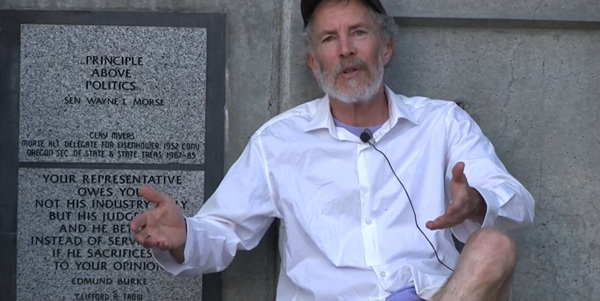
Presenter Rewind with Todd Boyle goes back to the year 2019 and a series of statements in the Wayne Morse Free Speech Plaza in downtown Eugene.
Todd Boyle I’m Todd Boyle and I came to talk about the housing crisis for people who don’t make a lot of money. And the problem is growing worse and worse. And this causes homelessness. It causes broken families, it causes economic stress, and it causes runaway kids and runaway fathers. It breaks down society, basically. And so that’s the conveyor belt that causes homelessness.
I am here at ‘People’s Forum’ to point out this tile: ‘Principle Above Politics’ by Wayne Morse. None other than Wayne Morse. And the relevance of this to our housing crisis—and there is a housing crisis of which the homeless crisis is a big part—is that our policies shaped restrictions, the infamous anti-housing ordinances of Eugene.
The definition of policy is a system of principles, principles which guide the formation of actions and staffing and budgets and so forth. So it really is all about principles. So I just want to name principles that really drive me nuts.
One of the principles that’s very prevalent here in Eugene is that property owners who own land in a neighborhood ought to be able to set the rules or to have a strong influence over what gets built in their neighborhood. Now, where did that ever come from, you know?
Well, obviously it was popular among property owners, but it isn’t working in an ever-increasing population with a rigid land use boundary, your urban growth boundary. And so what happens is that the scarcity of housing causes prices to go up, and then your lowest-income people to be displaced out into the street, which is completely absurd policy.
Another one is that the idea that if a person owns land, that their property rights should not decrease in value because of land use, you know, changes in land use restrictions… and in perpetuity now. Is this going to be for 100 years or 1,000 years? And in 1,000 years is it still going to be 6,000 square feet, and they’re still going to be protected against changes in policy that make their property price go down, such as building some apartments in the neighborhood.
Those of you who really care about this problem of displacement, we have to start arguing about these principles that have been accepted for too long. And we have to look to our City Council to be leaders and not poll-takers—leaders who can articulate the problem, identify the causal factors, and change that, so we won’t be literally seeing homeless people dying in the streets.
Some of the underlying principles that our policy makers use when they make policy, and, you know, they have an incredible privilege and they just go on month after month on the boards and commissions, you know, just scratching their chin and deciding what are the principles. And one of them is that people who have houses, for example, have a right to say what’s going to go on in the neighborhood around the land that they own.
And so of course, they all vote right there: We’re not going to have any poor people. We’re not going to have people of color. We’re not going to have any, you know, we’re not going to have liquor stores and rendering factories and things. But, basically they have locked up all the—it’s all up and down the West Coast.
And that’s why the legislature finally had to pass HB 2001, which removed from cities the power to have R-1 single family zoning, because there was just no way that these cities were going to reform themselves. It’s a lot like New York and Washington. That system is not going to reform itself, you know?
And there’s no land that you can get. And that is an externality that’s imposed on the homeless. Now they have a human right to exist. They have a human right to exist on the earth. It’s something to do with gravity, I think. You know, you have a body and it keeps coming down on the earth somewhere.
And this has gone on for quite a long time and created quite a large displacement phenomenon because the city maintains a tight urban growth boundary, of course. And then it maintains its infamous anti-housing ordinances to make it impossible to build anything cheaply inside of the city.
So as a result, the cost of houses and the rents continue to go up. And this is the embodiment of Eugene’s policy. And it’s been going on for a long time. So it not only creates visible homeless, but it also creates a ton of stress among the human population.
So this brings me to the reason why I came, why I care about this. I have a house, but I want to live in a city that’s fulfilling its evolutionary role or its purpose for human society, and that is that everybody should be able to grow and be able to move through their stages of development and understanding and love and spiritual attainment and all this good stuff.
And when you’ve got a third of the population under economic stress, they’re not able to do that, but instead it manifests in more and more stress, mental illness, hostility, artificially-caused competitiveness, destructive competitiveness in market dealings and in labor relations and all sorts of things.
And all this can be avoided if our city will have a policy that embodies the actual purpose of a city, which is to have a congenial population that’s well cared for, and that they can develop in whatever their natural way, and they have to be reasonably close to downtown, not way out in a housing tract out there in the country.
The reason why people congregate downtown is for our human growth and development.
And so this is a result of a deliberate policy of draconian barriers against constructing cheap housing and an urban growth boundary that prevents, you know, runaway sprawl, which is a good thing. But what this translates into is that the rents keep going up really fast, and the prices of houses goes up really fast.
And so what this means is that this city is auctioning off our city to the highest bidder, and housing is being allocated on an auction system of who’s got the most money, instead of who already is living here and has family and relations here, jobs here and trying to raise kids here, retired here. They’re just being pushed out by the high rents.
You know, this is pretty crazy. This is pretty crazy stuff. And people really ought to examine this and tell the City Council that business as usual ain’t working. It ain’t working.
Our policies that restrict the construction of cheap housing and allow the cheap housing that exist to be bid out from under the people who live there, that’s got to change. It has to change at the philosophical level.