Urban renewal project at 1059 Willamette needs more time, money to pencil out
7 min read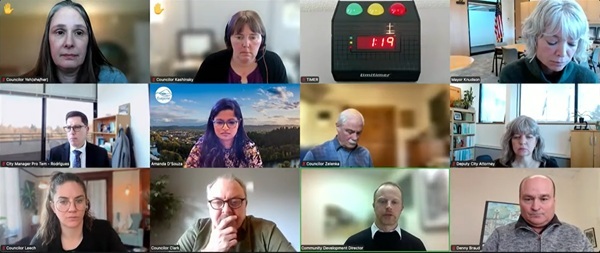
Presenter: Five years in, a proposed housing development at 1059 Willamette needs more time and more money. At the City Council Jan. 21, Councilor Alan Zelenka:
Councilor Alan Zelenka: So we’ve been working on this for over five years and it still hasn’t come to fruition. And the developer’s been working on it since what, October, 2021. So we’re four years into that, and we’re still not at the point where it’s a doable project.
Presenter: Councilor Mike Clark:
Councilor Mike Clark: We’re trapped in this system. We’re trapped in the system of intentionally constraining land use and having to publicly subsidize low-income housing. I’m not in favor of this system, frankly, but it’s the one we’re in, so we should probably be working on some method to say, you know, ‘We’re willing to invest X number of dollars (per unit) of public funds to produce low-income housing.’ And at X + $1, we say, ‘No, it’s no longer worth it.’
Presenter: Community Development Director Will Dowdy:
Will Dowdy (Community Development, director): We’ve had community members note this property as a problem and as a barrier to their investment in their property.
Presenter: Councilor Eliza Kashinsky:
Councilor Eliza Kashinsky: This is a combination of market-rate units and income-limited units. It’s kind of getting the worst of both worlds from the challenges of the funding, getting the funding together. Is that right?
Amanda D’Souza: Yeah, I would say so.
Presenter: Amanda D’Souza:
Amanda D’Souza: I’m Amanda D’Souza, development programs manager in the Community Development division. Today I’m here to provide you with an update on the 1059 Willamette Redevelopment Project.
The building has been vacant since 2013 when Lane Community College moved to their new downtown campus. In 2019, we began exploring the possibility of using the site to pilot a mixed-income housing project and that year LCC approved sale of the property to the city.
We acquired the property in 2020 using federal community development block grant dollars, and the strings tied to that are at least 51% of the units needs to be affordable to at least 80% area median income.
A few months later in 2020, Council approved the use of a Request For Proposals (RFP) process for disposition of the site. The RFP outlined several criteria for the project and identified the availability of $1.1 million for SDCs (system development charges) and permits.
That $1.1 million is a combination of downtown urban renewal funds and the MUPTE (multiunit property tax exemption) moderate income housing fee collected from Gordon Lofts.
The RFP was released at the end of 2020 and we received one response which you selected in June, 2021.
Later in 2021, you approved deal points for the proposed project, and in May, 2023, you approved revisions to those deal points. In June, 2023, Council amended the Downtown Urban Renewal Plan, increasing the spending limit by $50 million, emphasizing the intention to use the majority of those funds to support new housing in the downtown core.
And finally, in February, 2024, you approved the MUPTE for the project and revised deal points. And on the same day, the agency board approved an additional $740,000 of urban renewal funds for project-related costs to help offset increases in construction costs and interest rates.
Since then, the development team has worked to prepare for construction… and in 2025, they applied for and received approval for all permits needed to construct the building.
All in all, the team has already invested about $1.6 million to get the project to where it is today. The total project cost is just under $33 million. The city and urban renewal agency have allocated $1.84 million towards that and is offering the land at no cost.
On the private funding side, the development team has been able to secure the debt needed to have an even split for the project. However, they’ve struggled to attract the equity investment needed because their expected rate of return is below market, meaning it’s not competitive to attract investors.
Without an option to significantly increase rents or decrease construction costs, the development team would like to make a proposal for additional urban renewal funds to offset project costs and bring the rate of return for project equity in line with market realities.
We’re working with the team jointly led by deChase Miksis and Edlen & Co. Both of these are experienced developers with a variety of market-rate and affordable housing projects throughout the Pacific Northwest.
The projects they’re leading (and which you’ve approved) includes 133 units: 68 of those would be income-qualified to 80% of area median income and 65 would be market rate. Those income-qualified units would remain affordable for 35 years, which is longer than the minimum of 20 years that we required.
The project would offer resident services from Cornerstone Community Housing. Ten units will be designated for Hope & Safety Alliance. There’s an active ground floor with incubator retail space and local art. There’s pet amenities and Council authorized the use of $1.84 million for SDCs, permits, and other project-related costs.
We’re here today because right now the development agreement requires the city and the team to close by Feb. 1. Today, Council is asked to approve an extension of the closing deadline by six months…
Right now they estimate the funding gap is within the range of $1 (million) to $3 million. However, the investment of any additional public funds in this project is likely to trigger the prevailing wage laws, which they estimate could increase the gap by an additional $5 to $7 million.
There are a few paths forward, but because we used federal CDBG dollars to acquire the site, we must implement a project with at least half the units affordable to 80% AMI.
Presenter: Councilor Alan Zelenka:
Councilor Alan Zelenka: And it looks like they’re not only asking for extension, but they’re asking for a substantial amount more money to fill the gap if they can’t fill it.
I guess the question I’m struggling with is: Is it time to move on, or are these projects doable? Or they’re just not doable.
Presenter: Amanda D’Souza:
Amanda D’Souza: We need all the housing we can get. We’re trying to creatively use the tools we have, and in this case it was CDBG and urban renewal. But I think, yeah, the question you pose is one for you and the councilors to ponder.
Councilor Alan Zelenka: Yeah, well, if we had done a full percentage point on the construction tax, we’d have a million dollars that we could contribute to this, but we didn’t do that.
And one of the things we learned a while back was that affordable housing projects are exempt from prevailing wage laws, which is understandable, but troubling at the same time. And it really adds another $4 million to the cost of the project?
Amanda D’Souza: Yeah. The estimate is that it adds about 20% to the construction cost, to the labor cost.
Presenter: Councilor Mike Clark:
Councilor Mike Clark: Despite his editorial comment, Councilor Zelenka brings up a good point: How do we, from a policy perspective, evaluate what’s a good investment for us to continue with, versus time to, you know, fish or cut bait?
We need a better method for evaluating the value in that way, and I would turn towards staff and ask for some guidance with regard to how to evaluate that. If you’ve got any thoughts on that, I’d love to hear it.
Will Dowdy (Community Development, director): Will Dowdy, Community Development director. I think that we can bring back a little bit more of that sort of information…
The promise of urban renewal—the genius of urban renewal the way we use it— is that it creates an internal feedback loop, so that the investments that you make in every urban renewal project in some way contribute to the creation of more tax increment, which then becomes an opportunity for further investment, which becomes an opportunity for further feedback. And so —
Councilor Mike Clark: We’re doing that with private land though, correct?
Will Dowdy (Community Development, director): It’s both. I think some investments are better suited or have a stronger tax impact than others. But what we’ve seen overall in the district is the opportunity for each investment to have some sort of feedback.
And so this project—for however Council wants to move it forward—what we can do is we can look at some of our projected tax numbers from this and come up with a way to describe this project in terms of real impact going forward.
So I think we can do a little bit of all of that. I just want to paint that bigger picture that I think is really important, and is something that you considered when you were looking at the urban renewal district.
Councilor Mike Clark: Right. We’ve got to think of the broader picture, and I agree with you on that… I really would like a better metric for how do we evaluate the value of any individual subsidized project and what it’s likely to cost on a per-unit basis.
Presenter: The Council granted the extension and staff now has six months to develop an evaluation method that can quantify the benefits of urban renewal.