
County looks beyond the headlines on mental health rankings
13 min read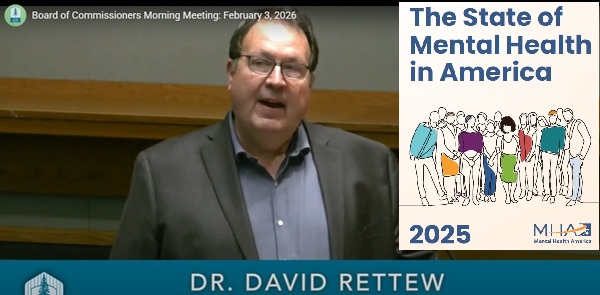
Presenter: Lane County commissioners got a report on the state of our mental health. On Feb. 3, the county’s medical director of psychiatry, Dr. David Rettew:
Dr. David Rettew A lot of the things that show up in the headlines—that we’re doing poorly, we’re one of the worst states in the entire country—these interesting headlines that talk about how we rank last or near the last in both the prevalence of mental health problems and in our treatment resources. And those statements on the headlines, as you can see, are often bundled together like we’re talking about kind of the same thing.
So I wanted to look a little more closely at that question, and also sort of challenge folks: Do you know where this mainly comes from? This ranking that we get?
So there’s an organization called Mental Health America. They’re a pretty well-respected group and every year they publish a report and they don’t create their own data, but what they do do is, they assemble sources of data from lots of different national surveys that are out there.
And they put them all together and they have basically 17 different data points, 17 different mental health indicators, and they combine them all together, and then rank them, and that’s how you get your score as a state.
And Oregon has been near the bottom of this list for many years, but I want to take us a little deeper on this survey and some others, because I think when you do a very superficial look and just sort of take that number, we are missing quite a bit. And that’s what I want to try to bring us up to speed about.
One way that if you take a little deeper dive is that it also divides up the measures between adult mental health and child mental health. And when you do that, you find that we rank 39th when it comes to youth mental health and 46th when it comes to adult. Not a huge difference.
What I think is really important and something we don’t talk about at all is, remember how I mentioned that most of the headlines put prevalence and treatment together? If you actually look at the survey, you see a wildly different picture where:
We have the highest rates of mental health and substance use disorders in the entire country, we are 51st, whereas, when it comes to access, we’re actually ranked seventh.
And in some areas we’re actually looking like we’re doing really well. The number of mental health professionals per 100,000, we’re actually ranked fourth in the country when it comes to that.
So just taking it one level down, already we’re seeing a very different picture. So it really made no sense to me that we should be bundling these two things together because at least according to this survey, it paints a very different picture and, that’s kind of a weird combination, like, ideally, the more treatment you have, the lower the prevalence of mental health disorders should be.
You would hope that those two things would kind of run together, but they don’t in this state. So the question is: So what’s up with that?
So one of the things I did is I wanted to see what kind of company we were in and how unusual this, what I thought was this odd pattern of having very high rates of mental illness and substance use, but also according to this survey, at least, having pretty good access.
And so I looked at states that were either in the sort of the top third in these access and prevalence and I found a really interesting pattern, that in some ways was just remarkably geographic.
The states that tend to have high rates of mental illness and low access are a lot of our western neighbors, Nevada, Arizona, Wyoming, Idaho.
The states that report low levels of access, but fairly low levels of mental illness are basically all in the South: Texas, Mississippi, Florida, South Carolina.
The states that have, I guess the best? combination of high access and low rates of mental illness is a little bit more of a mixed bag. So that’s New York and Iowa and the states that actually came out at the very top of the survey.
And then we are in this combination of high rates of mental illness, but low access. That’s the pattern that we see with states like Vermont, Maine, New Hampshire, Rhode Island, and then there’s us. So we’re kind of the outlier there, geographically.
So, why would we have this combination? What could be behind it? And I don’t know the answer, but there are a lot of different reasons.
So one is that we’re not measuring things very well. The regionality also makes me think that maybe there is something about cultural differences here in terms of people, especially self-identifying that they need some help and seeking out treatment. It’s also possible that when people need mental health resources, they move to states that have more access. I certainly have seen that.
It may be that we have a lot of clinicians around who can make a mental health diagnosis, but as anybody who works in mental health treatment knows, it’s hard to actually have them no longer meet the criteria. People get better, but it’s a higher bar to actually have people no longer have the condition anymore.
Or I think we also have to think about this sort of uncomfortable, and as a clinician, I really don’t want to think about this, but maybe we have good access, but our treatments that we offer is not as effective as it should be.
So the diagnoses are staying, and that could be for a lot of reasons. I think probably one of the most apparent ones is our high rates of substance use. Substance use is known to sabotage treatment effects. So that may be a reason why we have that.
We don’t really know about how much people are getting different types of therapy. Are they getting this type of therapy, that type of therapy, medication treatment, combined treatment?
It also may be something to do with our delivery of mental health system. We have a lot of providers, for instance, who deliver services only through telemedicine. And that can be a great way to reach people where access is difficult. But for a lot of people, the telemedicine format just doesn’t quite work as well.
So let me take this now even a level farther on this Mental Health of America survey.
So one of the questions, and it comes from a very well-known national survey called the National Survey of Drug Use and Health. So this was a question that loads onto the ‘Access’ dimension for this report. And it basically says, for youth? It said, Did you have depression and you needed or sought treatment and you couldn’t get it?
And for youth, actually Oregon did quite well. We were ninth. So 42% of youth said that that was true with a national mean was over 50%.
For adults, we actually didn’t do so well. We were 43rd where 30% said that when the national mean was 25.
But what was really interesting to me about that item was the next level, because they then asked, ‘Well, why were you in this situation where you needed help and didn’t get it?’
And by far, for both youth and adults, the number one reason was they felt they should be able to handle their mental health problems on their own. That was the number one reason. So if that’s really the reason that makes me wonder, ‘Well, is that really an access problem? That to me is not an access problem. That to me is a stigma problem.
And if we’re going to treat this as access, I think we’re going to go down down the wrong path. So this was, makes me question this, and it made me start to look at other sources of information. And this is the rabbit hole that I started to go down trying to find all these pieces of information that would ask these similar questions in different ways.
Let’s then look at how effective our treatments are in Oregon. Mental Health of America, in 2024, they did actually have a question that asked youth, basically: ‘If you got treatment for your depression, did it help you?’ We were 40th in the nation. So, Oregon, about a little over half of youth said they were helped, where the national average was about 65%.
And here was a spot that we actually did diverge from New England, where we generally were clustering together, but people were reporting higher rates of success in terms of treatment in some of those other states.
Looking at this from other sources, I know some people are tuning in and I just want to say, I’m going to be talking about some subjects like suicide.
So I just wanted to turn to some other data sources too to see if we can’t sort of fill in this picture a little bit more. So what do we know about actual suicide deaths?
So, considering all ages, the national rate is about 14 per 100,000 people, and Oregon’s rate in 2024 was 19.4, so that is significantly higher than the national average. It’s not the highest. The highest is Alaska at 28.2, but it’s much higher than the lowest state, which is District of Columbia at 5.7.
Suicide is the second-leading cause of death for young people, well, for especially young adults. Oregon had the 11th highest rate in 2023. There’s been a national trend where the rates have been slowly going up for about the last 15 years, and you can see Oregon shares in that trend and actually it is more pronounced in that trend.
Although starting around COVID really, we’ve actually seen a little bit of a hopeful drop in those numbers. The rate of overdose deaths was really going up in a very alarming way and looks like in the last couple of data points may be coming down significantly, which is really great to see.
Another metric that we, in my opinion, don’t spend enough time on is this really serious problem we have with school absenteeism. We have a lot of youth who don’t go to school very much.
And the data show that in Oregon that this was a problem that surged nationally with COVID and what often happened is kids didn’t go to school during COVID and many of them didn’t really go back much after COVID.
So what we saw from 2019 and 2023 statewide is the rate of chronic absenteeism, which is defined as missing at least 10% of your school days went from about 20% to 38% and the Eugene District was pretty much right about on the state numbers in terms of that.
It looks like that number has flattened out just in the last couple years, but we’re still at very elevated rates of school absenteeism.
The Oregon Student Health Survey, which is a survey that’s given to sixth and eighth and 11th graders every, I think it’s every two years. I don’t want to overload you with lots of data points, but 58% (and this combines these grades) said that their mental health is overall at least good. And that’s a rise from 50% in 2022. So happy to see that. We’re still not quite at the state average.
I thought this was interesting about over 40% of youth check their phone at least every 15 minutes.
And I thought this was really interesting too, the number of youth that are identifying as cisgender, so, not being non-binary and are identifying a straight sexual orientation seems to be rising. So that number has, I think, been going up. It peaked and may be coming down. I think it’s a really interesting trend and would like to understand that a little bit more.
I’ll tell you just some of the things that I took away from this. One is that I think it’s indisputable that Oregon really does struggle with extremely high rates of mental health problems and substance use. Despite that there may be some positive trends recently, what’s really behind this kind of odd combination of having high rates of mental health problems, but at least on some metrics, having relatively good access is not something I don’t think we understand really well, but I think it’s something we should understand a little bit better.
I am really gratified by some of the recent trends about the lower rates of especially of suicide and depression in youth and I really hope that we can continue that.
But I also have to say that, I’m left looking at all of these metrics saying: ‘We don’t really know as well as we should what is going on in our county and in Oregon.’
So I just want to finish by sort of thinking about, you know, what the proverbial ‘system of care, ‘you know, our network of resources that we have, and all the different levels of system—outpatient and crisis services and hospitalizations and emergency department—it is important to understand that.
But one of the things that I think this data journey has helped me understand is that we could benefit from maybe a different model, a different way of looking at this.
So to just help me think through this (and this helped me and I wanted to share it in case this helped other people), is that instead of looking at the system components, I actually kind of reframed our system of care by looking at an individual who goes from not-having mental health problems to having mental health problems to getting improvement.
And when you look at it this way, you know, what I call different stages, in between those stages are what I’ve called intervention points. And these are all opportunities for us to intervene at different levels. And when you look at it this way, you can see areas that our traditional surveys have not covered very well, in my opinion.
For example: We almost never talk about prevention. That first step when somebody goes from not having a mental health problem to having a mental health problem, well, that’s where prevention can really really have a huge effect.
And we’ve often considered like, ‘Well, as long as somebody has access to any kind of care, we’re done.’ Right? But more and more, I’m thinking (and I think a lot of people are thinking), that really isn’t the final piece. It has to be effective mental health treatment. It has to be enough. The dose has to be right, the quality has to be right.
And we’re not measuring that really at all.
I think we have to be very careful about, especially taking these headline conclusions about how we’re doing at face value.
I think if you look a little more deeply, you find very different answers. We do have extremely high rates of mental health problems and substance abuse problems. Some of what may be framed as access traditionally may have less to do with access. This may have to do with more with stigma, with quality of treatment, with lack of prevention services.
And I’d like to see that fleshed out a lot more.
And I think overall, I think we as a county and as a state could really benefit if we had a more accurate and reliable and consistent way of surveilling mental health and mental health resources that would allow us to make more reliable assessments about our trends and would help guide policy making for the future.
Especially with all of these big projects coming right down. We’re going to have a new hospital, we’re going to have a new stabilization center. We have a lot of really great initiatives and we need to know whether they’re going to work.
And so this is the time, in my opinion, to establish a baseline so when these big things happen, we can know if we’re moving in the right direction…
We need to come up with measures that are specific and reliable, and that’s where—especially in the mental health field—we’re I think at a disadvantage.
Presenter Commissioner Pat Farr:
Commissioner Pat Farr I believe that one thing that we can do—and I’m going to go back to what you say—this is the time to establish a baseline. You say that out loud and powerfully. If you bundle things together, it becomes very difficult to address the specific needs.
And (Community Justice and Rehabilitation Services Director) Greg Rikhoff and I listened to you three weeks ago at the mental health summit, and it’s like somebody threw a light on for me while you were talking, and then you illuminated the light even further today.
Your work has just begun, Dr. Rettew, and talking to the people around you, getting the advocates involved in the work that we need to do to very specifically, very specifically address the things that can be done, I can’t go into that right now because I don’t have—unlike the other Patrick Farr, I don’t have letters after my name. I’m not a therapist. But once again, this is the time to establish a baseline. Our work has begun and I think, maybe naively so, but I think that we can be a leader in Lane County.
Presenter: Lane County’s medical director of psychiatry calls for mental health measures that are accurate, reliable, and consistent.