Public comments ask EWEB to drop UO pilot project
6 min read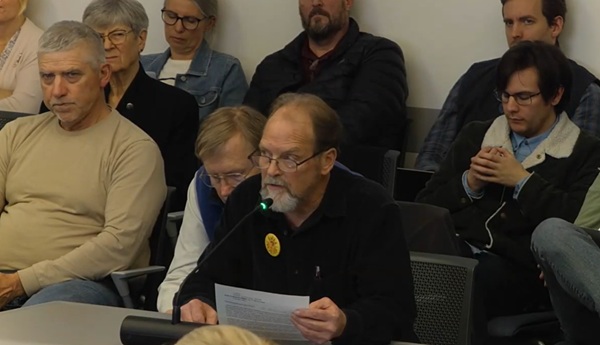
Presenter: Public comments at EWEB Feb. 3 call for an immediate end to a fossil fuel pilot project with the University of Oregon. Andrew Simrin:
Andrew Simrin: My name is Andrew Simrin. I’m coming to you tonight with concern about the pilot with the University of Oregon to spin up a turbine to generate electricity.
I think that EWEB must cancel the pilot immediately. This will increase localized emissions, impacting air quality along the greenway that I frequent when riding my bicycle.
And we know that there are many other ways to bring power into the grid. And we’re concerned about resilience. We can focus on demand response policies with more technology and smart meters. This will easier to roll out and help with that and testing the load as well to when we have more renewable.
EWEB should cancel the pilot immediately. We know that there’s other ways, like things like demand response to shift the load for peak load. And we need to be looking at policies to build out local renewable energy generation, such as geothermal.
We know that we aren’t expecting supply shortages, and especially that we are a Tier 1 BPA customer, we know that they provide mostly clean hydro power that has low carbon intensity. So again, please cancel the pilot. Immediately.
Commissioner John Brown: Next is Emma Bartlett.
Emma Bartlett: Hi, I’m here to urge EWEB to cancel the pilot program with UO utilizing their fossil fuel generator. I moved to Eugene for my dream job, which is working for a wave renewable energy company. And very quickly, you know, my view of good renewable energy equals good fossil fuel equals bad, that became a lot more nuanced.
I definitely have an understanding that we can’t effectively combat the climate crisis and meet the demands of our communities unless we utilize some imperfect solutions. This seems to be the justification posed in the article posted to EWEB’s website about this pilot program.
But, I believe that this statement was misleading and based on the information I’ve seen elsewhere, this is not actually an unfortunate means to a net benefit, but is actually going to set us back years into the future.
I think that from what I’ve seen, the premise of this being necessary for peak demand in the future is dubious, , that the claim that it would displace less efficient and more carbon-intensive natural gas generators, could be true, but I would really think that the community deserves to see a lot more actual numbers there.
And I get that this is appealing to have power available tomorrow. But it opens the door to utilizing this, opening this door will in all likelihood, lock in additional fossil fuels combustion, and give EWEB and UO an easy out on their climate commitments. We need to do the hard thing and set up our community with cleaner options.
Commissioner John Brown: Jack Dodson:
Jack Dodson: I’m also calling to oppose the pilot project at the University of Oregon. It is going to increase local emissions, on the slim chance that it lowers statewide emissions, which, I’m sorry, all of because of the lack of transparency around this from both EWEB and from the University makes me very skeptical about the claims being made.
It would’ve been nice to let ratepayers know more information about this pilot program earlier on and given us a chance to comment then. I’m also worried about like the health impact from increased air pollution, and I think that needs to be prioritizing renewable energy, not falling back on gas. Thank you.
Commissioner John Brown: Isa Eisenberg:
Isa Eisenberg: I’m here to give public comment on behalf of myself as well as some members of the student group Climate Justice League.
I believe that EWEB as a public utility has a unique position to support and collaborate with our community for effective climate solutions and the boiler pilot program with the University of Oregon an example of this.
I believe it should be canceled and additional steps to create transparency and input and collaboration with the community should be implemented. It is causing negative health impacts for our community. And I don’t believe that the reasoning EWEB has put forward for the program is making sense. I think additional research should be done or additional transparency and public input should be had. Thank you.
Gene Enos: My name is Gene Enos. I saw the recent article in Register-Guard regarding the pilot program with the University of Oregon. I’m looking at the future and as per the article is that natural gas generation in the coldest winter months can bolster grid reliability when demand for energy across the region is high.
However, in the same article, EWEB commissioned study reported the entire Pacific Northwest is at risk of energy shortfalls with that risk increasing every year, as per Brian Booth, EWEB, chief energy resource officer. At this time I’m asking EWEB:
- What specific issues has EWEB identified to improve and strengthen the grid reliability?
- Is the contribution of the 530X smart meter program part of this effort?
- Is EWEB considering expansion of gas turbine generation and what future costs and savings can customers expect with an EWEB service area in the Pacific Northwest?
EWEB has a long history of being a reliable partner to Eugene. I hope the board continues to balance the need of system upgrades with the very real and impactful economic pressures facing your customer owners.
Eric Dziura: Hi, my name is Eric Dziura. I’d like to mention the pilot program with regard to the University of Oregon’s power generation system. I think that the idea behind it, motivation for doing a pilot, studying—is correct.
I think we need to take a look at all possible sources of energy, especially for times where there could be, could possibly be rolling blackouts. I understand that it was a response to studies that have been done recently that look at specific weather conditions and so forth that could make electrical energy scarce from the many sources that EWEB has.
And so I think that’s the right thing to do. I think the article in today’s Outlook was misleading. I think it led people to believe that this was going to be a long-term arrangement that was going to rather than something that would be used only occasionally and for short periods of time to help EWEB, and our customers most importantly, weather short-term power averages. And I think that’s a good thing to do. So. Thank you.
Jim Neu: My name is Jim Neu. Regarding the BPA contract, public input and consensus were important to EWEB staff in making their decisions. The community group respond opposed a future local electricity generation that was nuclear, specifically SMRs (small modular reactors) and was dirty methane gas-derived.
Yesterday’s EWEB newsletter stated that U of O and EWEB are considering a joint pilot project where the utility would purchase fossil-fuel derived electricity generated by a U of O large methane gas turbine. This is the first time EWEB has mentioned this and it was not at a commission meeting.
According to U of O Sustainability Director and former EWEB Commissioner Steve Mital, this gas turbine would generate 65% more fossil fuels emissions from one of the largest carbon emitters in the county. Why assemble a public community table and ignore their recommendations? Was this an exercise in checking all the boxes?
This proposed methane gas turbine pilot program does not align with the state of Oregon’s climate reduction goals, nor the goals of the City of Eugene Climate Recovery Ordinance, nor those of EWEB’s own board’s Strategic Direction Policy 15.
With no previous commission meeting discussion, were the commissioners even aware of this pilot project? Being that EWEB is a public utility, the public deserves an opportunity to learn the details and information the commission is reviewing in order to make their decisions.
The shareholders are the customers (and) need to be able to have a public comment and voice their concerns before decisions are made. Let’s keep transparency part of the public utility process. Thank you.
Presenter: Public comments at the EWEB meeting Feb. 3 criticize the lack of transparency and public process, as EWEB explores the use of electricity generated with fossil fuels at the University of Oregon.