Business leaders discuss economic development, next steps
14 min read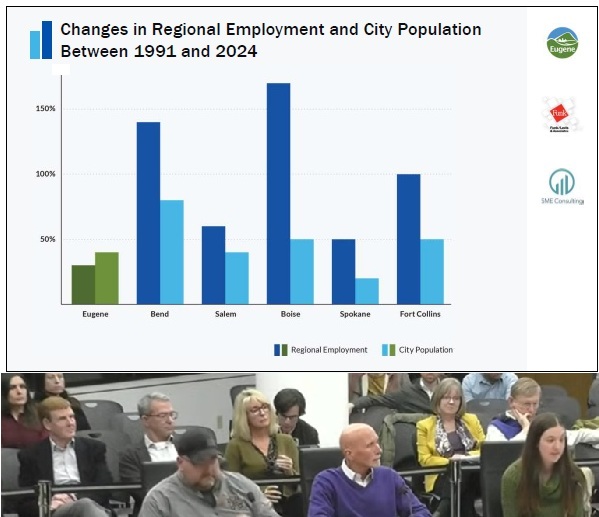
Presenter: Local business leaders say Eugene is at an inflection point, as the Technical Advisory Group (TAG) charts a path for economic development.
In a city council work session Feb. 9, Economic and Fiscal Adviser Sarah Emmans:
Sarah Emmans (TAG economic and fiscal adviser): A former colleague of mine named John Taponga, who was recently named to the Oregon Business Council as their new president—at a business leadership summit last fall, John talked about the threat that Oregon is entering a new era of stagnation.
And I believe this Council was briefed on some of the data points that John talked about in his presentation with data heading in the wrong direction related to homelessness and housing prices, housing starts, K-12 achievement, and so forth. And population growth.
We did a benchmarking exercise where we looked at Eugene in the context of other similarly-sized cities that play similar regional roles to Eugene. All of the other cities had more job growth than population growth. Eugene is the only city in this group whose population grew faster than regional employment. So Eugene is definitely lagging, at least this group of comparable cities in this one data point.
Presenter: Councilor Randy Groves:
Councilor Randy Groves: I am very concerned. I listened to John (Taponga)’s presentation on stagnation at the Chamber earlier this year, and it really rattled me. This is not something to take lightly.
And when I hear some people in our community say, ‘Why are you spending time on economic development?’ Economic development is our pathway out of the position we’re in now.
Presenter: Councilor Mike Clark:
Councilor Mike Clark: The truth is that we’re all either progressing into the future and growing or we’re dying. And it’s time to choose. It’s time to choose that we need to grow together as a community and that we all have a role to play.
I sense for the first time in a long time, an opportunity for alignment amongst an awful lot of people who don’t always agree.
Presenter: Councilor Greg Evans:
Councilor Greg Evans: I want to go back to the ability for young families to be able to afford to live here. My son and daughter-in-law moved back here from spending time in China, working in China for a couple years, and then moving to Hawaii, where her family is from, and understanding that the cost of living was just way over the top for them.
And having a 3-year-old and now a 5-month-old, and then trying to figure out how you’re going to make ends meet in this environment where we have runaway inflation, our incomes are not increasing to the level that’s meeting the cost of groceries, health care, child care, all of these things that are critical to what I call having a successful family.
That’s the sector that we really need to grow is young families that are going to be here buying homes, staying here for the next 30 or 40 years and hopefully retiring in this community. We really need to figure out how do we support that and how do we support them in being successfully engaged in this community, both financially and socially as well.
Presenter: Technical Advisory Group Chair Greg Erwin:
Greg Erwin (TAG member, chair): One of the things that came out of the TAG that was very important was a focus on jobs and better-paying jobs. And so one of the things that we’re going to need to focus on is the ability for this community to create the kind of jobs that will allow the next generation to reside and stay in our community.
So, good jobs is going to be a chief component of the results that we’re hoping to achieve.
Darren Sparks (TAG member): My name is Darren Sparks. I think that there’s a shift in a more welcoming environment around the notion of economic development. I may be wrong, but I think that there’s a lessening of the cynicism that has been around the notion of economic development, as if that’s greed and opportunism, and this is not the case.
It’s a very necessary activity regarding our prosperity, and I think we’re seeing more endorsement of that, more recently from our governor, who has a ‘Prosperity Roadmap.’
So this is something that is necessary for us to go do. So I think the environment’s a little bit more welcoming to the activity and that excites me.
And I would share as a business owner that the best businesses have always recognized that their vitality economically is not the end game. That is what fuels you to pursue your mission, and that’s certainly how it was in my business. There are plenty of businesses that think that way.
I think that city’s the same way. You need the economic vitality to pursue your mission, which is to serve our community. So I think that those things are becoming okay to say and do.
I think we’ll be tapping into our community ethos. This community has a very distinct personality, and sometimes we look at that and say, ‘Well, there’s some things they’ll tolerate and some things they won’t tolerate.’
But I want to flip that around and say, I think that the part of the personality here is: What can they help us promote? I think there’s a lot to be dug into there, along with a SWOT analysis. Say, what can this community help us do by way of pursuing our economic prosperity?
And I would also point to some inspiration we have at this moment in time. I look to our neighbors in the north in Seattle who have a climate innovation hub. That is fascinating, that they are looking at doing good for the world while pursuing prosperity.
That’s what I see us doing next is looking at those two things hand in hand.
And we happen to have our own local circumstance, which has been mentioned already. We have an innovation corridor that wants to promote life sciences. Bringing good to the world, we can prosper with that…
The world changes, environments change. The plan must change with it. But if we’ll do that and invest in that and do all the things I’ve just discussed, I have every reason to believe that we can be prosperous and at the same time, do great things for the community.
Presenter: Sarah Emmans:
Sarah Emmans (TAG economic and fiscal adviser): So the TAG wanted to really to kind of chart an alternative course for Eugene, a target that the TAG created to say, kind of, what would it look like if we bent the curve a little bit with these recommendations? So that during the period that the TAG is considering, what if we grew by 1%…?
Presenter: Anne Marie Levis:
Anne Marie Levis (TAG, facilitator): What we come to with this within 10 years is 14,000 jobs and $25 million in tax revenue, not from 10% higher, which wouldn’t be realistic, but from 1% higher.
And so looking at ways that we can, and you said it so eloquently, ‘Bend that curve a bit’ to be able to grow this.
This is not like turning on the faucet. It’s not like tomorrow you say we’re doing, ‘Okay, now we’re doing economic development. We’re going to grow by 1%,’ and it will happen. It really is starting today and we start to implement.
It’s probably no surprise to any of you that this is where much of the TAG work went in looking at this and where we see we can be useful into the future again, and so there is so much that could be done.
Looking at the importance of a healthy business environment to help the overall community to be able to pay for things that we want, working public-private partners to define clear roles and moving this work forward.
I really want to say that I think we are at an inflection point in this community where we have a lot of people moving in the same direction.
We have members of the Chambers of Commerce, the University, so many people who are looking at: How do we help grow in a way that really serves our community and serves the ways that we want to be with the corridor work.
So much is happening. Nobody on the TAG thinks the city has to do this alone. It really needs to be all of us working together.
But we all do have to work together to do this, and the city is an absolute critical part of that.
Really looking at business retention and expansion: Economic development is not about saying, turning the light on that says we’re open and a large company will come and solve all of our problems.
It really is about retaining and expanding the people who are already here, finding ways to keep them identifying what is needed, should we be able to bring new people. And then looking at ways to really support housing expansion, to support all of that three to five years, looking at what’s needed for infrastructure.
Some of economic development will come with cost, that is a really important thing. Not all costs are equal. Some business expansion doesn’t cost as much.
So looking at things as well as state level reforms that can help us to be more competitive. And then five to 10 years out, really looking at this gross total of $25 million for property tax and payroll tax.
Presenter: Other members of the Technical Advisory Group introduced themselves. Samantha Sorensen:
Samantha Sorensen: I’m Samantha Sorensen. I’m a CPA, but first I’m a mother of two. I have a 5-year-old and a 10-year-old. So the community here is obviously very important to me.
I’m a transplant from Idaho, actually. I moved here to start my career in public accounting, working for Moss Adams in their Tax Advisory Group, supporting a lot of the local businesses that are here and in the surrounding areas.
After my career there, I left and worked for Roseburg Forest Products, which I’m sure a lot of you are familiar with, doing all of their tax compliance that they do. And then I now sit with McDonald Wholesale as their controller. Again, this is a local company, owned locally, that serves a lot of our local restaurants and other wholesale food.
We talked about the expertise that was on the group, but I would just emphasize that it is really incredible the minds that came together and I learned so much from everybody, and it’s just great to have those contacts.
A few things that I really took away from the report and the experience that we had is (1) Going back to zero-based budgeting. So I know that (Chief Financial Officer) Twylla (Miller) is working towards, you know, switching up how we do budgeting and taking a different look at it.
And given my financial background, I really believe in starting back with the basics and building up a budget, versus trying to take it from the top and do cuts. So I’m really excited to see that next process and how that all goes.
The other thing that I’m most excited about is obviously economic development, well, I would like to just call growth because I think that when you hear ‘economic development,’ you just imagine new employers coming in and developing on some empty plots.
But there’s so much more to that. Just as Anne Marie was getting at, there’s growth in our population. If you look at some of the figures that Sarah provided, you can see our population on a whole is aging and we aren’t retaining young families.
I experienced the adversity of moving here, having no support system, having young, young children and a very demanding career, and then going through COVID with a 4-year-old and pregnant with my second, and it was very difficult just finding child support and feeling like you have that support.
So I understand that there’s some struggles that we need to get through in order to experience kind of that growth and decrease our average age. I think we all understand what the impact is on our community as we watch that average age go up. So I’m excited about that.
I’m excited about the overall picture that we can have for the economic development and pulling together kind of: ‘What does Eugene offer? And where can we specialize and really highlight?’
Jeff McGillivray: My name’s Jeff McGillivray. I’m a business agent for UA Local 290 Plumbers and Steamfitters. Also the vice president of the Lane County AFL-CIO chapter. So I’m the labor guy.
The city of Eugene has always been an enthusiastic supporter of union jobs, understanding that it will bring the higher pay, better benefits, will bring the best, and we want the best people working in the city.
We’re all facing the need to be as efficient as possible and look for ways to communicate better about our priorities. Every city in Oregon’s facing difficult decisions and choices right now, costs are rising faster than property tax revenues. And we need to figure out how to come up with solutions.
I know you all have had to make some pretty hard cuts over the last few years and are going to be facing some more in the future. A couple things from my experience on this. I was also part of the Springfield process of doing the same thing last year, and when we did that, we had a report that was made by a third party. (Anne Marie alluded to that earlier.)
And it was really helpful for us to be able to see that, where it showed where they were efficient, where they’re lean and mean, where they weren’t, and everything. It not only helped us for making those decisions on what to cut, the payroll tax that they’re proposing, it also gave buy-in for your taxpayers for the citizens, ’cause they saw that you’d already, you know, went out and seeked outside help to find this out. So, I would definitely recommend that—it will be definitely in this—recommending that.
We’re also recommending you do that before any revenue measures. That way it gets the buy in for everybody.
My union is in support of growth. We understand more jobs, more building is good for us and good for the tax base. We also know that new tax revenue will pay for things that make this community so livable.
I’ve lived in Eugene for all 52 years of my life. From the age of when I was paying attention, which would’ve probably been in my 20s, Eugene’s kind of taken a reactive approach of recruiting and retaining businesses, and I really feel that moving forward we need to be proactive in that and in recruiting and retaining good family-wage-paying businesses to the area that fit Eugene.
There’s a lot of groups that are going to be at the table with this, working out the solutions for Eugene’s problems. We can get it all, what we need, without anybody going without. I believe we could find responsible solutions to Eugene’s budget, employment, and housing issues without losing the uniqueness that is Eugene.
Presenter: Councilor Lyndsie Leech:
Councilor Lyndsie Leech: I think the thing I like the most is kind of this through line through the report, that it’s not just about cutting or about implementing new revenue, which often, that’s kind of our choice, right, that we’re given, like: Which direction do we take, and how and why? And communicating that to the public.
But the through line I saw really, was, ‘How do we intentionally shape our future together?’ And I think that’s really beautiful.
And how do we do that before structural forces, which are immense right now, how do we do that before those forces choose for us? If we can get ahead of that, and really be mindful, intentional, and collaborating and partnering with the amazing people and organizations and businesses and universities and entities in this community—we are all Eugene. And that’s what makes Eugene amazing and why we all want to live here.
Presenter: Councilor Alan Zelenka:
Councilor Alan Zelenka: I very much appreciate the call for the economic development that’s in the report.
Every so often there’s a call for more focus on economic development. I’ve been doing this, I think this is the third time this has come around in my tenure, that we refocus on economic development, and it’s super important for a whole bunch of reasons. well-paying jobs, quality of life, economic growth, sense of contribution and well-being for our citizens.
And I support the establishment of a group to focus on economic development, but it itself is not going to be a very effective budget balancing strategy, especially in the short run. It will definitely help in the long run for our $10 million gap.
For $25 million in new revenue, I think (if I used your numbers right) you need about $6 billion of commercial, industrial, investment, new investment in our community. That’s not going to happen quickly. That’s a long-term strategy.
Presenter: Mayor Kaarin Knudson:
Mayor Kaarin Knudson: I want to begin by saying that, you know, we all have heard that adage about the way that opportunity can come from crisis.
With the work that we’ve done in our community over the past year, the opportunities that we are finding are a result of a willingness of a lot of people to step forward courageously. And we see real benefit and value from that work that is now available to our whole community and to this body as this Council moves forward in a lot of different conversations.
It’s when we have the information that we need and people willing to come together around difficult challenges, we find paths forward and, almost always, those moments feel a lot like this conversation felt to me tonight, which is like leadership in community.
I think that there are many good things that will come from it, and that will come from the continued dedication and trust and partnership that are a part of this process. It’s been really an extraordinary thing to see us circle around and then bring forward in this past year.
Presenter: Greg Erwin:
Greg Erwin: For the better part of the last year and a half, we’ve been talking about bringing people together in our community around the idea of economic development, for lack of a better phraseology, prosperity, whatever you want to call it.
We know there’s financial challenges throughout our state, throughout our city, throughout all the communities, and the idea that we can solve problems if we get together and we talk.
And what happened with TAG in terms of honest dialogue, a transparency, good faith, the more we do of that throughout the community, whether it’s with Council, whether it’s with the University, whether it’s with the business community, all the different stakeholders in our community—
We have a moment, I believe, and a number of you have heard me say this before, that we’re in a moment. It won’t last forever. We have to have people engaged and we have lots of people who are engaged right now and anxious to be more engaged. So if we don’t take advantage of this moment, we’ll miss it.
So again, I just want to reiterate how important it is for all of us to continue to support this coming together and talking and solving problems together as opposed to coming at it separately.
Presenter: An advisory group analyst says Eugene ranks last in job creation among similar regional centers, as business leaders deliver their report on how to turn that around.