City whiffs on new contract for CAHOOTS-like services
6 min read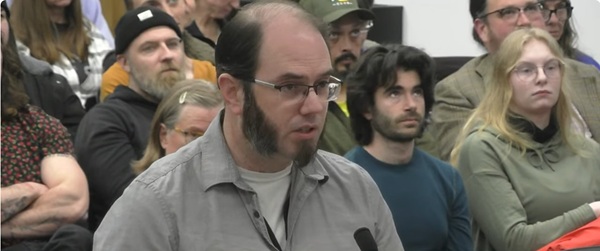
Presenter: Public comments at the City Council say public safety officials whiffed on a proposal to restore a CAHOOTS-like service. Feb. 9, Athena Aguiar:
Athena Aguiar: My name’s Athena Aguiar. When we were asking previously for a RFP for a CAHOOTS-like crisis response service, this is not what we meant.
What we meant was a service which is accessible by calling 911, responds to crises in all of Eugene, including downtown, and is in operation 24/7. I want to feel like there’s someone I can call if I’m in a crisis, and that someone will show up and help.
That’s why I got involved in all this in the first place, back in the beginning of last year, when I was coming to get policy changed at Police Commission. An adequate crisis response service is a necessary core service, and this RFP is not that. Thank you.
Presenter: Robert Parrish:
Robert Parrish: My name is Robert Parrish (Ward 7), and I’m coming to speak as a community member with 21 years of experience as a community responder in Eugene about the problems with the recently released RFP.
I was hoping that the RFP would be a path to resume the work I’ve been eager to return to, the work that your own gaps analysis identified as an unmet need.
But this RFP is a swing and a miss. The community, myself included, is asking for an alternative response that addresses the mid-acuity calls, like welfare checks, public assists, some medical events, medical evals, wound care, and basic needs that your gaps analysis identified as underserved.
Peer navigators as case managers—disconnected from non-emergency dispatch—is no replacement for the service Eugene lost last April when White Bird stopped running CAHOOTS in Eugene.
Less than 7% of the RFPs requirements have anything to do with the work of a community responder service like the one Eugene had for 36 years.
If the city needs peer navigators, that needs to be a separate process, decoupled from the efforts to return alternative response to Eugene.
I ask that this RFP be amended or changed or reissued, or however that needs to happen, to actually align with the service Eugene lost after more than three decades because that’s what people were actually asking for, because such a program provides utility and care and safety to the community, because it makes our community stronger when dispatch can offer police, fire, EMS, or alternative response.
And it cannot be overstated in the current moment how valuable community care and safety is, when masked federal agents take people without warrants and attempts to enact mass surveillance are again being pushed in our community.
For all these reasons and more, please change this RFP to something better aligned with returning the community responder service the city finds itself without after 36 years.
Presenter: Dr. Nadia Raza:
Dr. Nadia Raza: I’m a professor, a parent, and a longtime Eugene resident. My work both in and outside of the classroom intersects and focuses on public safety alternatives to incarceration and reentry support.
It’s from that perspective that I’m here to express my concern and disappointment about the city’s RFP for peer navigation and alternative response.
I’m asking the council to revise and review this RFP to address the mid-acuity response gap clearly identified in the city’s own gaps analysis following the closure of CAHOOTS.
In the report shared in October, Fire Chief Mike Caven notes that since April, crisis response has shifted to a patchwork system that has left significant needs unmet, including crisis counseling, welfare checks, support for intoxicated persons, non-emergency medical transport.
These are not marginal calls, and I think sometimes we generalize what a welfare check is. It is the most essential form of safety net that we could ask for. These calls were the core of CAHOOTS’s work, yet the RFP does not meaningfully address these mid-acuity needs at all. And it begs the question: Who is this RFP for? Like Robert just said, it’s a swing and a miss.
This RFP narrowly focuses on homeless outreach in a limited geographic area of downtown and the Whitaker corridor. This is not an alternative response. It’s a partial one, and if left unrevised, this model will further overburden police, fire, EMS, and emergency rooms. This impact cannot be underscored enough.
We also know, acknowledged by the EPD, that community crisis response prevents calls to EMS and reduces incidents altogether. That kind of prevention is harder to quantify, but its absence is felt everywhere at this moment when every—nearly every single social safety net imaginable is eroding.
Why are we piloting something new when we have a 36-year nationally recognized roadmap of what works? We need an RFP that includes true community crisis response, and I urge you, council members and leaders, to advocate for the return of these vital services.
As Councilor Yeh mentioned earlier, proximity is part of what you do best. So please review and revise this RFP.
Presenter: Jacob Trewe:
Jacob Trewe: Hello there. My name is Jacob Trewe, and I’m here to talk about safety as most other folks have as well. Here to talk specifically about community alternative response.
Since White Bird’s withdrawal at the end of the CAHOOTS service last April, we’ve been without a community alternative response. Over nine months. Over 270 days where if you see someone in crisis and you would like to call 911 and get a compassionate community alternative response.
You can’t do that in Eugene. You can do it in Springfield, but you can’t do it in Eugene.
Y’all received a report from TAG today. That’s the Technical Advisory Group on Fiscal Stability. Among improving efficiency and effectiveness, raising revenue, increasing growth in cutting services, some easy low-hanging fruit to save money here in Eugene is to bring back alternative community response.
Simply put: For moderate-severity calls for service, a community alternative response (like we once had with CAHOOTS) saves loads of money over Police or Fire response.
Just a week or so ago, the city of Eugene issued an RFP, which is a Request For Proposal for a peer navigation alternative response, and based on the language there, we still won’t be able to call 911 and get compassionate community alternative response.
Who can call these peer navigators? On page 13, Part 5, Section 4(a) and 4(c), they specify that as who can, you know, call those folks are Fire, EPD and partners. And those partners are defined in 4(c) as city staff and private security.
That’s not being able to pick up the phone and call community response.
We need confirmation that what the city wants is a service that uses the vans that have been sitting unused since last April; that covers the entire city, not just a few areas; that includes a plan to get to full coverage, not just 10 to 12 hours a day; and includes trained medics that are ready and skilled to respond to mid-acuity cases, such as basic medic needs, welfare checks, and crisis counseling.
Now I know that the City Council can’t act on that directly. You know, the RFP is put out by city manager, so I would like to ask the city manager to modify the RFP, review and revise so we can actually get community alternative response back in our community here at Eugene.
Presenter: Public comments say a recently-released Request for Proposal suggests the city is not going to be restoring the CAHOOTS service in Eugene.