Lane County reviews its priorities for the legislative short session
9 min read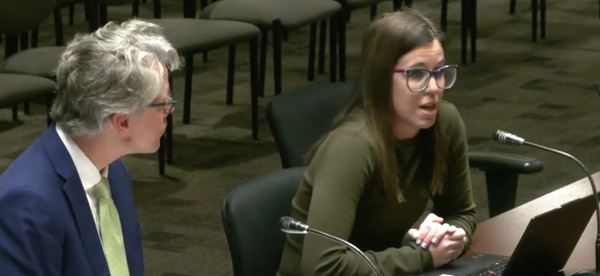
Presenter: Just before the start of the short legislative session, Lane County commissioners agreed on their game plan. Intergovernmental Affairs Manager Vanessa Cornwall:
Vanessa Cornwall: For the record, Vanessa Cornwall here to talk about some of the things that we can expect for the short session.
Lawmakers will concentrate on several key priorities, including unfinished business from the previous session, and (namely) rebalancing the state budget to address shortfalls caused by federal changes in HR 1.
In addition, the legislature will begin advancing Governor Kotek’s Prosperity Roadmap and the work of the Prosperity Council, chaired by former Sen. Tim Knopp, which aims to expand economic development opportunities and drive economic growth.
Transportation funding will also be a major focus, particularly issues with the revenue-raising portions of the previously-passed transportation bill. That was a highlight of the special session late last year. ODOT is facing some substantial cost challenges. So the legislators must identify solutions to fund operations, maintenance, and respond to potential impacts from severe weather.
From what I understand, the current plan revolves around introducing legislation to move the transportation funding referendum to the May ballot, while continuing negotiations until a funding agreement is reached.
And in preparation for this session, our legislative committee reviewed and refined the legislative priorities and principles, approved some priorities to push in the 2026 session, including expanded TLT use and flexibility, battery producer responsibility, and budget defense.
And of course along with that, we will work closely with our partners to ensure that the county’s ability to deliver essential services, including public safety, housing, and emergency shelter, is not in danger.
We also discussed a particular piece of legislation that our esteemed county counsel worked on and flagged, which is the cannabis omnibus, which will be introduced by Rep. (Kim) Wallen. I will defer to Mr. Bovett to continue that conversation and discuss potential next steps.
Rob Bovett (Lane County, counsel): Thank you for the opportunity. So the cannabis omnibus has 12 components; 11 of them are basically nonmonetary. This is keeping our cannabis programs functional.
One of the 12 actually goes back to 2018 where we had an agreement with legislators of the joint cannabis committee to make sure that we took off the top of cannabis tax revenue sufficient funds to provide for law enforcement and victim services for going after essentially the cartel grows that were plaguing at that time Southwest Oregon primarily, but now they plague us and a few others.
So the proposal right now is to have the, I don’t want to call it the skim (but that’s what it is), off the top fully fund the IMMEGP (Illegal Marijuana Market Enforcement Grant Program), that grant program, which funds three sheriff’s deputies here in Lane County.
There’s a tension there. Because anything you take off the top affects further distributees, in this case, the Byrne funding.
Presenter: That is the Edward Byrne Memorial Justice Assistance Grant, which supports state and local efforts to combat illegal marijuana cultivation, distribution, and associated criminal activities. Lane County Counsel Rob Bovett:
Rob Bovett (Lane County, counsel): And so the proposed legislation also would move all intoxicating hemp products behind the counter at OLCC stores and subject that to 17% sales tax. So the question is: What is the impact? What is the real impact? And we won’t know that until it occurs.
If you’d prefer that we prioritize the Byrne funding and not impact that at all, I will take your marching orders. That would probably mean we would lose the IMMEGP statewide, which would be of concern to me. But I understand the importance of Byrne funding as well.
Generally, Byrne funding is raising about $180 million per biennium. This would impact it by about 10%. And again, it’s going back to the deal struck in 2018, but I’m subject to your marching orders. So, that’s one issue.
There’s another bill we have on the Senate side that would essentially give counties more control over the Byrne money itself, which is legislation we’ve proposed twice now.
Instead, the legislature essentially took away the direct authority of the oversight committee created by Measure 110, and kept that authority within OHA.
However, we haven’t seen a whole lot of local control, and my goal, of course, is local control, because, to quote a famous county judge from many years ago: ‘If you’ve seen one Oregon county, you’ve seen one Oregon county.’
And, of course resources and needs vary from county to county. And, to be honest, I trust this board more with how to spend Byrne money than a board sitting in Salem that doesn’t really know Lane County. So that will be a bipartisan bill introduced in the Senate.
The cannabis omnibus will be a bipartisan bill introduced in the House. It’s going to economic development, so I’m subject to your direction on either of those really, but those are the only two bills I have any involvement with this session. I’m trying to, quite frankly, walk away from all my legislative obligations and mostly successful, but not quite there yet.
Presenter: One commissioner asked about super siting, referring to legislative actions to bypass land use regulations. Last year, commissioners testified both for and against an unsuccessful effort to allow the CleanLane project on a parcel in Goshen. Super siting was also used to allow a behavioral health center in Springfield. Commissioner David Loveall:
Commissioner David Loveall: I also want to come back to the board direction and that stemmed from some not necessarily legislative priorities that we already had established, but ones that we moved within the moment to do that just seemed to be not communicated.
So my question is, if we decide to do something, for example, super site or do something of that nature, how is that information going to get to the board in a timely fashion instead of just to the two board members that are on the legislative committee?
Presenter: Commissioner Laurie Trieger:
Commissioner Laurie Trieger: We were reminded at the last legislative committee, in fact, that this whole concept of having a principles and priorities document was exactly to make our lobbying team more effective, to give them the nimbleness they needed and know they were operating within board direction.
And it was a request made and originally established by our previous Leg(islative) Affairs Director Alex Cuyler because he knew there were opportunities we were leaving on the table because he didn’t have enough guidance.
So it was an attempt to be not so prescriptive that we missed opportunity, but not so broad that he didn’t feel confident he was operating under the direction of the Board. And this is especially important in the short session because as quickly as things move in a regular session, they move even more quickly in the short session.
So I really have appreciated since I joined this Board and this whole method of managing our legislative work by having this overarching principles and priorities document. It helps all of us, I think. It helps department directors and it certainly helps our lobbyists to know we’re sort of on the right track.
But ultimately what this is is legislative advocacy, which means it ends up in the hands of legislators and legislators actually get to decide what kinds of amendments get made, which bills move out of committees, and which don’t. Commissioners don’t decide that. We’re just there to advocate for these guiding principles and priorities.
Presenter: Commissioner Pat Farr:
Commissioner Pat Farr: What has been frustrating to me: I served in the legislature. I was a Republican. We had a 35-25 majority in the House at the time. And communication goes on party lines. It does, and there’s not much avoiding that.
So if you happen to be in a county that has all Democrats in there, the Democrats tend to give their information to people who they feel are in partisanship with them. It’s hard to get around that.
And until we have a nonpartisan legislature, that’s the way it’s going to be, which makes it more difficult for you to present the information on an even-handed level, you know, the opinions of Republicans and Democrats, even though at any one time one has the edge in the legislature, both opinions have got to be forwarded and both of the efforts need to be moved forward so that we as a nonpartisan board of county commissioners, which we are, nonpartisan.
We’re a nonpartisan board of county commissioners. We get an even representation from Democrat, Republican and any other party that may happen to be represented up there, which is rare that it would be any other party. Bob Jensen may have been the last one, and that was a long time ago. And he was Republican and Democrat and unaffiliated.
So that being said, it makes your job more difficult to get all of the information that each one of us on the Board of Commissioners would like to hear. If we happen to have a close relationship with a legislator, for whatever reason it may be, we’re going to get a lot of information from that legislator, and there’s no getting around that.
If a senator happens to be a neighbor of mine, then I may hear from that senator fairly regularly. If a state representative happens to be a neighbor of yours, then conversely, that may be the information. But that makes your job more difficult in making sure that all of the information is passed along.
And I’m here to say that I’ve never seen it been brought forward at as high a level as I see it today. And Vanessa, the work you’ve done, that represents a lot of work. And I believe that you’ve been responsive to things that you’ve heard from this board in redesigning, rewriting this legislative prior principles document.
So that said, I’m beyond satisfied with the work that you did in the legislature. I love it. I think you call on us when you need help from the nonpartisan Board of County Commissioners.
When I was there, we didn’t have short sessions. We had special sessions instead. I like the current process that’s being used, having a short session because it takes the pressure off the regular session. In 2003, we sine die‘d in August. They don’t do that anymore, do they?
So again, it is a moving target and you do a better job than I’ve seen happen at Lane County and probably in any other county on hitting that moving target. So thank you.
Presenter: Commissioner Ryan Ceniga:
Commissioner Ryan Ceniga: Commissioner Farr, you brought up some good points and I suppose that’s why I don’t hear much from our state legislators. Being unaffiliated, nobody wants to talk to me.
I’m joking, but, you know, having those relationships is huge because I’ve really worked hard to bring our coastal area in and worked with Vanessa’s buddy (Rep.) Boomer Wright. And you know, we got some great things done with Mapleton and those kind of things and we’ve just built that kind of relationship, so that’s very, very helpful. And, because he is retiring, we will have to start over again, but we can do that.
I know we move fast at the state legislative level and you have to, but it is frustrating when you hear about a direction we headed from somebody else other than staff, after things have been done.
So if we could do anything, it would just be improve that communication when—hey, we are going off our legislative priorities, which is great, I agree, there’s been a bunch of good work done there—but just a quick, ‘Hey, this is what’s going on, like it or not.’
You know, ’cause you don’t like to hear things from other people and I think that’s kind of where some of the angst is from.
Presenter: Lane County commissioners agree on broad legislative priorities, giving staff the flexibility to move quickly during the fast-paced short session.