Oregon campaign finance bill called ‘a complete betrayal’
9 min read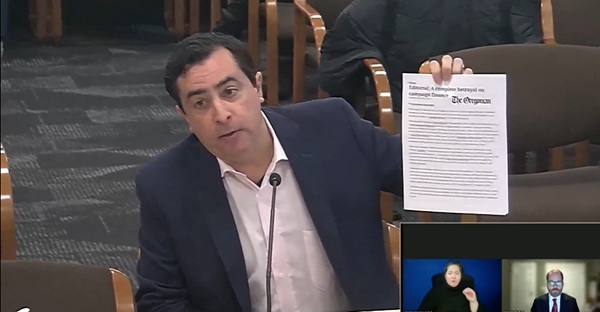
Presenter: In a Sunday editorial, the Oregonian quotes the League of Women Voters calling it ‘a complete betrayal,’ while one long-time senator calls it ‘appalling.’ At the Senate Committee on Rules Feb. 23, Jason Kafoury:
Jason Kafoury (Honest Elections Oregon): I’m an organizer with Honest Elections Oregon. I hope everybody had an opportunity to read the Sunday editorial in the Oregonian, ‘A complete betrayal on campaign finance reform.’
I dedicate my free time in life to this one political issue, trying to limit the domination of big money in politics, because I think it is the most important issue that defines all of the problems across legislative conditions that we have day to day.
Here in Oregon, we are one of five states with no limits at all on political contributions. And I want to give you a little bit of the backstory of how we got here today from where we were two years ago when we passed (HB) 4024.
When you work on housing policy in this building, you know who’s at the table? Experts on housing policy. When you work on land use, you work with land use experts. When you work on environmental issues, you work with experts on environmental policy.
Why in the world would the legislature draft up a bill that changes 40% of what we agreed to in 2024? Forty percent has been altered or changed with zero input from good-government groups.
This is one of those few issues—campaign finance reform—where Democrats, Republicans, and independents overwhelmingly support this issue. When we look at the voters in Multnomah County and in the city of Portland, we had campaign finance reform passed in 2016 and 2018 with 89(%) and 87.4%. When was the last time you saw a yes vote on anything with 89% ‘Yes’?
Here in the state of Oregon, almost 75% of the people amended our constitution in 2020 to say, ‘Yes, we do want to have contribution limits and we do want to have transparency.’
In 2024, a group of good-government coalition advocates put together a ballot measure. We were tired of the legislature not actually implementing real campaign finance reform. We went and collected 100,000 signatures. We were on the way to the ballot. And guess what happened? The legislature did a historic thing.
Speaker (Julie) Fahey, Scott Moore at her office brought together business groups, brought together labor, brought together both the spenders, the people that worked, the boots-on-the-ground folks, and they brought the campaign finance reform advocates.
And you know what we did in a matter of weeks? We passed, for the first time in 150 years, a historic achievement for the state of Oregon: real contribution limits and real transparency.
Now, those limits are supposed to go into place next year, 2027. The transparency is supposed to start in 2028. We still have two more years to get the transparency right.
So. What happened since 2024? There were work groups put together. I worked tirelessly with Speaker (Julie) Fahey’s office, with Scott Moore.
We had an agreement for a year and a half, and it was a very simple agreement. We’re not going to change the policy of 2024 unless we have group buy-in with everybody on board. That was the deal.
We can talk about technical fixes and we spent a year and a half working through trying to get to technical fixes. Then what happened?
For the last eight months, since the end of the last session: complete radio silence. I haven’t had one phone call or conversation with Scott Moore or Fahey’s office, but you know who I was talking with, the secretary of state’s office.
And do you know what was happening behind the scenes that I learned about two weeks ago at 5:23 p.m.? A massive rewrite, massive rewrite, 40% all-new stuff was put into a bill that I had worked really hard two years ago with all of you to pass. And what does that say?
Do you know who was at that table that was working to write that up? The big spenders were there. Our Oregon folks, the labor unions, the business community, they all were in the room drafting up these edits to (HB) 4018.
Now there are massive policy changes in this, and this is not something that we should rush through in this short session.
Do you know how much public debate has happened so far on this topic? There was an 83-page document posted at 5:23 p.m. two Tuesdays ago for an 8 a.m. hearing. We had one person, Dan Meek, who was able to make that to actually provide testimony.
Two days later, they had another hearing where they only took three people that were opposed that were sitting here. I was prepared to testify remotely. They didn’t take any remote testimony. That’s been the extent of the entire debate that we’ve had on this topic in the legislature.
Well, let’s talk about some of the big substantive policies that this does.
It says that if you create multiple entities, and as long as it’s not the ‘sole purpose’ of the entities, you can effectively eliminate all the contribution limits by giving unlimited money and evading the contribution limits. There’s no reason to have that phrase ‘sole purpose’ in there, zero, unless you were writing it to avoid the contribution limits and the disclosures.
Two: They took out the definition of ‘coordinated expenditure’ from the definition of contribution. Again, small word changes. What does that actually do in real life?
So I’m Chevron. Before, under (HB) 4024, I’m banned from directly coordinating with a campaign. I can’t say, ‘Here, would you like a million-dollar ad? And what if I change it to say this, to attack your opponent? What if I do this?’ That was all banned. Now they’ve taken out that definition of coordinated expenditure. I don’t think it’s banned anymore.
I think we have created, if this passes, we have created a third type of massive money: (1) independent expenditure, (2) direct contribution to a candidate, and suddenly (3) unlimited coordinated expenditures with candidates. That’s scary. That’s really scary.
And I will just leave you with this. I ran into one of your colleagues who’s a multi-decade senator, and what they told me was, this process that you guys are doing right now at the legislature on campaign finance reform is appalling.
It’s a big word. It really is appalling to have a gut-and-stuff with only big spenders at the table, and no campaign finance reform advocates is not the way our democracy should work. And I really hope we can get this right and not do this big huge gut-and-stuff bill.
And I will just say that, you know, we’re going to have to go back to the ballot if we can’t work together collaboratively to keep this campaign finance reform, but this time we’d have to do it as a constitutional amendment.
Presenter: Senator Jeff Golden.
Sen. Jeff Golden: Mr. Kafoury, you mentioned a little bit of the history the last few years, including the ballot measure that you and other good government groups put together. I think you said you had gathered a hundred thousand petitions, and I think it was not unlike the measures that you successfully passed in Multnomah County in Portland.
You agreed as a group to drop that initiative petition when (HB) 4024 was being crafted. What was your understanding of that agreement that that led you to drop IP 9?
Jason Kafoury (Honest Elections Oregon): Our understanding, at the time, working with Speaker Fahey and Scott Moore, was that if we dropped our ballot measure, which we had already spent four or $500,000 gathering those signatures, that in return for dropping that, 4024 would only have technical fixes, that we would collaboratively have a working group that we established and we did that for a year and a half.
The problem has been whoever was working behind the scenes over the last six months to draft this current (HB) 4018, completely shut us out of the process and you know, sometimes there’s good rationales for why changes happen.
The problem is, right now, I don’t know who wants these changes. I don’t know who drafted the changes. I don’t know if there’s unintended consequences. I mean, literally this has been dropped on us and we’ve been having national experts look at this stuff. We’ve been given a week and a half to look through this and try to come up with comments.
This is not the way democracy should work. This is a complex thing that should be worked at, at a regular long session. Not in, in, in a rapid short session fashion like this,
Sen. Jeff Golden: But it was explicit that were there to be further changes after 4024, if that were to be changed, that the good-government groups would be informed and involved in those discussions?
Jason Kafoury (Honest Elections Oregon): Absolutely. Yeah. I would never have agreed, nor would all of our coalition have agreed to drop our 100,000 signatures unless we thought 4024 was going to actually move forward and become law.
Sen. Jeff Golden: And what are the major groups that comprise what we call the good-government groups?
Jason Kafoury (Honest Elections Oregon): So we’ve got the League of Women Voters. There’s Honest Elections, Portland Forward, Common Cause, COIN (Consolidated Oregon) Indivisible Network. There’s a series of like smaller groups, you know, but those are the main five.
Sen. Jeff Golden: I think in my view, this is right at the top of the list, the most important things we’re dealing with this session.
I’m going to lie with the camp that says that this is an appalling process and rather than go on and on, I would invite people to read the editorial yesterday in the Oregonian.
So I’m really hoping that nobody on this dais would vote for a bill in its current form. I will be voting against the bill if it comes to the floor in any form, and I want to tell you why. I wonder if anyone else listening to all this has the sinking feeling that we’re on the wrong track with this bill with 4024, the original bill and the problems that it is causing in cost and lack of clarity are inevitable, and that we do not have to go in this direction.
I voted against 4024 because I saw it as kind of a Frankenstein monster of different pieces that were negotiated in 72 hours, maybe a little bit more than that, because of the threat of the initiative petition that would’ve taken power and the influence of money out of the hands of those who have it currently, and in my view, given it to the people. I was a supporter of that initiative.
And finally, after three years of inaction, these groups that normally are adversaries in the legislative process came together and threw this thing together and they gave us (best I could tell, I follow this issue a lot, and I don’t 100% understand 4024), but it gave us a complete outlier to what happens in other states.
The in-kind staffing is incredibly complex and will give rise in my view—even if we fix this and get it on track now—will give rise to, and into the decades in the future, litigation about what a legal in-kind staffing contribution is and isn’t. No other state does that. They’re smarter than that.
And, Mr. Chair, my strong conviction is that if we ‘put this thing back on track’ this session, we are facing implementation costs. We heard today $25 million requests now and very possibly more later.
These other states—I have four here, Washington, Idaho, Maine, Colorado; there are others—their implementation, I don’t have numbers, but was a small fraction of that because they didn’t try to invent these entirely new things that would get everybody to ‘Yes’ around the table who are already major donors.
I really think the best course here is going to be for us to maybe do whatever we need to do to implement the limits, but to have this body look at some of the other states here.
As I say, there are four (I can share this), and what they have in common is modest levels of contribution from individuals, corporations and unions and PACs have the same limit as individuals. In a couple places, they’re banned altogether.
I think we’re on the wrong track. I think we ought to join many, many other states who’ve implemented their system successfully. They’re probably not perfect, but we don’t hear these kinds of problems. I don’t know why we would want to go and be the kind of outlier that this bill pushes us in the direction.
Presenter: Monday morning, Sen. Golden urges colleagues to vote against an attempt to gut Oregon’s campaign finance laws.