Human Rights Commission asks to be included in city events related to human rights
9 min read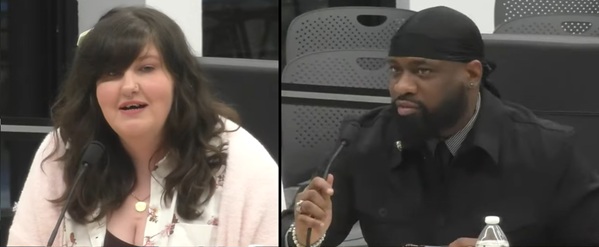
Presenter: The Eugene Human Rights Commission briefed the City Council Feb. 23 on recent accomplishments and future goals. The session began with a statement on human rights and Black History Month by HRC Chair Dr. Silky Booker:
Dr. Silky Booker (Eugene Human Rights Commission, chair): The Black experience with trauma and systematic oppression continues to shape how safety, trust, and belonging are understood in our community. Black residents are often asked to place trust in institutions that reflect the same systems that historically cause harm. When hesitation or caution is expressed, it is frequently misunderstood rather than recognized as a rational response, grounded in lived experience.
Too often the cumulative impact of generations of exclusion and inequity is minimized and overlooked. For those living on the margins, this creates a difficult reality. We are asked to move forward without clear evidence that the systems affecting our lives have fundamentally changed.
These are not visible wounds, but they are real. They influence how communities engage with government and public process. As Eugene continues to address issues of equity, we must ask whether our efforts are producing measurable change or simply maintaining familiar approaches that create the appearance of progress.
Representation alone is not transformation, especially when leadership and decision-making remains closely tied to existing power structures.
It is important to distinguish between symbolic recognition and meaningful repair. Restoration requires intentional action that addresses harm and creates opportunity. It does not place the burden of reconciliation on those who have been historically harmed.
Change does not begin with statements alone. It begins with decisions—decisions about standards, accountability, and what this city is willing to confront. The question before us is whether Eugene is prepared to move beyond performative comments and take concrete steps to address anti-Black outcomes.
Unity within our communities is essential. The unity must allow room for imperfection, growth, and support. No one has all the answers and progress requires collaboration rooted in respect and shared responsibility. I’m committed to being part of the change and I encourage others to do the same.
Civic engagement is active participation, whether addressing racism, sexism, ageism, classism, or other inequities. Progress happens when people invest their time and leadership into solutions.
Human rights must be protected for everyone, everywhere, every day. However, Eugene must also confront a longstanding pattern honoring Black contributions symbolically without sustained economic investment. Black history and legacy are often recognized through names and stories, while Black residents continue to face barriers to land ownership, resources, and wealth-building.
True recognition must include tangible outcomes. Representation without compensation is insufficient. Recognition without reinvestment is incomplete.
As we honor leaders such as Dr. (Edwin) Coleman, Ms. Charmaine Coleman, the first recognized Black families of Eugene and community members like Wiley Griffon, Henderson Stone, Mabel Byrd, Maxine Maxwell, and many others, we must ask how their legacies are reflected in today’s policies, budgets, and development priorities.
History should not only be remembered, it should inform action. Legacy should not only be acknowledged, it should be invested in. Thank you.
Presenter: At the end of the HRC presentation, which included a list of its accomplishments, a question from Eugene City Councilor Jennifer Yeh:
Councilor Jennifer Yeh: I wanted to get your guys’ opinion. Oftentimes, I mean, I know you guys set a work plan like other commissions, and they’re often thinking well ahead of when you get to a subject, but sometimes things come up at our table, it feels, a little last-minute.
I’m wondering if you think there is a way we could better be able to have input from the Human Rights Commission on those things that come up and they’re not something where you have two or three months to, you know, respond, right, but it’s a little more like maybe in the next month or two.
‘Cause it feels like there are opportunities where we could have used good advice from the HRC, but it just wasn’t—there wasn’t a system in place to be able to make that reasonable.
Presenter: HRC Chair Dr. Silky Booker:
Dr. Silky Booker (Eugene Human Rights Commission, chair): I agree with you on that and I’m open to suggestions of a better way to communicate with City Council.
We do have a liaison, but not always is our liaison able to be there, just for scheduling conflicts. But that is one thing that’s in place.
Another thing was just having more of a open dialogue with HRC. One of the things I remember from interviewing the new city manager is, she stated she wanted to be more interactive with the commissions, and I think that’s needed.
Having a relationship with city councilors, city managers, and not just being looked upon as an advisory council—I think HRC’s voice and presence is needed in a lot of issues presented to City Council. It’s just, we’re always looked upon as an advisory commission. That hinders, I think, our input and our participation and a lot of things that should require us to show up.
For instance, when the mayor had the press conference, a couple weeks ago and was declaring human rights as a national emergency for the city, Human Rights wasn’t invited to that or notified of that press conference.
I saw NAACP there, saw Sen. (James) Manning there, saw I think a few commissioners, other people, I wasn’t even aware who they were, but that alone would’ve shown Human Rights (Commission) presence to stand with the mayor and, you know, have that presence shown.
So a lot of times I think we’re just not included or looked upon to have a voice in things that should require our voice and our presence. So I’m open to creating a more direct pathway for HRC to be involved in things that we should be involved in.
And especially like given the fact of what happened with the Federal Building downtown, unless we speak on it in our meetings, we’re not involved, you know, and we, I see videos all the time online, people, you know, ‘Where’s the Human Rights? Where’s this, where’s that?’
Well, we’re here. It’s just, I think the community at large doesn’t understand how to interact with us or what we’re utilized for, or anything that we are involved in is very detached from the community.
So we would love support from City Council in promoting us more, making sure that the websites and different things that require promotion mention Human Rights along any issues that pertain to human rights, which is pretty much everything, right? (Right.)
So yeah, just, I’m open to suggestions on how to build that relationship, not only with the community, but with the city councilors as well. I think it’s needed. I would show up, you know, as chair. I think that’s part of my duty is to show up and have these conversations and dialogue.
I’m just, I would like to be invited. I think that’s the biggest part is being invited to the table. But, yeah, I hope that answers your question, but, yeah, I’m open to any suggestions that would allow Human Rights to have more of a voice, a presence and relationship with City Council and the community at large.
Presenter: Human Rights Commission Vice Chair Jamie Bowman:
Jamie Bowman (HRC, vice chair): In our last meeting we established a subcommittee to respond to the needs of immigrant families and how we could go about that more expeditiously, instead of waiting for our monthly meetings. There’s only so much we can cover in the hour and a half that we meet.
And I’m wondering if something like that is an option. If there’s a subcommittee of us that says, this thing is coming up and here’s some representation, and we can assemble at a moment’s notice and give advice or hear.
And yeah, really move the commission past kind of the box-checking point that it feels like it is in now, where we’re more reactive than proactive and start building more community, like Dr. Booker said, and being a presence that’s out there, that people know that we are a resource and we can be utilized.
So being responsive to what our community needs from us, more than sticking to this like white supremacist ideal of, ‘Well, I have an agenda and I’m going to stick with that regardless of what comes up, and these are where my deliverables are.’
Like, that’s not as important to us as making sure that, again, our community sees us, hears us, knows that we’re here to support them, and that we are showing up in ways that are tangible, enforceable, and feel like they’re more than just a box check.
To me to stick with this white supremacist value of a deliverable and a checkoff box that, ‘I’ve done this thing that I said I would do,’ our responsibility is community responsiveness, is paying attention to what is going on right now, and unfortunately, more than any other commission, we are pulled by what is happening currently. Constantly there’s another crisis, another thing that comes up.
And so while these things are important—and of course they’re beautiful, lofty goals, I love that they’re written down, I love that we can reference them—the way that we measure our success is not necessarily against what’s written on this piece of paper.
It’s: Does our community know who we are? Are they showing up to the events that we’re planning? Are we reminding them that we’re here? Are we remaining consistent in the way that we show up? Can they count on us every year to do an event?
Are we not only coming up with what we as a city like to do and taking the reins and pushing that forward, are we listening and are we responsive to people who are already doing this work who just need our support?
And so I just think it’s just important to keep in mind that this is not necessarily a check kind of list the way that it can be with other organizations.
Presenter: Councilor Eliza Kashinsky:
Councilor Eliza Kashinsky: One of the recommendations that you’re working on is on ‘family composition policies.’ Can you let me know a little bit more what that is and what that’s about?
Jamie Bowman (HRC, vice chair): Yeah, so we were approached by a group called OPEN (Organization for Polyamory and Ethical Non-monogamy), and it’s a group of polyamorous folks, acknowledging that family structures and relationships can look a lot of different ways to a lot of different people.
As it stands right now, there are very few places where those families are protected from workplace discrimination, from rental discrimination, from discrimination of any kind.
And so what they’re trying to do is approach cities to—as much as we can within our own city structure—protect families from discrimination who maybe are made up of three people who, maybe there’s four parents involved, whose families look a lot of different ways and are not granted the same protection that your typical two-parent household is.
And as a person who’s married to a woman, I understand that it’s like my rights have just very recently been codified in any kind of law.
And so it really speaks to me as a person who didn’t always have that to know that it’s important that we don’t get to dictate what somebody’s family looks like. We don’t get to dictate what relationships mean to people.
But we can say, ‘I don’t have to understand it. It doesn’t have to make a lot of sense to me, but I can do what I can do to protect you and your family structure and make sure that you have housing and employment and you’re able to pick your kid up from school.’
And so we’re just really excited and proud to do what we can to hear these folks out and make our recommendation that, ‘Of course, no matter what your family looks like, you should be able to have housing. Of course, you shouldn’t be able to get fired for that.’ And those protections don’t currently exist, so that’s what we’re doing.
Presenter: The Human Rights Commission looks ahead to the arrival of the new city manager, who said she hoped to be more involved with the city’s boards and commissions, as its chair and vice chair ask that the city involve and promote the HRC at city events related to human rights.