PIELC 2026: Rights of Nature implementations are collaborative, science-based
14 min read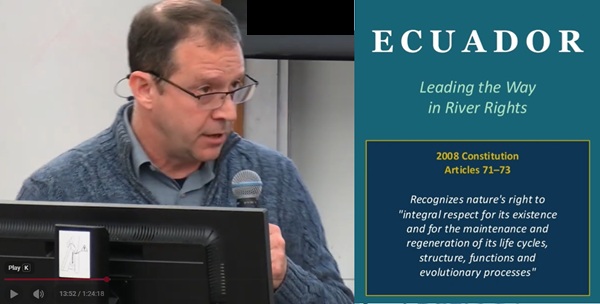
Presenter: Lane County voters will consider a watershed bill of rights in the May 19 election. At the Public Interest Environmental Law Conference March 15, UO professor of political science Craig Kauffman explains what would change with passage of Measure 20-373:
Craig Kauffman (UO): The difference is in: What are the principles on which decisions will be made? And what is the goal? I would say the difference is based in the entire paradigm of the relationship between humans and Nature.
The conservation approach (as I understand it) is based on this idea that humans are separate and apart from Nature and therefore we can manipulate Nature, try to bend it to our will, and we should try to force Nature to adapt to our needs and wants.
And that has led to a practice of what we think of as conservation, which is: Nature’s going to be all that’s separate from us and we’re going to wall it off and try to keep people out of it or regulate how people interact with it.
And that’s led to the critiques by many Indigenous groups and other local communities who lived harmoniously in relation to the local ecosystem, right?
And so this is, I think, a fundamental difference with the Rights of Nature paradigm. It’s just fundamentally different, right? It’s based on the assumption that humans are part of Nature. We’re not separate. So there’s an understanding that we are part of the system, we are living in the system, we are impacting the system. We are going to have an impact.
This is not ‘Wall it off and don’t touch.’ But with that then goes a responsibility to govern ourselves as humans, such that we behave in a way that allows the system to keep regenerating the conditions that are necessary to support life.
And that’s just a fundamentally different paradigm. And so here with Rights of Nature, the idea of development is being able to have a high quality of life in a system that is balanced, meaning it’s not going to exceed the tolerance levels and collapse. You’re trying to sustain the system’s ability to regenerate its life cycles and everything else should flow from that.
And that’s necessary to ensure human well-being, ’cause we’re part of the system.
Presenter: The Lane County measure is one of about 160 local Rights of Nature initiatives in the United States, and one of 39 initiatives that address the rights of rivers. Craig Kauffman.
Craig Kauffman (UO): One of my main projects is I run the Eco Jurisprudence Monitor, which tracks initiatives around the world to embed ecological jurisprudence into various kinds of legal initiatives.
There are almost 700 of these initiatives across 62 countries. There are 140 Rights of Rivers legal initiatives across 25 countries on all six continents, right?
One of the main critiques that’s being levied against this movement is that it’s too abstract; it’s not clear how you recognize when a Rights of Nature of violation occurs; and then how you would measure performance on this, in essence, how do you create a regulatory framework that can be used to allow policymakers to enforce this systematically?
So what I wanted to talk to you today about is the need to create concrete regulatory frameworks to enforce these.
Ecuador has led the way on this, and I should say this has been the topic that scholars have really focused on for the last five or six years, because we’ve now gotten to the point where we’re moving past these moral philosophical questions to where policymakers are having to grapple with this.
I’m going to describe the regulatory framework for Rights of Rivers that’s being developed in Ecuador, just because they’ve advanced the furthest in this so far. And in part that’s because Ecuador was the first country to recognize Rights of Nature generally in its constitution.
And because it’s in the constitution, there are all these court cases percolating through, alleging violations, and finally, around 2019, the Constitutional Court said, ‘All right, we are going to select a series of cases to create binding jurisprudence that settles a lot of these about how you interpret Rights of Nature as it intersects with a variety of different constitutional rights,’ like economic rights, human rights, cultural rights, and that sort of thing.
There’s three articles in Ecuador’s Constitution that recognize Rights of Nature. Nature has a right to its integral respect for its existence and for the maintenance and regeneration of its life cycles, structure, functions, and evolutionary processes.
And I point this out because it’s important that these scientific principles of ecosystems as systems, having life cycles with particular structures and functions and evolutionary processes that’s embedded into these rights, right?
Because this then creates an opening to say: How can we use traditional ecological knowledge as well as ecological science to see when an ecosystem’s ability to regenerate its lifecycle is threatened or not?
And so I’m going to essentially lay out the framework that was created through 14 court rulings by the Constitutional Court, and then also lower courts addressing rights of river systems.
One of the underlying principles for all this, which is really important, is that as early as 2015, the Constitutional Court ruled that Rights of Nature is transversal, meaning that it affects all the other rights in the constitution. And the logic that they gave for this is that, in the constitution, it draws on the traditional Andean Indigenous concept of sumak kawsay.
It recognizes Nature as a system in which all the component parts are interconnected through reciprocal relationships. So Nature is conceptualized as nested ecosystems of interdependent biotic and abiotic elements. And that includes humans. So we’re part of Nature.
And that means this is very different from the way law in the western world often conceptualizes Nature, very different from conceptualizing Nature as independent stocks of resources that you can just sort of pull apart, manipulate, reorder, so forth and so on.
By recognizing the systems and relational approach, then you’re recognizing that Rights of Nature, human environmental rights, and Indigenous cultural rights are all interrelated. And so protecting river rights is also a way to protect the rights of communities that depend on that river, including Indigenous cultural rights.
So in the constitution, the Rights of Nature are fairly abstract, but the court ruled that you can infer from that that specific ecosystems have rights because again, Nature is conceptualized as nested systems in which local ecosystems are nested in broader systems and so forth and so on.
And then since all ecosystems are unique, the standards for measuring the violations of those systems have to be tailored to each ecosystem type, right? So river rights are going to probably look different from ocean rights, which might look different from forest ecosystems and other kinds of wetlands, for example. They all have different types of life cycles, right?
So the court then started turning to different types of ecosystems to establish binding jurisprudence. And because the vast majority of, issues surrounding Rights of Nature in Ecuador around rights of rivers, not coincidentally, because fresh water is one of the main ways that humans sort of interact with or, experience the pressures of climate change and biodiversity loss, rivers are particularly important.
So the first case that the court selected to go down this road of creating binding jurisprudence was in 2021. And that particular case was chosen for the purposes of settling issues or questions about how Rights of Nature should be interpreted and enforced in fragile endangered ecosystems generally.
And so the case they chose was Los Cedros, which was a protected forest. It established this underlying principle of ecological tolerance. So this idea that natural systems and the organisms within them have specific limits for environmental factors, so temperature, moisture, nutrients, etc., beyond which they cannot sustain their physiological processes or natural cycles.
So if you’re trying to think about where do we find the threshold for when an ecosystem’s ability to have its right to regenerate its natural cycles, you have to have a sense of what its tolerance levels are.
One of the implications of this ruling is that it leads to the precautionary principle, right? This idea that if there’s a risk of irreversible damage and there’s scientific uncertainty, the state must implement protective measures favoring Nature. And then that then has shifted the burden of proof to the polluters. That is to say, state and private entities must demonstrate that a proposed activity will not violate river rights.
It’s not enough to have procedural compliance. You can’t just say: ‘I got a permit from the Ministry of Environment, and therefore you can’t say that I didn’t violate the river’s rights.’ No, the river’s rights can be violated despite the fact that you did an environmental impact assessment and you got a permit—if the state was negligent and not considering the rights of the river when issuing those permits and so forth.
The court then chose a case over alleged violations of the rights of the Aquepí River to establish binding jurisprudence around the idea of the rights of rivers.
They started by saying, ‘Okay, first we have to define what is the river’s life cycle.’ And so talking to scientists, ecological scientists, as well as Indigenous, traditional ecological knowledge holders.
They define the river’s lifecycle through three dimensions: the structure, functions, and evolutionary processes. So by structure they mean its morphology, like the shape of the riverbed, the bottom and sediments, flow patterns, water quantity, and quality.
And the thing to keep in mind here is that these things then affect the functions, the natural functions that the system plays: provision and purification of water, irrigation for food sovereignty, habitat for plant and animal life, food and drought control, but also connectivity of ecological and social systems from the source all the way to the mouth, right through the whole system. Again, these systems are interconnected. That’s really key here.
And then when you’re thinking about evolutionary processes, the court says you’ve got to view this historically. This is a recognition that ecosystems are not static entities, right? They’re dynamic. They change constantly.
So when you’re trying to think about whether particular alterations have gone too far, you’ve got to look at it historically and assess what’s happening now against the historical pattern of the diversity and abundance of life forms that the system has supported.
The idea is that drastic human interventions, if they’re really indeed posing the risk of severe violations, that will be evident through this kind of historical comparison.
The court then also really dialed in on ecological flow as a really important metric. Ecological flow is the quantity and the quality of water, the magnitude, duration, timing, so forth that’s needed to maintain adequate system health and sustain a river’s lifecycle.
Obvious examples would be where you’re diverting so much water that the ecosystem collapses, right? It exceeds the tolerance levels.
But I think it’s important to recognize that you can also undermine the lifecycle of a watershed by increasing the flow, particularly if that water flow increase is accompanied by a lot of pollution, because that can, for example, change the turbidity and temperature, which can disrupt the reoxygenation of a river system, and then therefore making it unsuitable for life right?
Another key principle is that when you’re measuring this, it’s not enough to just take a moment in time and looking at point source pollution or flow, you’ve got to consider the cumulative impacts.
If you’re looking at the impacts of adding a new hydroelectric dam on the river, you don’t just consider what the impact of that single hydroelectric dam. You take that into consideration along with the impacts of the other three or four hydroelectric dams that are also on the river.
And that assessments have to be made in a way that reflects current conditions against a historical baseline.
The first and probably most important case was the case of the Aquepí River. The National Water Agency, which is called SENAGUA, had authorized the diversion of 440 liters per second from this river to build an irrigation project for a community that didn’t border the river, that was inland. This community was experiencing drought.
But the communities living on the riverbank filed suit, alleging that this violated the rights of the river and then therefore also their rights because they depended on the river, because it produced—already the river was having very low water levels, even during rainy seasons.
So the Constitutional Court selected this case to make binding river rights jurisprudence, and in the end what they found was that the water agency violated the river’s rights by exceeding the ecological flow thresholds during dry season.
And the reason they did that was because they were using a faulty methodology for estimating flow. And this was result of a failure to collect data across multiple years at the same seasonal point. Ecuador has a rainy season and a dry season. They were taking measurements across different seasons.
And so that then resulted in an excessive diversion, which exceeded the river’s tolerance levels, thereby threatening the lifecycle. Therefore, they ruled that it was a violation of the river’s rights, right?
So the impact of that is that, they said, ‘You’ve got to audit this irrigation project, and you have to cancel it if you can’t figure out a way to be able to do it without ensuring that the river’s lifecycle can be regenerated.’
And so they ordered the commission of comprehensive studies of the river’s flow, and they ordered SENAGUA to change the methodology it uses for measuring flow and on which it’s basing its decisions.
I just wanted to just give you one other case, because it’s an example of an urban environment—a river going through the heart of Quito—where the city was found to violate the rights of the river, not because it took too much water out, but because it essentially created an urban infrastructure that diverted a ton of additional water into the river system, essentially overwhelming it.
So the municipality of Quito was channeling about 99% of the city’s untreated wastewater directly into the river. But then on top of that, you’ve got urban rainwater runoff, which was loaded with hydrocarbons.
And this dramatically increased the flow, which then caused intense erosion along the river banks, which changed its morphology in a way that increased the turbidity and temperature extremely, which then disrupted the river’s natural reoxygenation capacity, which then in turn eradicated all the aquatic life and vegetation.
And so this is a concrete example of what it means to say you’re changing the river’s flow in a way that’s destroying its natural functions: water filtration, flood control, habitat protection.
So the court ruled that this constituted a violation of the river’s rights for that reasons, and ordered the city to start treating the wastewater, but then also, create a infrastructure that’s removing certain embankments, restoring wetlands, creating urban lagoons for filtration, and then also installing permanent water quality monitoring to ensure that the changes that are made are actually in line with the rights of the river to be able to regenerate its natural life cycles.
Then crucially, it also ordered the creation of a governance council made up of all the stakeholders who had interests in the watershed, for the entire watershed basin, so that they could create a collaborative system for determining how to solve the problems of the stakeholder needs in a way that’s consistent with the ability of the river to regenerate its natural life cycles and functions and evolutionary process, essentially.
Presenter: He was asked who has legal standing to file lawsuits on behalf of the river. Craig Kauffman:
Craig Kauffman (UO): That’s a great question. And it’s a complicated answer because different Rights of Nature laws in different countries structure this differently. So there is actually no ‘one size fits all.’
So the first thing I want to say is that legal standing is only one component of the broad principles of Rights of Nature. Different societies that are operating in different legal and cultural environments are structuring, bringing Rights of Nature differently for obvious reasons, right?
And so one purpose of these Rights of Nature initiatives is to help societies switch their paradigm of how they think about humans’ relationship to Nature, to get past this idea of humans are separating apart and Nature’s a bunch of these individual stocks and rather recognize Nature as systems.
We’re part of these systems and therefore we have these interdependent, reciprocal relationships, therefore we should care.
Here in the United States, we empower anyone to be able to represent Nature. So representation is voluntary, but it’s not obligatory. And a lot of people think this is going to then just lead to a raft of lawsuits, but actually it tends not to, because it creates a collective action problem.
You know, lawsuits are expensive and if everybody can do it, but nobody is obliged to, then it tends not to happen unless you have a very wealthy benefactor who’s interested in funding these lawsuits.
But, in other countries, they do it different, which is to say they will construct a new sort of governance institution, which is a collaborative governance arrangement comprised of all the stakeholders in a particular system. And then they are not only empowered, they are obliged—they have a duty to represent Nature in various institutions.
And that is (I’ll just be honest), that’s been a more effective way to go about doing it, in part because then you can embed these representative agencies in the various decision-making bodies so that the Rights of Nature is protected upfront in the decision-making process rather than waiting for a violation to occur and then going to the courts and then hoping someone will pay for a lawsuit.
Presenter: Some have asked why the Lane County measure is written so broadly. Craig Kauffman:
Craig Kauffman (UO): Legislation built at the local level is always broad because it’s focused on principles, because principles is the first step that you have to engage with when you’re trying to create change.
And so if you read the Clean Air Act and Water Act, they’re very broad, like, very vague, very broad, and this is the nature of the relationship between the branches of government. Executive agencies figure out a regulatory framework.
Someone is going to have to do the hard work of trying to then craft a regulatory framework to implement this if it gets passed.
And I would encourage everybody who cares about this to try to be involved in this process and not just be like, ‘That’s their problem.’ At some point in the implementation, this is going to have to turn into a more of a collaborative arrangement where we say, ‘Okay, we presumably we all have goals that we want to have a healthy watershed ecosystem.’
You know, you’re talking about EWEB. EWEB wants to have healthy ecosystems, right, to do their mission. And so then you can say: ‘We now have this mandate for underlying principles and goals. Let’s now think about measuring compliance and using valid science to figure out thresholds and tolerance levels.’
Presenter: Craig Kauffman from the University of Oregon discusses the Rights of Nature at the 2026 Public Interest Environmental Law Conference. You can learn more about the Lane County watershed measure at the website, ProtectLaneCountyWatersheds.org.
You can see the entire panel discussion on Todd Boyle’s YouTube channel.