EWEB predicts 5% higher costs for BPA power after court order
4 min read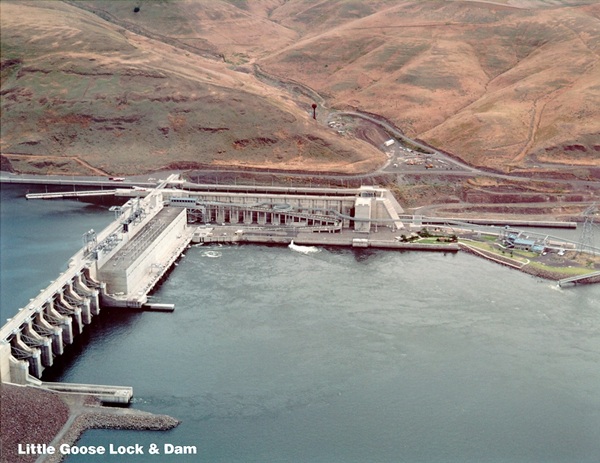
from Eugene Water and Electric Board and Robin Bloomgarden
EWEB, the Eugene Water and Electric Board, is raising concerns about a recent federal court order requiring increased water spill at Columbia and Snake River dams, and is calling on Oregon’s Gov. Tina Kotek to engage directly with the utilities responsible for powering more than 1 million Oregonians.
A preliminary injunction which took effect March 1, 2026 requires significantly increased spill from the federal hydropower system. That means less electricity generation from a system that provides roughly 80% of EWEB’s power supplied. Preliminary analysis suggests the ruling could add approximately $100 million in annual costs, costs that ultimately flow to utilities like EWEB and from there to customers.
EWEB estimates a 5% increase in BPA-related power costs. EWEB general manager Frank Lawson joined more than 30 Oregon consumer-owned utilities in signing a letter to Gov. Kotek urging her to meet directly with the utilities bearing these consequences of this decision.
The letter calls out an apparent contradiction in the state’s position. While the administration works to address affordability and the growing demand for clean energy, it is simultaneously supporting litigation that threatens Oregon’s most essential source of steady, carbon-free electricity.
Decisions of this magnitude—which directly impact energy reliability and cost—should not be made without meaningful input from the families and communities who will bear the consequences, the letter states.
The coalition addressed the letter directly to Gov. Kotek because it was her administration’s decision to reinitiate litigation against BPA and federal agencies that set these consequences in motion.
It is the second such request. An earlier letter sent in October, 2025 received no response.
The court order governs spill, fish passage, and reservoir operations at the four lower Snake River dams and four dams along the Columbia River. But the assumption that more spill is always better for fish is not uniformly supported by scientific studies.
Community-owned utilities, including EWEB, are the primary funders of fish and wildlife protection programs in the Columbia and Snake River Dam ecosystems.
‘We believe salmon recovery and affordable, reliable hydropower can and must coexist,’ said Lawson. ‘Court-driven mandates issued without a responsible plan to replace loss generation serve neither goal, and they leave our customers to absorb costs and risks that were never part of any public conversation.’
Electricity demand in the Pacific Northwest is growing, driven by industrial development, electric vehicles, and building electrification, while the region’s available supply is increasingly constrained. The federal hydropower system has long been the backbone of that system, offering carbon-free power when the grid is under stress.
But the court ruling will change all that. ‘Our region has already come dangerously close to rolling blackouts during extreme weather events,’ said Lawson. ‘This ruling makes those events more likely, not less.’
The court ruling limiting hydro generation is an example of one of many reasons behind EWEB’s ongoing work to evaluate backup generation options for supply-constrained peak periods.
One such effort is currently underway in the partnership with the University of Oregon. EWEB and UO are conducting a study to understand if running the UO’s onsite combined heat and power CHP generator, even for a few hours a year, can support grid reliability during periods of high electricity demand and limited renewable supply.
The study will also evaluate whether running the highly efficient UO generator would result in an overall net greenhouse gas emissions reduction regionally by reducing EWEB’s reliance on other power plants when the grid is the dirtiest.
Our customers have consistently told us that reliable power and affordable rates are their top two priorities.This study is a prudent effort to understand what options exist when the regional grid is under stress and demand spikes beyond what conservation and renewables can cover in real time, said Lawson.
The BPA spill ruling is a clear answer to why that question needs asking.
Robin’s question
Robin’s question is: Why has EWEB not considered ramping up solar generation over the past 10 to 15 years that they have pretended that water will always be flowing at low rates from BPA to the Bonneville Power Administration?
They deliberately sold off the shares they owned of a Washington State solar farm, leaving them with nothing to fall back on. EWEB has steadfastly not considered installing solar on the built environment in Eugene, on the many flat roof buildings in central Eugene and the U of O that could be part of a larger supply of clean energy.
And now they cry about not having any backup and expect customers to pay through the nose instead. Frank Lawson has been against anything like this since he arrived at EWEB. Why, exactly? There will come a time when Bonneville will not have the flow needed to power everything. And then what?
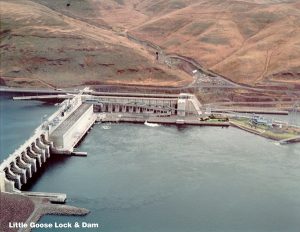
Image of Little Goose Dam, one of the eight Columbia and Snake River dams named in the court order, courtesy Wikimedia Commons.