Measure 20-373: Rights of Nature or rights of corporations?
13 min read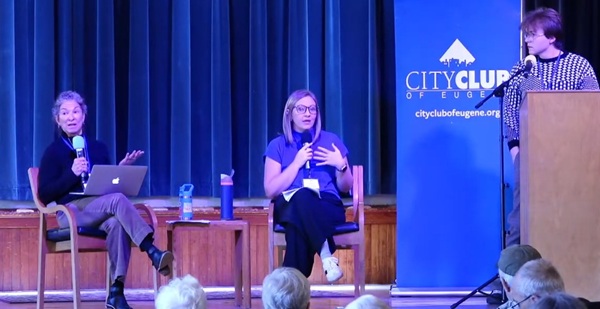
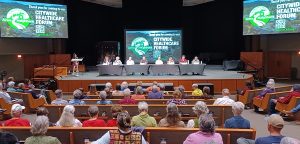
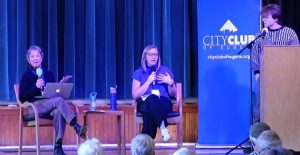
Presenter: The Rights of Nature, or the rights of the corporation – which should be supreme? At the March 27 City Club, program coordinator Mary Leighton:
Mary Leighton: Today we will learn about Measure 20-373, Lane County Watersheds Bill of Rights. Our first questioner is a journalist who specializes in environmental issues—that’s KLCC reporter Nathan Wilk. He’s been working on this story for weeks and has collaborated with the speakers on his summary.
Born in Portland, he graduated from the University of Oregon School of Journalism and Communication. He served as a DJ and public affairs host across Oregon.
Nathan Wilk (KLCC): Hi there. My name is Nathan Wilk. I’m a reporter with KLCC… So today we’re talking about a measure which would create a bill of rights for watersheds in Lane County, and a process to sue businesses and governments for violating them.
So what is a watershed? Well, according to the measure, it’s all the land and the water that drains into rivers, lakes, the ocean, and other similar natural features here in Lane County.
Under this law, these areas as well as their natural communities and ecosystems would have the right to exist and flourish.
That includes having clean water free from pollution, and people would be given the right to affordable water access at their homes. Lane County would be directed to enforce these rights, and the public could also sue on behalf of a watershed.
If they oppose a project that’s been approved by a government, they could ask a court to nullify that agreement. If a company or government is found liable, they’d have to pay the costs to reverse the damage to the ecosystem and they’d be fined for each day they failed to stop the impairment after it was reported.
The public could also sue to force a government to take protective measures, even when there is not, quote, scientific certainty or full evidence of the risk. The measure says the rights it lays out would be above less protective state, federal and international laws.
Presenter: Program coordinator Mary Leighton:
Mary Leighton: Brittany Quick-Warner is the president and CEO of Eugene Area Chamber of Commerce.
Her work is promoting prosperity in the economic life of our community. Prior to this role, she was Eugene Chamber’s director of business advocacy and events manager. She has owned a small business and was a volunteer coordinator for United Way. She now serves on several nonprofit boards.
Her community engagement provides other perspectives on the downstream effects of our environmental stewardship. For example, I hear of her work all the time on solving, resolving, meeting the challenge of homelessness.
Brittany Quick-Warner: My name is Brittany Quick Warner, here representing a growing coalition of elected officials, individuals, nonprofit organizations and businesses, including my hat as a board member for Better Housing Together and in my professional role at the Eugene Chamber of Commerce.
I want to start with something that I think everyone here agrees on. We all want clean water. We all want healthy watersheds, and we care deeply about protecting this place that we call home. That’s not where the disagreement is.
The real question before voters isn’t whether we value those things. The question is how we choose to govern them and whether this measure is the right way to do it.
And based on what we know as we’ve come to understand this measure, we believe the answer is no, because when you look beyond the title, this measure isn’t really about setting clear standards for clean water or improving how we manage our watersheds.
It’s about creating a new and very broad legal pathway for lawsuits and not just against big businesses. In fact, the measure allows any individual to sue a business, a farmer, a utility, a school district, a local government.
And not just for actual harm, but for perceived risk of harm, and this comes straight from the measure: ‘without the need for clear scientific certainty or full evidence of risk.’
That means a piano teacher who runs a business out of her house could be sued by her neighbor who doesn’t like how she’s landscaping her yard and claims it’s impacting the watershed. This is a significant shift in how we make decisions as a community and a shift that comes with real-world consequences.
Many we believe are unintended by the writers of this measure, but they’re real nonetheless. For example, one of the most concerning unintended consequences is how this could impact wildfire response.
As written, this measure opens the door for lawsuits against the very actions that we rely on to keep people safe, like building fire breaks, conducting controlled burns, or using fire suppression materials, all of which could be claimed to impact the watershed. Those are essential tools preventing catastrophic wildfire.
When you introduce legal uncertainty to those decisions, you risk hesitation, delay, and increased cost at a moment when we need clarity and speed the most.
We should also be honest about what this could mean for housing in our community. We already struggle to build and have housing in this region across the state. This measure creates a new pathway for projects to be challenged or delayed through litigation, whether it’s affordable housing, infrastructure, or basic development.
When those challenges don’t succeed, the delay and costs alone can still be enough to keep projects from moving forward. We’re already seeing it in the housing development space.
This just adds another layer and opportunity for litigation at a time when housing affordability is already one of the biggest challenges we face. It’s a real concern that we have about this measure now.
I think it’s also important to recognize that we are not starting from zero when it comes to environmental protection.
Oregon already has some of the strongest water quality protections in the entire country. In fact, just a few years ago, environmental organizations and industry came together after those decades of work and after extensive scientific review to pass what’s known as the ‘Private Forest Accord.’
That effort resulted in one of the most significant expansions of water protections in decades, including large protected buffer zones along streams, strict herbicide regulations, strong requirements for road design and erosion control, and meaningful protection for fish habitat and drinking water.
And here locally, year after year, our drinking water meets or exceeds all state and federal health standards, and this was before that new and extensive program went into place.
So the question becomes, if we already have strong protections in place, is this measure the right tool to improve them?
Because if the measure doesn’t build on those systems in a clear and targeted way, and instead relies on litigation to drive outcomes, that’s where a lot of people start to have concerns.
Regardless of how a case is resolved, the cost of defending lawsuits is real. And when that risk is applied broadly to governments, to utilities, those costs don’t disappear. They show up in higher rates and higher costs or reduced services.
At a time when our local governments and school districts are facing severe budget deficits, this measure could require them to spend millions in legal defense instead of services for our community.
Now, I want to be clear. Conversations about sustainability and conservation matter, and we should absolutely continue to have them. But this measure is a solution in search of a problem, and it introduces risk and uncertainty and unintended consequences without a plan for clear outcomes.
This measure, at the end of the day, comes down to balance protecting our environment and protecting our community’s ability to function, grow and thrive.
And the measure as written doesn’t strike that balance. And it’s why I’m encouraging a ‘No’ vote on this measure.
Presenter: For the City Club, Mary Leighton:
Mary Leighton: Michelle Holman has lived in Deadwood in Western Lane County’s Coast Range for more than 30 years, and has been active in the anti-herbicide struggle since the late 1970s. She lives on Deadwood Creek, which drains into the Siuslaw River. In her backyard, the salmon spawn.
After many years of fighting unsuccessfully to stop aerial spraying of toxic chemicals, she co-founded Community Rights Lane County and the Oregon Community Rights Network. She has served on the Mapleton School Board for 35 years.
And what she and I have in common is: I also lived (50 years ago) in the Coast Range where a river ran through our property and marketable trees hung around everywhere.
Presenter: In support of the watershed bill of rights, Michelle Holman:
Michelle Holman: ‘Yes on Measure 20-373’ is a grassroots effort led by local volunteer residents to secure legal rights for our watersheds and to guarantee residents the right to clean water.
We are members of this community who believe it is our right and our responsibility to protect the water we depend on from harmful corporate activity.
With the help of some very able attorneys, we wrote this measure because the current law protects harmful business practices over the health of the people and the environment.
We wrote this because nature requires better protections.
We wrote this to acknowledge those who have been and currently are harmed by toxic chemicals in the environment.
Today, water can be contaminated with herbicides, pesticides, and PFAS and still considered acceptable under regulatory standards. But those standards ignore the real dangers of cumulative exposure.
They’re not designed to truly protect public health.
We need a new baseline, one that puts the health of our watersheds and the people who rely on them first, before corporate profits. Measure 20-373 adopts the precautionary principle, also known as ‘Better safe than sorry.’ It requires creators of products to prove their safety before widespread use is allowed.
The standard avoids environmental damage and human health hazards when the stakes are high, like when the timber industry uses toxic chemicals on timber lands.
The precautionary principle is widely accepted policy standard for managing risk and potentially serious harm. It’s used in the European Union, the UN, public health agencies worldwide.
With so many cancers and neurological diseases on the rise, it’s well past time that we in our country and in Lane County follow their cautious approach.
There are 668 Nature-protective initiatives in 60 countries around the globe, including 179 in the U.S., according to the Eco Jurisprudence Monitor. Why not right here in Lane County?
This measure takes a preemptive, preventative, commonsense approach. It gives residents the tools to act before contamination becomes widespread. Once pollution happens, it’s far more expensive, often impossible to fully undo.
And now we have the very real threat of large scale AI data centers locating in our county.
Data centers require vast amounts of water for cooling, straining local resources. These cooling towers contain a cocktail of toxic chemicals that end up being disposed on nearby lands and endangering nearby communities.
Measured 20-373 is needed. Current environmental protection laws are not robust enough to protect Lane County from data centers, and our governor is proposing massive tax breaks for data centers.
This measure would make Lane County less appealing for the corporations whose data centers raise our water and electricity rates and pollute our water.
Please understand, this measure comes after decades of effort. People have testified, organized, written letters, met with officials, asked for stronger protections again and again, only to be told these harmful practices are legal. Just because they’re legal doesn’t make them right.
Communities in Lane County are living with polluted water, aerial pesticide spraying, industrial clear cutting, increasing environmental harm. Opponents will try to shift the conversation toward fear, fear of change, fear of uncertainty.
But that fear must be weighed against the reality of watersheds under stress, human and animal communities living with environmental harm, climate pressures making clean water more scarce and more valuable.
The question is not whether the current system is working. It clearly is not. The question is whether we are willing to say that in Lane County, the health of our water, our communities, and our futures matter more than the ability of powerful interests, many of whom who don’t even live here in the county, to continue to engage in harmful practices.
At its core, the measure is grounded in a simple truth. Water is not optional. Healthy ecosystems are not optional. They are the foundation of our health, our economy, and our future. We are often told that we must choose between economic strength and environmental protection. This is a false choice, especially here in Lane where recreation creates twice as many jobs as timber extraction.
A healthy economy depends on a healthy environment. Without healthy watersheds, we risk losing both.
And there is also the question of democracy. Who decides what happens in Lane County, the people who live here or outside interests who profit while we bear the consequences? Why should big corporate interests have more power and privilege to do harm in our communities than we have to protect ourselves from those harms.
I live in the Coast Range. I’ve lived in Deadwood since 1977. A lot of clearcut logging, a lot of aerial herbicide spraying, and a lot of harm.
So, we have multiple cancers. The chief petitioner for the spray ban was sprayed and got cancer and she died. I, myself, after my first child, I had seven miscarriages. Then I had my son and I had three more. My husband has Parkinson’s. There’s a family of four in Triangle Lake, all exposed to atrazine, the kids with spontaneous bloody noses right after the exposure.
Farmers have had animals die. Sustained crop damage. Countless stories of significant health effects.
Herbicides are extremely toxic to people, plants, and animals, and the spray drifts. They like to say that these are really very surgical operations. Not true. The wind patterns change and sprays, they find their way. They all find their way into the water.
You know, we talk about: ‘We all live downstream.’ That is not just a saying, that’s a reality. So, this is a problem. This is a massive problem and we want to stop it…
This is what we do when we’re pushed to the brink. We have to bring the courts into it. If you look back in our history, the women’s right to vote at that one point, that was not a thing, and we pushed it into the courts to make it a thing. The same with slavery. It used to be legal to own people, and if you just sat down at the table and tried to collaborate with slave owners, you likely weren’t going to get anywhere.
Sometimes we have to push it, like the Paris Accord. That’s based on countries doing what they say they’ll do, but there’s no teeth in it. We have to put teeth in changing behaviors that actually harm us. We have to put teeth in it. It has to be a law. If it’s legally protected to do harm, then you have to take it into the courts and into a legal setting that creates protections for the people and the environment.
Our measure affirms that watersheds matter, our communities matter. When larger systems fail, we the people still have the right and the responsibility to act.
Look past the fear, look at the reality, stand for clean water, healthy ecosystems, and the future of our county vote yes on Measure 20-373.
Presenter: Brittany Quick-Warner:
Brittany Quick-Warner: Yeah, I think that an old personal value of mine is to always pursue collaboration at every extent possible. And I think that we’ve seen collaboration, we’ve seen negotiation, compromise kind of coming together around things in a lot of different areas and issues that have been successful.
The challenge that we have with this measure and not just introducing a new path to litigation is that it doesn’t even clarify for folks what they should or shouldn’t be doing to improve the watershed. And so I think that while we are pushing it into litigation, we’re not actually even bringing any clarity to the folks that we’re trying to inspire to be acting differently.
And I think that’s the challenge. The ambiguity in here is written in such a way that there’s conflicts within the measure and the language. There’s no limitations. There’s no clear understanding of what impacts the watershed and what activity an individual business or government agencies, etc., are doing.
And so I think that litigation for the sake of litigation isn’t going to actually create a cleaner watershed for us, or a cleaner environment. And that’s really what this is going to turn into, because there’s not even a way for the courts to say what you are or aren’t doing is wrong, based on the measure that’s in front of us.
I want to leave you with this. We all agree—I do believe this—we all agree on the goal that clean water and healthy watersheds are important for our community.
But good intentions alone don’t make good policy. Our concerns come down to these basic things.
This measure is broad and vague and it opens up so many different community institutions and community members to frivolous lawsuits, which will cost us all with higher taxes, economic harm and risk to services. Some of those risks include risk to wildfire response by creating uncertainty around the tools that we use.
Risk to housing by opening up the door to delays and challenges at a time when affordability is already a crisis and a risk to our community through this cost and uncertainty and unintended consequences. I do believe that. And all of that comes with how to clear plan for how this actually is going to improve our water quality.
Because the truth is we already have these strong protections in place and we need to see them through to the completion and to the place where they’re already now protecting our water. And even more so in the future. We’ve made real progress through that science-based policy and collaboration.
We don’t need to replace that with a system that’s built around litigation. We can protect our environment and protect our community. I don’t believe we have to choose either-or and this measure, however, I don’t think strikes that balance.
It’s why I’m asking you to vote ‘No’ on Measure 20-373. If you have questions or want to learn more or want to join the coalition, please visit ProtectOurCounty.org. Thank you.
Presenter: At City Club March 27, Mary Leighton is program coordinator for a look at the Lane County Watersheds Bill of Rights. Brittany Quick-Warner urges you to vote ‘No,’ while Michelle Holman makes the case for a ‘Yes’ vote.