Transportation planners asked to adjust to changing patterns
3 min read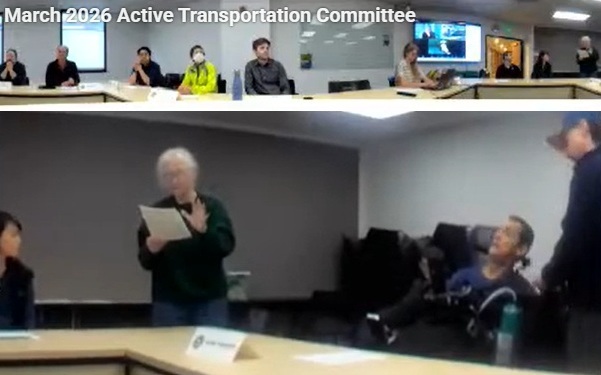
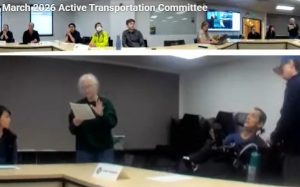
Presenter: Eugene transportation planners are asked to identify and predict changes in traffic patterns—to help save lives. During public comment March 12 at the Active Transportation Committee, Connie spoke about the brilliant UO doctoral student killed Jan. 25 while riding his bicycle.
Connie: Well, this is going to be a little different. Everybody knows what happened at 22nd and Patterson. And when it happened, I had direct concern at the time that no one seemed to be addressing, and that was that the closure of the YMCA, affected the whole dynamics of traffic from (East) 18th (Avenue) to (East) 24th (Avenue).
And I think you go back and remind yourself that Monday through Friday from five in the morning till 10 at night, there were people coming and going from the Y, Saturday and Sundays 6 (a.m.) to 9 (p.m.)
So previously we had a flow of hundreds of pedestrians and bikes and cars every day, staffers, users, and using the crosswalks, using the sidewalks, and going to and from all the different parking lots and everything else.
So that was all day long. So people were dropped off. And so from 20th to 22nd, we had this constant flow and it acted as a natural slower of traffic going down the street. That’s before the sidewalk, and the crosswalk and all that.
So we knew as local people, I’ve been going down that street for 50 years, that we had to slow down from 18th all the way.
And so, my concern when they had the Y closed down and then put at the end of 24th, was that you developed a straight shot down the street to the Y and I really have a lot of questions.
We have so much planning when someone builds something. But I don’t know that we have our Planning Commission people and our transportation people cued into the reality of what happens when a major congestion source and traffic source ceases. So, why don’t we have our planners or transportation doing that?
And I have a question of why that never happened and why that wasn’t addressed. We’d go from massive congestion to nothing, and then not see that that was going to be a problem for the traffic on that street.
The apartments generate some foot and bike traffic and there’s relatively little going to the tennis center that still is there.
So as I say, I’ve been crossing by bike and by foot on 22nd 50 years, and driving on Hillard and Patterson for 50 years. And it seems like the traffic dynamics are so obvious.
I just want to really ask, I guess larger groups like the planners and transportation people: In the future when we lose something, not just when we build something, when we decommission or close something, we have to address how that affects the traffic patterns.
And so we don’t end up having a speedway where before we had a sort of synthetically-controlled traffic flow. So that’s just my comment about 22nd.
Presenter: At public comment, Connie says closure of the old Y transformed Patterson into a straight-shot speedway from 18th to 24th. Neighbors saw the danger and ask transportation planners to watch for it in the future.