KEPW features Encircle Films homelessness panel
11 min read
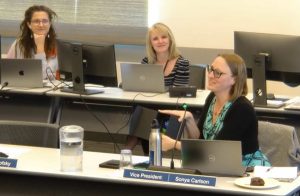
Speaker HEAT, the Homeless Empathy Action Team, will start meeting again in January. That from Wayne Martin, as he moderated a panel discussion of A Rising Tide, a look at homelessness in Alameda County. Encircle Films hosted the screening and discussion.
Wayne Martin Eric Jackson led a homeless camp at the butterfly parking lot, and was forced to move to a gravel lot on Highway 99. And several of us helped him set up a camp there. And I said, ‘What do you want to call this?’ And he said, ‘HEAT: Homeless Empathy Action Team. We need all the help we can get.’
So we want to revive that in the memory of Eric Jackson. So, the formation of a new group involves maybe a few churches to get it started, and this group called HEAT—Homeless Empathy Action Team—will be focused on starting up in January with a few get-togethers to form that. And it’s going to be a group that meets monthly with unhoused people sitting at the table with housed people and mapping out the things that could be very, very helpful and very necessary during the time where HEAT is needed most during the winter. So if any of you would like to be informed about that, we’ll keep you up to date on that.
Pastor Zane Ridings My name is Zane Ridings, and I’m the pastor of Eugene First Christian Church. And I’m working with Wayne to try to get this HEAT coalition off the ground, because the thing I really appreciated about this film is that, you know, you can have systems, you can have people working, but what you have to have is hope that there’s actually some things that we can do about this problem.
And, you know, here in Eugene, like Oakland, we have a lot of amazing things going on, a lot of fantastic resources, a lot of wonderful people out there working. But there’s still disconnects happening. So I think hope and communication with one another and with what other people are doing are the two biggest things that I took from that film.
Mellinda Poor (CSS) My name is Mellinda Poor. I am the service navigation manager at Community Supported Shelters. And, if you don’t know what Community Supported Shelters is, we have the Conestoga Hut communities that you might all be familiar with.
We have 13 communities in the area. In the past year, we served approximately 238 households in shelter and approximately 800 households at our access center, people on our wait list accessing showers and resources. So approximately 900 to 1,100 households were served by Community Supported Shelters in the past year.
I think that what I took from that film, one thing that I wanted to talk about was, you know, just that investment, that if you’re not doing it for moral reasons, you should be doing it for selfish reasons. Because really, when we invest in stability and safety and housing for all, we are investing in our community as a whole and in our safety as a whole. And, you know, while we’re investing billions of dollars in incarceration, we could be putting that money into, you know, helping people build better lives.
I definitely feel hopeful, despite the setbacks that we’re currently facing, and one of the main reasons that I feel hopeful is because I see so many people coming together and collaborating, like the amount of collaboration that’s happening in the agencies here, coming together around this issue—the formation of A.C.T. Now Lane, that’s what gives me hope is, that I think that this community here, that we are a part of, outside, we don’t need to look at a larger scale level. I think this community is invested in solving this issue.
And I think that we do have the political will and that we just need to really, you know, like, what did they say? ‘It takes a small group of determined individuals who just do not give up.’
Wayne Martin Did you want to say one more thing too?
Mellinda Poor (CSS) I had one more thing to say, yeah. I just wanted to touch on what you were saying about the economic system being, you know, something that makes it really, really challenging to do what we’re doing. And for me, always what I turn to is that we need to create systems of interdependence in response to that, and we have to build those things from the ground up.
Camryn Leland I’m Camryn Leland. I’m the permanent supportive housing manager with Homes For Good. So the film touched a little bit on the different housing types and the different programs that are most effective and supportive for ending our homelessness crisis, and permanent supportive housing is one of our newest affordable housing types, but it specifically provides that wraparound services that’s necessary in helping people kind of get that next step and be able to find long-term stability.
So I think the conversation around affordable housing and the current situations that we’re experiencing in our community in Lane County and Eugene is a push for more permanent supportive housing. These are the programs that provide the necessary wraparound services so folks can have access to behavioral health and mental health needs, along with physical, which is all super, super crucial in terms of long-term stability.
It does take the importance and power of community coalitions. It does take interdependent networks. It takes all of us talking in these community meetings and settings and forums, and also empowering the folks that are experiencing the very things that we’re talking about. It’s a privilege for us to talk about these things, and I think where we could start to transition that conversation is just giving more room for folks to be able to advocate directly to the folks in power.
Wayne Martin And let’s go to Gabe Piechowicz.
Gabe Piechowicz My name is Gabe. I’m here because four or five years ago, I decided logging wasn’t a long-term solution for a life. And then I met Mr. Wayne in West Eugene when I was trying to help a few people out, and he said, ‘Do you know what you’re doing?’ And I said, ‘I have no idea.’ And he said, ‘Let me help you.’ And the rest is history.
Now founder, executive director of Everyone Village in West Eugene: four acres, 80 tiny homes, a bunch of programs, including a new partnership with PeaceHealth to bring recuperation units and a primary care medical clinic to the neighborhood.
What I took from the film was: We’re one of three nations in the United Nations that still choose to not make housing a human right. They can do that all day long and not keep me from making it a human right. They can do that all day long and not keep you all from making it a human right. And so that’s where it must start. You cannot help ten if you cannot help one, you cannot help one hundred if you cannot help ten.
So one of the quotes in there, I don’t remember it specifically, but it indicated the way for a soul through all the tragedies we just saw, is someone walking alongside you through it. And I ask you: What actual human with a name in this town who’s experiencing homelessness, or many of the setbacks we saw in that film, that you’re walking with through it? The actual name of an actual human. If you’re not doing it for one, you’re not helping.
You must find one first. That’s how it started in West Eugene, right, Wayne? I tried to help one human on the street, and you said, ‘Let me show you how to help two.’ And the two worked with me and Wayne to help three and then four, and now 80 at the village in three years. So find your ‘you’ if you don’t have one, and start walking with them, and I think we will see the changes that we’re after.
Amy I’m Amy. I’m homeless. I didn’t really prepare a speech, but I do know what I’m standing up here for. And that is, trying to find help for people like myself, to make it further than just where I’m at, on the streets, but having the end result being housed, you know, and I want that for myself. I want that for everybody out on the street.
And I know that I can speak for everybody when it comes to some things firsthand what we’re all struggling with.
If there was possibly a place for somebody to build something where all the homeless people could possibly work for building their home or something, I know that they would all do it. I know that there would be a lot of people, if they wanted something to benefit their self, if they had an opportunity to build their own home on somewhere. I know I would definitely work hard on building something that was a place for myself, you know?
Wayne Martin Thank you. All right, it’s time for you folks. What’s on your mind?
Danny Huffsmith Hey, everybody. I’m Danny. I think the thing that struck me the most about this film was the focus on how structural racism impacts the homelessness crisis, and I’m curious if we have ideas on how to apply that to Eugene.
Wayne Martin Thank you. Camryn, do you want to address that?
Camryn Leland Oh, it’s a community problem. I would like to address that and just acknowledge that we might not have the same population of Alameda County or of Oakland in particular, but we have similar patterns of problems. And so understanding the particular culture of Eugene and recognizing what our cultural patterns and the problems that come from our cultural patterns are, is going to help us address in a tangible way how to support the houseless community in Eugene.
Pastor Zane And I also think that a really deep and rich understanding of intersectionality can really help us to address systemic racism, racism issues, accepting that, you know, a white male who is homeless is dealing with different problems than a Black female who is homeless, can be a good start towards crafting programs and support systems that can help both of those people in really rich and life-giving ways.
Lisa Levsen Hi. I’m Lisa. I’m a chair of Neighbors Feeding Neighbors. We work with Wayne, and this is a group that’s been serving the homeless in Eugene for 15 years now—originally with Brother Charlie serving oatmeal down under the bridge at the park.
We’ve expanded our services to be more than just feeding people. We host Occupy Medical twice a month, and we do a lot of outreach things. But the thing that I see that does give me hope… but it’s hope with maybe what we talked about, with permanent supportive housing. If you don’t address health, mental health and physical health as well as iteratively give people an opportunity when they fail.
And a number of our people do fail and we need them to fail upwards, and they often fail downwards and they feel completely defeated. They maybe get into housing and they get kicked out with a behavioral problem, or they’re unwell and they don’t know how to navigate the health care system. Housing First doesn’t work without services. Very rarely can you get people to navigate through the system and know when and where they’re going.
So when (Gabe) talks about ‘Start with one,’ they need friends. They need people to help navigate. I took a young man who was almost dead to the emergency room, and I stayed with him for 24 hours. He had no idea how to navigate through, and he would have walked out, and he was about to lose both of his legs.
So we need people to support them as we find them a permanent place to live, and that everybody in this room can do that. And I challenge you to have hope and find a way to be connected, to help people do so.
Wayne Martin Thank you, Lisa. Any other thoughts, ideas, feelings?
Pastor Zane Ridings I want to kind of synthesize a couple of things here. Amy had mentioned really just wanting to have her own agency to build and support, and when it also comes to the systemic racism issues, you know, grassroots is really hard, but it’s also, like, such a wonderful answer.
I mean, that’s really how Gabe’s stuff got off of the ground. That’s how Neighbors Feeding Neighbors got off of the ground. It all started from people who care and people who are homeless, and a combination of inside, outside, on the side, all around, all coming together to try and do something.
Speaker KEPW’s Curtis Blankinship rebroadcast the panel on his show Talk Is Cheap and shared his thoughts too.
Curtis Blankinship In my own opinion, we need to really focus on mutual aid and environmental issues because if they don’t destroy the environment, we will still be able to grow our own food in community gardens and things like that. And these spaces need to be used for community gardens. Right now we have a huge glut of commercial property that could easily be turned over with a little bit of money. It could be turned over to temporary shelter or shelter, low-cost shelter, instead of just tearing it down.
It all can be done. So get with your local mutual aid people, especially Neighborhood Anarchist Collective and people like that, CALC. If all else fails, you know, every town has a usually you can find an anti-war demonstration at least once a week, at least once a month in every town. So wherever you are, you can start by going to the anti-war demonstration in your local town, especially here in Eugene. And that’s where you start when you can’t find anybody.
When all else fails, go down to the anti-war demonstration, and that’s where you’ll find information on how you can support mutual aid and other people that are working for a flattened, direct-democracy, consensus-driven society that is not extractive and exploitative of the environment and the world, and is a cyclical economy instead of a linear spiral to a death spiral economy.
Speaker Local churches plan to support the Homeless Empathy Action Team (HEAT) in memory of the late Eugene homeless advocate Eric Jackson. Encircle Films hosted the screening and discussion. For more, see EncircleFilms.org. You can listen to Curtis Blankinship and Talk Is Cheap every Saturday at 4 p.m. on KEPW 97.3, Eugene’s PeaceWorks Community Radio.