Under new HUD policies, Lane County would lose 180 permanent housing units
8 min read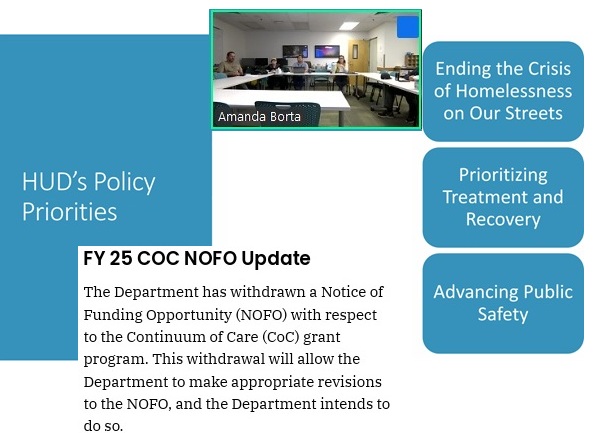
Speaker Under new Trump administration policies, Lane County would lose 180 units of permanent housing. At the LEAGUE meeting Dec. 5, Lane County’s Amanda Borta:
Amanda Borta I just want to be clear with all of you that there will be significant changes in terms of the programming that is available in the community. They are really shifting which priorities that they have in terms of what types of programs. They’re moving away from permanent housing and back to transitional housing and services-only projects, including outreach.
And because we’re limited to only 30% permanent housing, we’ve already had to make decisions around projects to be reallocated, or reduced. And so we will lose an estimated about 180 units of permanent housing, could be potentially a little bit more or less, depending. But overall, as far as the units that we have identified in application previously, we will reduce down by 180 units.
And we will certainly increase some of those in transitional housing, but those are not permanent options. Folks in transitional housing are considered homeless for up to two years, and then they need to move to permanent housing. So those are not permanent housing options for folks.
Speaker She explained that the new policies are visible in the application for federal funding. Amanda Borta:
Amanda Borta Since the last time that we met, HUD, the Department of Housing and Urban Development did release the FY25 Continuum of Care (CoC) Notice Of Funding Opportunity (NOFO). So that’s the big application that we complete annually for what’s close to $8 million right now for primarily permanent supportive housing and rapid rehousing programs.
You’ll remember, we were initially supposed to not have to complete that. They did a two year NOFO for FY24-25. But then with the new administration, they, indicated they would be doing a new competition this year. And so we were long awaiting that, since July when they announced that.
And so this is very, very, very late, for us to be receiving a NOFO. Typically we would have already submitted it by this point in the year. It is due Jan. 14. That’s a very quick turnaround. especially given like holidays and other things in between. We have very few days to actually do this.
We do always have to rank our projects just in case there’s not enough funding for all projects to be funded. So we always have to rank them, and what is known as Tier 1 is always sort of relatively secure, and so the others that fall into Tier 2 are more competitive nationally and may not be funded.
Tier 1 is typically about 90% of the amount of money that we receive annually. This year it’s limited to 30%. That’s a significant reduction in programs that are safe and not subject to competition. So that’s in itself a major shift.
In addition to that, permanent housing is going to be limited to just 30% of the amount needed to fund all projects. Right now, that’s closer to about 85%-90% of our projects are funded through permanent housing (so permanent supportive housing, rapid rehousing, and joint PH-rapid rehousing).
And so they are really shifting which priorities that they have in terms of what types of programs. They’re moving away from permanent housing and back to transitional housing and services-only projects, including outreach. So those were part of the Continuum of Care program more than a decade ago, and they were phased out around 2013, around that time. So it’s been a long time since we’ve been able to fund those.
Unfortunately, it’s now being in place of the permanent housing projects that we have currently. So HUD always identifies their policy priorities within the notice. Typically they’re fairly general and have not changed much over the years; they emphasize Housing First and ending homelessness.
And so all of them this year are completely different than they have been in the past. A lot of them reference the executive orders that have come out, really emphasizing law enforcement, reducing encampments, public camping and drug use, prioritizing treatment and recovery.
So there’s a lot of emphasis on moving towards substance use treatment and less focus on harm reduction approaches. Advancing public safety, cooperating with law enforcement, promoting self-sufficiency—there’s a lot of emphasis on employment as well as moving folks away from assistance entirely, improving outcomes and then minimizing trauma.
There are a lot of requirements around providing on-site services, providing 40 full-time services that is reduced proportionately for those that have employment. For new permanent supportive housing projects, they’re limited to serving elderly and only physically disabled individuals, so that does not include the full range of disabilities that are typically served.
So what this means for us is that locally, you know, $5.7 million of our Annual Renewal Demand (ARD) supports permanent housing. And now that’s limited to just $2 million. So you’ll see that that’s about a $3.7 million reallocation that will be occurring away from permanent housing programs and into transitional housing and supportive services.
There are added requirements. So in our programs—typically they’re Housing First approach and services are not required—that will be going away. Services will likely be required in all of our programs and people will be required to engage in services. Again, no harm reduction and move away from that approach and a move away from Housing First approaches.
And again, the emphasis is on movement off of government assistance and away from providing permanent assistance to most individuals.
You know, it’s very impossible to sort of implement this sort of large of a shift in philosophy and overall approach to homelessness, kind of in the time that they’re allowing us to fill out this application. It’s literally the opposite in many ways of the direction we had been going over the last over a decade or two. And so it’s very much difficult to kind of just shift that entire direction very quickly.
We will in the application be describing what we have in place today, but it’s likely we’ll score very low, because there are several criteria that we just simply can’t meet. And there’s not any way to do anything about meeting them, because some things like the PIT (Point In Time) numbers are what they are.
And so what that means is, the Tier 2, the ones that are at risk, which is now 70% of our ARD (annual renewal demand), that is completely based on your CoC (Continuum of Care) score. So if your CoC score is low, you’re less likely to get Tier 2 awards.
And so for that reason, many of our projects are at risk. And in many ways, we’re being penalized for following previous policy requirements.
We do have a couple of new project opportunities out right now for transitional housing, supportive services-only outreach and then a YHDP (Youth Housing Demonstration Program) diversion. So we will see what new projects we get. And so we’ll be that will be our way of determining new projects that we will submit in place of the ones that are being reallocated.
We have a very, very quick turnaround, again, to get this in mid-January. So things are moving very quickly. I encourage you if you’re interested, just follow along with the meetings that are posted, the PHB meetings, LEAGUE. And we’ll try to update folks as things get decided.
Richard, did you have a question before I move on?
Richard Self Our Attorney General Dan Rayfield, and 20 other attorneys general from other states are suing the Trump administration over these new guidelines of funding and to restore what was before and to use Housing First as the model.
Amanda Borta Richard, thank you. As Richard mentioned, there are now two lawsuits against HUD based on this notice, one for 21 states (with Oregon is included in that) basically saying that this is not a good process, and there are a number of things that are not correct about it and not legal about it, do not follow statute. And so we don’t know that we’ll know the outcome of that prior to the deadline of this.
So we don’t know yet that anything will happen, but ideally what would happen is that they would reinstate the previous NOFO and continue funding FY25 and make these changes at a later date, with more time to actually implement them. We don’t know that that will happen. As you know, courts can take a long time and these things don’t happen quickly.
And then there was a second lawsuit filed by the National Alliance (To End Homelessness and the National Low Income Housing Coalition) and other organizations to cover all of the states, since that first one only covered 21 states. So we will see, but again, court will also hold up our funding, likely, because until that’s decided, then they wouldn’t be able to issue funding.
Amanda Borta Melinda, you have a question?
Melinda Yeah. This is awful. Do we know when those permanent supportive housing units are going to be lost?
Amanda Borta Good question. So all of our HUD grants are on different sort of time periods. (Right.) So it won’t be all at once. The earliest ends as of December, this December, so, the end of this month. So we have already moved those 11 people into a different program because we knew we wouldn’t know about that funding in time for that grant to end.
The latest are, I think, October or November, where their grants would not renew. So they are sort of throughout 2026 and wouldn’t be all at once.
And we’re already having conversations internally and with Homes For Good around options for folks and ways that we can move folks on to other, permanent housing placements. But as we all know, that’s limited even now, and then we’ll really see the impacts once we don’t have those programs to refer people to, especially those who have the highest needs in our community, where transitional housing is not going to be sufficient to stabilize.
We’re going to have to be strategic about how we then build up permanent housing from other resources (right), that we will have gaps that will occur, once this all goes in.
Melinda Thanks, Amanda.
Speaker Monday afternoon, just before a federal court hearing on the two lawsuits, HUD announced that it had withdrawn the Notice Of Funding Opportunity to “make appropriate revisions.” Lane County now faces another delay and even more uncertainty about federal funding.