‘Holistic’ committee sees promise in Research Triangle model
5 min read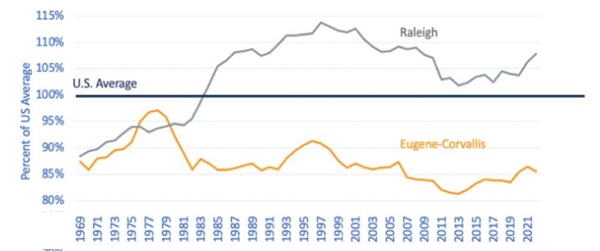
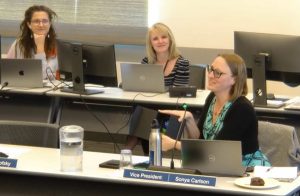
Speaker A city manager committee offered a preview of its forthcoming report on the city’s long-term financial health. Dec. 8, outgoing City Manager Sarah Medary:
Sarah Medary (Eugene, city manager) I’m super happy to be here tonight to talk about the work of the Technical Advisory Group. As you know, this is a group of members that we pulled together that have technical expertise, especially when it comes to finance and business operations. I invited them to take a much closer look at our long-range financial picture. While we’ve had many community groups advise on revenues in the past, I’m not aware of any groups that have been invited to holistically look at our operations, expenditures, economic development, and revenue.
One of the key areas of recommendation you’re going to hear more about is the need for the city to reinvest and engage in the work of economic development. Coincidentally, this fall, the Chamber of Commerce held their Economic Summit and the stakeholder meetings for the Southern Willamette Valley Innovation Corridor were initiated. The combination of information coming in from the advisors and these two events was sobering.
Speaker Sarah highlighted trends in jobs, population, housing and personal income.
Sarah Medary (Eugene, city manager) Both the nation and Eugene took a major hit in 2020 but the difference is what happened next. While the U.S. has surpassed its pre-pandemic employment levels, Eugene hasn’t yet fully recovered. Our growth line flattened after the initial rebound, showing slower job creation and more volatility.
The slower recovery means fewer local opportunities, reduced income stability, and less resilience for our economy overall. The takeaway is this: Eugene’s economic engine isn’t keeping pace, and that impacts everything else, from city revenues to housing demand to our ability to invest in core services.
For the first time in Oregon’s modern history, deaths are projected to outnumber births. That means our population growth is now dependent on people moving here, not on natural increase. Fewer young families and more retirees shift the balance of our economy. It affects school enrollment, labor supply, innovation, and the tax base.
For Eugene, that means we can’t rely on growth to come to us. We have to create the conditions that attract and retain talent and investment. Economic development isn’t just about jobs. It’s about building a place where people choose to live, work and stay. If we don’t focus intentionally on economic vitality, this demographic shift will make recovery even harder and constrain our long term fiscal health.
Housing prices have skyrocketed. While incomes have grown only modestly since 1990, the cost of a home in Oregon has increased roughly sixfold, while household incomes have not even tripled since.
That widening gap means fewer families can buy homes, more residents are cost-burdened, and communities struggle to attract or retain workers. It also underscores that this isn’t just a housing problem. It’s an income problem. Without a stronger, more diversified economy that creates higher-paying jobs, even the best housing strategies will struggle to keep up.
In the early ‘70s, Eugene and Corvallis and Raleigh (Durham, North Carolina) were in roughly the same place, both slightly below the national average. Both places are built around major research universities. Both have strong talent pipelines, but their economic trajectories look very different.
There was a period where we bumped up above, but over time, Raleigh has built an innovation-driven economy and surged ahead. We stayed flat. We’ve hovered 10% to 15% below the U.S. average for decades. The message isn’t that we lack talent. It’s that we haven’t fully connected our education and research strengths to job growth, industry investment and income gains. I think the other main takeaway for me is to show that when a community comes together and makes a decision to do something different, you actually can effect change pretty quickly.
Speaker Councilor Greg Evans:
Councilor Greg Evans Eugene’s recovery trails the nation. Natural population growth has gone negative. The home prices are outpacing incomes, and education in the valley is underperforming. How do we retain the talent that we are generating from our university community here, providing the kinds of family-wage jobs that are going to sustain the next generation that’s coming along?
The second thing is: How do we leverage our static assets better than what we’re doing now? When I talk about static assets, I’ll just be candid: University of Oregon, OSU. Regionally, we have got to do the kinds of things, and I’ve got a lot of family in the Carolinas and specifically in Raleigh-Durham, and my cousin teaches at Wake Forest. How do we begin to create the kind of synergy that we need for economic development?
Speaker Chair of the city manager committee, Greg Erwin:
Greg Erwin I think the most exciting part of all of the things that are happening in our community and our state, is that people are having conversations about something called the Southern Willamette Valley Innovation Corridor. If you haven’t heard about that yet, you certainly will.
There’s a lot of energy. The University of Oregon, Oregon State are banding together with the business community. They went back to the Research Triangle in North Carolina last fall.
So the energy around these notions of economic development, of how do we retain talent, there’s groups forming daily. You have Onward Eugene, you have Elevate 28. You have all these groups coming together, and they’re all having these conversations, these very questions that you are all raising are being talked about throughout the community and now throughout the state. And so there’s some very rich conversation…
Speaker Councilor Randy Groves:
Councilor Randy Groves I’ve got a question for the Chamber, maybe just a head nod. Is that (Economic) Summit, is that on tape? So maybe we can find a way to get at least the mayor and President Scholz commentary together. You know, it wasn’t really a Point/Counterpoint. It was a point supporting the point.
I love the way you two interacted, the dialogue that you had. And I think it would be really helpful for this group if we could see that and possibly add in the John Tapogna piece too. It’s a little bit of doom and gloom, but it kind of gives a realistic presentation of where we are and where we’re headed if we don’t reverse course as a state, let alone a community.
So I think that that would all be helpful as a prelude to the February meeting with the TAG (Technical Advisory Group) team, just so we can be as prepared and educated as possible and even be able to have some time to formulate our questions before we even get in the meeting.
Speaker A committee offered a preview of its report, which comes at a time of renewed interest in economic development.