
Lane County, Marcus Vejar praised in CFAA agreement
8 min read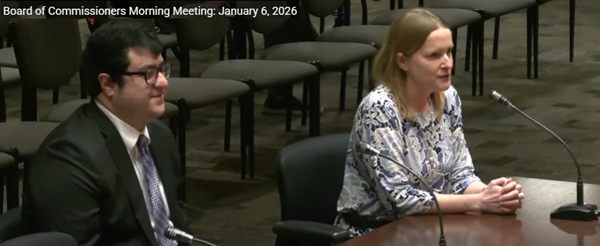
Presenter Lane County offers leadership in negotiations between all 36 counties and the Oregon Health Authority. On Jan. 6, Director of Health and Human Services, Eve Gray:
Eve Gray We are here to finalize what has been a very long process in achieving a new County Financial Assistance Agreement (CFAA)—this is the most important contract between the state and our behavioral health division in order to provide services that are primarily safety net services, what we call forensic services—which are individuals who are involved in the criminal justice system.
And for some, they have committed crimes and they do not understand their charges. That is the ‘Aid and Assist’ population. And it is our job to restore them to competency, to be able to understand their charges. That is a court-ordered process.
There is also a Psychiatric Security Review Board which is individuals who have been determined guilty except for insanity. And those individuals are monitored in our community, largely.
Then there is another group who are involved in the civil commitment system. So this is individuals who pose a threat to themselves or others because of their mental illness, but they have not at this point committed a crime. So that then goes into the civil commitment system
In addition to those items, traditionally, the County Financial Assistance Agreement has funded work related to behavioral health systems in our community: to expand residential facilities; for services to individuals who are uninsured; we have done older adult services. There’s a lot that happens as a result of this particular agreement.
The original agreement expired last June 30. We received an extension from the state to Dec. 31, 2025, because we were unable to come to agreement on what a new contract would look like. And we got into October-November time frame, we had really reached impasse at that point in the negotiations.
So there was some outreach that happened and all 36 counties came together and said, ‘You know, we really have to figure this out and we have to do it together,’ which is really cool, actually, because we don’t necessarily often all agree on something as 36 counties who can then come together and figure out how to move a pathway forward.
There was a group of commissioners, including Commissioner (Laurie) Trieger, who met with the governor, engaging the governor’s office in this process. Ultimately, the governor’s office was very helpful in helping to break the impasse.
And I have to give huge kudos to Mr. Vejar who was involved in the negotiations and our CMHP (Community Mental Health Programs) director, Dr. (Pauline) Gichohi, was also involved in the negotiations for a long period of time. I came in at the point of impasse. Mr. Vejar remained the entire time and was an incredibly important leader from the county counsel side statewide, in terms of getting to where we needed to get, and I think made a great name for himself. No one else can have him, but made a great name for himself in terms of the state.
And, you know, I think sometimes when we get to impasses in negotiations, it’s helpful just to bring in a few fresh eyes and ears, because, really, what I think happened is, on the particular sticking points, people just stopped hearing each other at the table.
And we were able—with the help of the governor’s office, with the Department of Justice in the room, with the Oregon Health Authority in the room, and counties in the room—to all really talk and begin to understand each other’s perspective. And at that point, we saw a lot of movement in the sticking areas of the contract so that the major issues that we were concerned about really did begin to become resolved to our satisfaction, which is why staff today are going to recommend to you to approve the new County Financial Assistance Agreement contract.
Presenter Assistant County Counsel Marcus Vejar:
Marcus Vejar I think that a big piece of the negotiations was helping OHA understand, from our perspective, how we view the risk and how we want to continue to do the work. We need to do so with some acknowledgement that we’re taking on that risk, and we need to have our contract essentially address that directly.
And so there was a little bit more of a direct callout to the Mink-Bowman litigation that’s currently ongoing. It’s the federal litigation essentially that brought Aid and Assist front and center into the system, and it did eventually lead to OHA having some contempt charges essentially against them while they’re trying to manage the populations and trying to get to a better place for the services they offer the state of Oregon.
And so a big piece of the contract was trying to call out the fact that while we still are performing this work, we do need to have some acknowledgement that this is risky work, and that we’re not accepting all the brunt of the liability when it comes to litigation in this space.
And so I think what this agreement in its current version does is help insulate that to not require us to use other funds to help support the missions in the agreement, and also specifically carves out that we’re not party to this federal litigation, that third parties cannot use essentially this contract to try to enforce terms through us, and that we will not be required to build residential infrastructure as a result of this agreement, all of which were important for us to have those pieces specifically outlined.
Now, and as I stated previously before, some of the big points I brought to you before were: risk and liability, which I believe we’ve addressed; service prioritization, which I believe we addressed; the local plan modifications and kind of the rules of engagement, which we’ve addressed; and the substantial compliance aspect, which we’ve also tried to address as well too.
And then we will continue negotiations to continue to improve the agreement over time if there does need to be changes made. And again, I think this agreement does a very good job of protecting us in the interim, while we kind of figure out how this new model will work.
Presenter Lane County Commissioner Laurie Trieger:
Commissioner Laurie Trieger This was a really great example of everybody coming together. It really was sort of about establishing kind of a culture of partnership, because that was (I know from our perspective as counties) the challenge.
This grant really exemplifies how counties operate as an arm of the state. We are an agent of the state in many ways when we’re delivering these services in particular, and they need us as much as we need them and the resource to do this service. The service will happen and this contract says how.
And I think some of the challenges also come out of us operating in such a time of scarcity. And so as good as we can feel about where we got—and yes, there’s always inherent risk because of the nature of these services—part of the problem is that we’re so inadequately resourced as a behavioral health care system, that we—and I say we, the collective we, the entirety of all the parties—we’ve created a system of liability that’s been increased and amplified well beyond what it needs to be and should be. And ultimately that’s just more human suffering.
So my greatest concern has always been that the prioritization of Aid and Assist does nothing but guarantee we will continue to have an outsized number of Aid and Assist clients to represent and serve.
And unless and until the federal government and the state and we as counties can figure out how to properly resource the totality of a behavioral health care system that focuses on the primary prevention work and the 360(-degree) supports for people, we will just always be in this position of being challenged to find ourselves the resources to care for people who have become the most sick and suffered the most, and in many cases cause the most harm to those around them.
So even more urgency around ensuring we get our behavioral health care stabilization center up and running as soon as possible, and that the OHA works with us to ensure we have the regulatory landscape in which to do that, and that the state legislature does everything it can, because that is a critical part of developing that system of support for the long term and to avoid having such a heavy load at the downstream end of the system. So, thank you. Well done.
Presenter Lane County Counsel Rob Bovett:
Rob Bovett From my perspective as having been a county lawyer for over 30 years now: This is a big deal. This deal we’ve struck is a big deal.
The CFAA has been probably the most, difficult and challenging contract between counties and the state for my entire career. But it’s never gone to this extreme before, and I think it’s driven largely by the litigation that Marcus mentioned that the state has found itself in. And we don’t want any part of necessarily. so this is a big deal.
And I mention this because we got to the point that Commissioner Trieger described and that you’ve described and there was a need for leadership—and the leadership came from Lane County.
And there’s 120 county commissioners, I think every single one of them engaged to some degree or another. And there’s about 100 county lawyers, and I think that all of us engaged to one degree or another. But really, Lane County took charge through Commissioner Trieger, through Commissioner Farr, and through Marcus (Vejar) and Eve (Gray).
And I know this not only because I observed it, but because I’ve been getting phone calls— from other county lawyers in particular, but also from some of Eve’s colleagues—wanting to thank Lane County, the two of you commissioners, as well as specifically calling out Marcus in particular.
I’m not sure we’d actually be here statewide without Marcus and Eve and the engagement of two commissioners.
So then my quick heads-up: I don’t think you’re done. I think because Lane County has showed leadership to get us to this spot, I think particularly Eve and Marcus and Commissioner Farr and Commissioner Trieger, I think there is, I hate to say it, a little level of expectation that you will continue to be engaged to make sure that these next 18 months and the negotiations that occur between them will be effective and productive for folks that need these services provided by counties in the state.
So thank you, Mr. Chair, for allowing me just a brief comment. And yes, I know, big kudos to Marcus. And no, I will fight off any other county counsel that comes around to try to steal him.
Presenter Lane County leaders are praised for bringing everyone to the table to manage risk, making it possible for Oregon’s 36 counties to serve a vulnerable population.