Public comment: Build trauma awareness into EPD policy
5 min read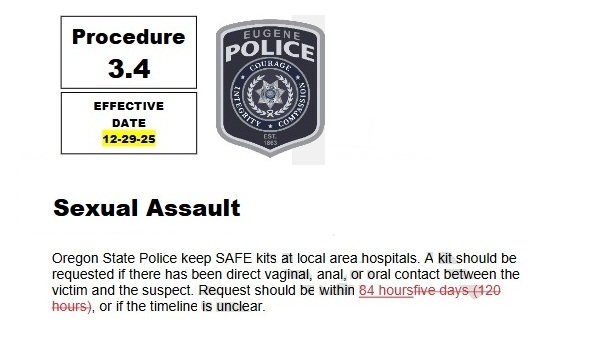
Presenter: You’re listening to KEPW 97.3 Whole Community News, covering public comment from the Eugene Police Commission Jan. 8. Daniel Brown:
Daniel Brown: My background is, I was a veteran in the military for 10 years. I served as a legal assistant, not as a legal assistant to an attorney, just as my unit assignment as I went to law school and ultimately ended up specializing in domestic violence.
I worked for the Domestic Violence Clinic for two years in law school, and then two years after law school providing legal aid to survivors of sexual assault and domestic violence. After that, I did private practice for a while. I am currently employed at Lane Community College as their general counsel and as their Title IX coordinator, where I serve students who have been victims of sexual assault or domestic violence, or sexual harassment or gender discrimination.
I’ve also completed the mandatory advocacy course for people who are advocates for survivors of domestic violence or sexual assault in the state of Oregon. It’s a 40-hour course. I’ve done it three times, twice online through OCASV, and once in person with SASS.
Also, I’m Silver Level FETI-certified, which is, FETI training is Forensic Experiential Trauma Interviewing training. It was developed through the military and the FBI and it’s being used throughout the state of Oregon, police departments at multiple levels.
It’s being used in the FBI, it’s being used in multiple federal agencies to address essentially any interviewing requirement. And it is advocated for very strongly by Sarah Sabri at the Oregon DOJ and it is frequently available.
And as part of my comments, I would encourage you to put in the qualifications for an interviewer to have a training similar to FETI or the actual FETI training.
Additionally, I would also encourage you to make a specific hour training for the requirements and what I’m specifically talking about is ‘Section 3.4.7 Qualified Investigators’ that have an hour requirement similar to the Oregon Advocacy course and potentially even reference the Oregon advocate course for trauma-informed interviewing.
The other major area that I would like to address is: One of my major concerns, through my experience as a domestic violence attorney and serving survivors of domestic violence, has been police response. And just essentially, like, the lack of belief of victims or survivors of sexual assault or violence.
And the reason is I think a lot of times is because trauma looks like you’re lying. It looks like you’re not telling the truth when you’ve just experienced a traumatic event. Your brain is all over the place. It’s not able to say things in a linear way or to express what a police officer might be looking for. And because it can’t express those things in that way, it’s expressing the things in a way that police officers are trained to see as lying.
And I would encourage you to think about a way to address that, either just specifically training police officers, ‘That’s what trauma looks like,’ but also maybe build into this policy ways that you can account for that and accommodate for that.
One of the recommendations in the FETI process is to do a follow-up interview, either three days or one week later, just to allow the brain to basically get out of trauma, to get out of crisis after a rape or a sexual assault. That’s how long it takes for the brain to just come out of that.
The other thing that I would recommend is some sort of training that acknowledges that 98% of reports are true, and if I had those Vegas odds, I’d take them every time, right? And one of the things that I have personally experienced, again, is the disbelief of victims or survivors and their stories, and so, just recognizing that.
The last thing that I wanted to point out, which I think Alyse will talk to and potentially have some questions, and I was hoping that even though that this is public comment, that perhaps you could answer the question: Why the change from 120 hours for evidence collection to 84 hours?
And part of the reason that I’m asking that question, and Alyse will follow this up, is the investigation agency for SAFE kits, Sexual Assault Forensic Exam kits, their evidence-based practice is 120 hours for evidence collection. They are the only providers of SANE (Sexual Assault Nurse Examiner) nurses and SAFE kit examinations here in Lane County.
Also, the Oregon attorney general’s task force on the SATF (Sexual Assault Task Force) recommends 120 hours. That’s our current recommendation by the state attorney general.
Presenter: Eugene Police Chief Chris Skinner:
Chris Skinner (EPD, chief): Chair, can I make a comment? Because it is clear to me that while we limit you (speakers) to five minutes, just so that we can stay on task tonight, that there may be an opportunity for you to submit some recommendations or comments in writing. That would be great for us to take into consideration.
So I want to just offer that as an opportunity, because we’re not going to be able to get everything from you tonight, but we’re happy to take those into consideration if you want to do that.
Daniel Brown: Thank you.
Presenter: During public comment Jan. 8, Alyse Brown:
Alyse Brown: My name’s Alyse Brown. I am a Sexual Assault Nurse Examiner (SANE) here in the area. I’m also a nurse practitioner. I have been doing SANE exams for three years. And so, I asked Daniel to come because he has a much more broad experience with this than I do—mine is very focused when I am working with survivors of sexual assault.
So my comment was mostly the 84 hours question. I noted that change from 120 to 84 hours. And I do work with the company that employs all of the same nurses in this area, and that is still our practice. I verified that nothing had changed as of yesterday, so questioning that change a little bit.
International Association of Forensic Nursing, which has been our major national credentialing body for SANEs, also still recommends 120 hours. And I fear that changing that may limit the window that say that survivors of sexual assault can come in and get treatment that they need to get and have the opportunity for evidence collection.
I also have done some of the FETI training, not to the extent that Daniel has and would strongly encourage having that follow-up built into the policy. You know, we can do all of the additional training all day, but having it built into the policy allows to be used sort of like a checklist to make sure we’re hitting everything we need to when we’re working with survivors.
Presenter: During public comment at the Police Commission Jan. 8: Why sexual assault survivors are often not believed, and a recommendation to follow up with survivors three days to a week later.