Oregon Food Bank prepares for the Cascadia quake
5 min read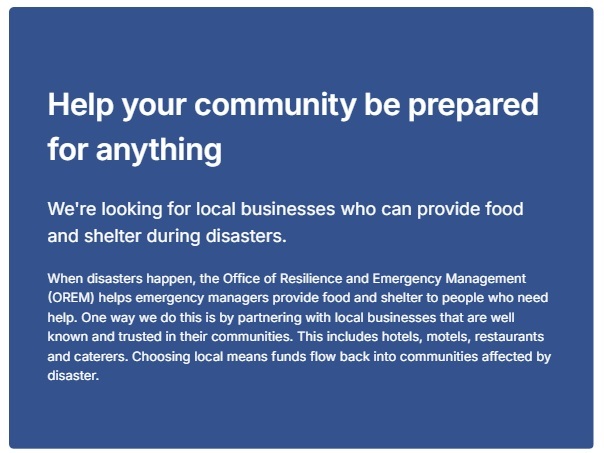
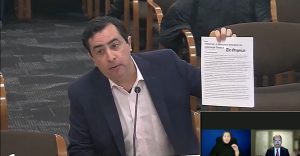
Presenter: The Oregon Food Bank told legislators about its plans, practice, and preparation for a Cascadia earthquake. Spoiler alert: There’s an ICS Liaison Officer, regular tabletop discussion exercises, after-action reports, and an organizational culture of continuous improvement. At the legislature Jan. 14, Chris Chuculate:
Chris Chuculate (Oregon Food Bank): My name is Chris Chuculate and I’m the associate director of distribution and warehousing at the Oregon Food Bank.
The Oregon Food Bank has a network of food banks across the state, as well as 1,400 food assistance sites in the state. And I’m happy to say that we do have a disaster relief plan for Oregon Food Bank, and it was based on the National Incident Management System (NIMS) structure and the Incident Command System (ICS) tools within that structure. I revised this plan and finished it up a couple weeks ago. It’s in place and ready to go.
These plans are at our main branch, 33rd Drive, North Portland, and our Beaverton location. Each of the remaining branches and regional food banks across the state have their own written plans, and they’re required to have their plans connected to OFB.
Additionally, I hold quarterly disaster response team meetings for the network throughout the entire state in preparation, response planning, critical discussions and more. And this year, we’ll be starting to hold tabletop exercises to test out our disaster relief plans throughout the state. In disaster situations, we could increase the frequency of these meetings as needed as well.
I think one thing that’s important to note for us is that we’re not first responders. So if a Cascadia subduction event happens, we’re going to be making sure that we’re reaching out to our employees to see if their families are safe—that is going be our first responsibility—and make sure that they can report to work in a feasible amount of time.
And if not, we’ll allow them time to get their belongings and their families together, report to work when they can.
When we have an event like this, we’re going to be sending out electronic notifications using Send Word Now throughout the entire Oregon Food Bank teams, these notifications go out through alerts via email, text, or phone.
One obvious question comes out of this, what if we don’t have any cell towers anymore, that’s going to be a problem. I’m currently working now to get a secondary communication device through FirstNet Cellular, and also we have an MOU (memorandum of understanding) with DHS (Department of Human Services) OREM (Office of Resilience and Emergency Management), and we could use their resources.
It’s called a COW. It’s just Cellular On Wheels, and it’s basically a cellular system that they cart out to you and set up. And then you have cellular data as well as phone calls.
Being the liaison officer for Oregon Food Bank, I would participate in calls and meetings when possible with Oregon Emergency Management and the Department of Human Services OREM Division to collaborate.
We start identifying locations that may need food and water at the Cascadia event. And with an event that size, there is a high probability that many geographical locations will be siloed, and we call it islanding. So pretty much think out in the Portland Metro region, if roads and bridges went out, there’s just going to be pretty much islands left over.
So what do we do in that situation? It would be really tough. We deliver our food via truck using the roads, crossing the bridges. So if road systems are down, we’re going look for alternative methods.
We would probably ship in food from other areas of the state through our network. And beyond that, we have support from FNS USDA (Food and Nutrition Service, U.S. Department of Agriculture) as well as FeedingAmerica.(org).
Simultaneously we’ll be assessing many things such as staff availability, access to our buildings, facility safety, building structural integrity, local and regional infrastructure failures.
Our main facility is built off Marine Drive by the airport, and that’s a liquefaction zone. So if there’s a big enough Cascadia event, it’s likely that our building would not be standing or could be sinking in the ground. Also likely that the dike may break on Marine Drive, flooding the area.
If something like that were to happen, then we would—according to our disaster relief plan—set up satellite warehouses in the Portland metro area and throughout the state using assistance from our network.
With Feeding America, we have many food banks across the country that can support us and the USDA has warehouses in Boise, Idaho that have plenty of food that they could ship over or fly over if needed.
So our response to the island mapping or to getting out to the community could be in relative short order with support from those two agencies.
Regardless of where we set up our operations, our goal is to serve the community with food and water to the best of our ability using the following daily operations.
Our incident command team would set up whether remote or in person. We would participate in emergency operation center meetings with state agencies. We would create incident action plans and execute them, provide staff communications with daily updates.
More importantly, we would evaluate what support staff may need, such as meals, childcare, personal support for any loss that they may have experienced.
We develop daily objectives, secure resources, track those resources. Inventory tracking, continuity operations is really big. We have to get food to the other agencies that we have. It’s possible that we still need to continue our normal business operations if feasible.
When that’s said and done, we would create after-action reports, we’d do some gap analysis to see where our processes are lacking or need improvement, we’d improve on our learnings and we’d repeat daily as needed until supporting recovery efforts take place.
So that’s the plan for us.
Presenter: To learn more about the Incident Command System, contact the Eugene-Springfield Community Emergency Response Team, CERT.
Volunteers from Southeast, Friendly, River Road, Santa Clara, and Bethel have developed tabletop discussion exercises for neighborhood groups. You can watch their YouTube videos, or get support in developing your own tabletops.
As retrieved Jan. 17, 2026, the DHS OREM home page is seeking local businesses: “When disasters happen, the Office of Resilience and Emergency Management (OREM) helps emergency managers provide food and shelter to people who need help. One way we do this is by partnering with local businesses that are well known and trusted in their communities. This includes hotels, motels, restaurants and caterers. Choosing local means funds flow back into communities affected by disaster. For more information, email Michelle.Richards@odhs.oregon.gov (with the subject line “Business Contracts for Food and Shelter”).