Lisa Loving and Jana Thrift offer tips for street journalists
6 min read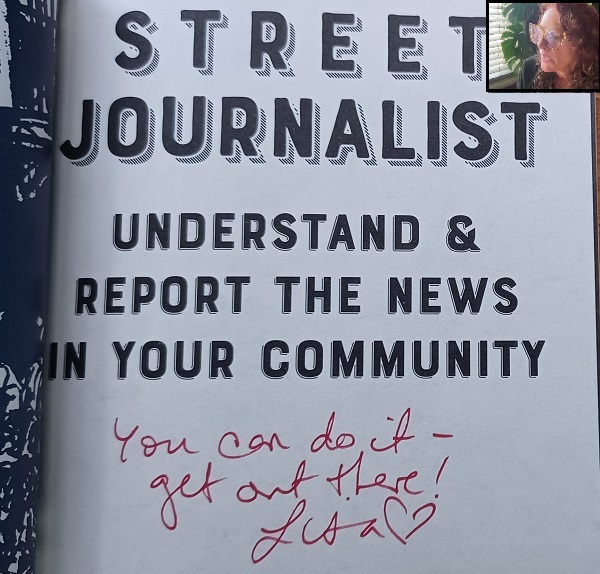
Presenter: KEPW’s Jana Thrift shows volunteer reporters how to livestream protests. And for all those attending and recording the Jan. 19 event, some tips for staying safe. From KBOO, author of the book Street Journalist: Understand and Report the News in Your Community, Lisa Loving:
Lisa Loving: The interesting thing, the amazing thing about the civil unrest that happened in Portland in 2020 is that everyday people went downtown with their phones and just started spontaneously being journalists. I’ve never seen such a thing. Never. It was remarkable.
Having said that, probably the most important thing that I want to impress upon you is that the Columbia Journalism Review basically came out and said the most dangerous place to be a journalist in America is at a protest. It’s not mamby-pamby. It’s really serious stuff.
Just be smart, okay? Do not take pictures and video of individuals’ faces when they’re engaged in direct action. Holy moly. Holy moly. I didn’t even know that was a thing until 2020.
So you might be going to a civil—it could even be a rally or something. And if you see people who are, I don’t know, locking themselves to a fence or if you see people breaking windows or throwing things at the police, I need you to understand that if you take a picture of their face, they might attack you physically right then, because that’s what happened.
Don’t take pictures of faces.
Because the other thing that happens is the police can confiscate your phone and look for all the pictures that you have of people at that demonstration, and then go arrest them. They examine social media, they try to identify people they didn’t arrest in the moment, and then they send people to their house later.
One of my biggest principles in covering civil disobedience or protest movements is: Do no harm. Okay? Do no harm. And this is part of it. Taking pictures of people’s faces, there might be a time when you think that that’s the story. You’re going to have to use your judgment, but be careful. Be aware.
All right, shifting gears right now, this is a big one: Who controls the narrative? I think it’s our job to ensure that issues behind the protest are not lost in the coverage of the protest itself. And we absolutely saw that with the college protests against the violence in Gaza. Like, almost, I saw so many headlines about those protests and how many of them were actually about Gaza, right?
So sometimes people will go and they’ll cover some violent situation and they don’t even talk about what it was about. These protests were about police violence and the police just brought the violence. So I need you to think consciously about: What is the narrative, who controls it, and make sure that you ring all of the bells about why you’re there.
National Lawyers Guild. I want you to write that down, okay? These are people whose job it is to literally track what the police are doing in a professional capacity. They’re almost all attorneys. These are legal observers and they’ll often have some kind of a vest that says ‘Legal Observer.’ Here in Portland they had a sort of Day-Glo yellow vest.
(And yes, the police beat them too. And every one of those resulted in a settlement that my taxpayer money paid. Just always going to underline that.)
Presenter: She recommended writing phone numbers on your arm. Lisa Loving:
Lisa Loving: When you get arrested, everything’s taken away from you, right? You can lose everything. But if you have the most important things written on you, it can’t be taken away and it’s useful. If you’re going to civil unrest, I want you to take a Sharpie, a Sharpie, right? and write the number of the National Lawyers Guild on there and write your editor’s phone number on there.
Have an advance plan with your editor about how you’re going to transmit your material to them if you’re on the ground in a scene of chaos. Decide in advance how you’re going to do that and when you’re going to do that. It’s important.
Try to find a buddy and team up, because when you are on a camera like this, you can’t pay attention to what’s going on around you. You can’t. Right? That’s not, that may not be readily apparent. And of course you might be there alone, but to have a buddy is very important.
If you’re an editor, if you’re a manager and you have volunteers or staff that have gone out there and been aggressed like that, self-care is important. If your journalists, if your reporters have been aggressed like that, you need to make sure that they access PTSD therapy, and I’m not joking. If you are at one of these protests, you need to get help if you’re physically injured, and please, please, please get therapy or counseling.
And I have to say this too: Livestreams are a big deal.
Presenter: At Growers Market Jan. 16, Jana Thrift:
Jana Thrift (KEPW): Okay, so what I showed up today for was to try to work on the idea of helping people understand how KEPW goes live on the air and can do that remotely from anywhere that we have wi-fi service. And I had this crazy moment where the thing with Renee Good went down and I felt really moved to be a part of that first emergency protest and it was too fast to get anybody on board for helping.
So I literally had my computer in one hand and I was livestreaming, absolutely crazy, but trying to keep the sound from the computer, which had to be on in order to have it go out on the livestream, away from the phone while I was livestreaming and talking over here to make sure that I could have that going on and discovered at that event that it actually is possible for me to livestream on my phone and be the mobile hotspot for my computer. (Woohoo!)
So let me explain how it’s done first, and how we’re doing it.
So YouTube has a thing called YouTube Live, and if you have at least 50 subscribers, you can use it. And once you’re streaming on that YouTube, it’s actually double fabulous, because people will watch the YouTube Live. It creates an another whole avenue besides KEPW to be heard, and it creates this backup YouTube Live video that is there for the longevity, you know? And so that’s kind of cool too.
Then once you have started streaming, then you need somebody that is actually on a separate machine—thus, the reason I had to have the computer—a second machine that runs an app called the BUTT app. In perfect radio humor, it stands for Broadcast Using This Tool, and it’s a really simple broadcasting app that basically you just say what stream you want—so we can play a stream from anybody. That’s how our live producers just produce a stream inside the studio.
And then that stream is what our broadcast computer says, at such and such a time, connect to that stream. And if they are on that stream at that time, their show goes on the air, and that’s how it happens. And we can do that from anywhere.
Presenter: And please remember to charge up your devices. From KBOO, author of the book Street Journalist: Understand and Report the News in your Community, Lisa Loving:
Lisa Loving: Charge everything and charge it again, okay? You could be out there for six hours. You could be out there all night. If you can, bring a portable battery pack and extra batteries, that’s going to help you.
The real goal of this whole project is to bring more journalists into community radio newsrooms. Because actually you’re going to be some of the most powerful people, some of the smartest and most connected people. And I can never say that enough. You should be doing this. And that goes for other people that are in your network, other people at your radio station, and you might know people at other radio stations. Please bring them over.
Presenter: Protesters can multiply the impact of their time at MLK / Day Without An Immigrant events. Hours you spent preparing, traveling, and participating Jan. 19 will be recognized with time dollars in your time bank account. The time bank supplements and supports mutual aid. Time bank members offer a wide variety of services, and members can also multiply their volunteer impact by donating time dollars to neighbors in need.