Fairmount asks for collaboration on East Campus
15 min read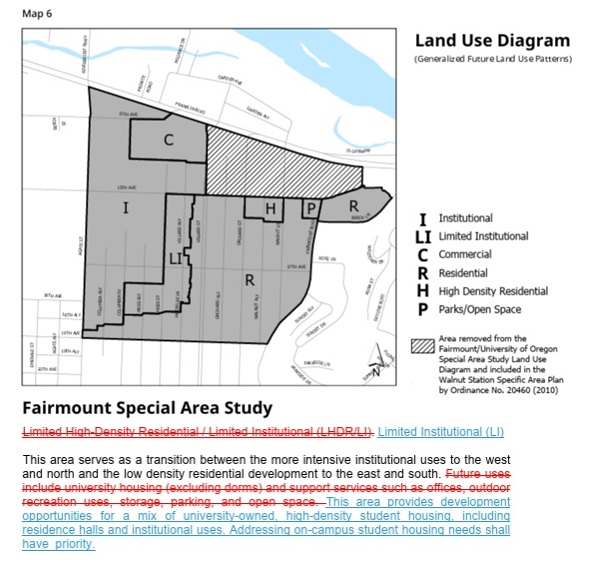
Presenter Fairmount Neighbors speak out against the University’s East Campus land use applications. At the City Council Jan. 20, Jeff Philpot:
Jeff Philpot My name is Jeff Philpot. I am co-chair of the Fairmount Neighbors Association, speaking on behalf of the FNA board.
We strongly oppose the sweeping amendments proposed to the Fairmount University Area Refinement Plan. Before you is not a limited or technical update, but a substantial rewrite initiated by the University without a legitimate opportunity for meaningful neighborhood review or input.
The applicant’s materials and the city staff report characterize these changes as narrow, supported by community engagement and consistent with the refinement plan’s goals of neighborhood compatibility and impact mitigation. That characterization is not supported by the record.
Taken together, these proposals would dismantle the refinement plan’s purpose, goals, and policies. They would allow high-impact development with no required impact assessments, mitigation obligations, public review opportunities, or requirement to address failing and unsafe public streets.
Despite repeated claims otherwise, the facts show these changes extend beyond the University property and were permanently and negatively affect all residential areas governed by the refinement plan. The proposals do not meet the city’s approval criteria under Eugene Code.
We urge you to carefully review the detailed analysis. That is included in FNA’s written testimony, as limited oral testimony cannot address all criteria or shortcomings tonight, the following speakers will address specific concerns on behalf of the FNA.
We respectfully request the Council remand this application and direct staff to convene a work group that includes FAA representatives justice Council successfully did in 2003 That process resulted in an updated refinement plan adopted without neighborhood opposition
Steve Gab Steve Gab speaking on behalf of Fairmount Neighborhood Association. We’re opposed to the ordinance. I’m frustrated and I’ll be direct. The application is full of errors and misleading claims, and the process is fatally flawed to this point. You can change that.
But I agreed to focus my remarks on the proposed refinement plan and code changes for the LHDR-LI transition zone.
For over a year, our neighborhood was effectively ghosted by our councilor. We later learned it was because he had been told he couldn’t talk with us about these proposals. That’s simply wrong.
I tried to follow the University’s internal process, but was repeatedly dropped from mailing lists. When we finally got the head and assistant planners’ attention last summer, we were told that the dorm behind us, right behind us, was already designed and couldn’t really change much. They showed us sketches with some articulation on the south edge, presumably to make us feel better, but they wouldn’t let us keep or photograph those because they were preliminary (of course).
We asked the Planning Commission to slow down long enough to understand what they were approving. They didn’t. Several commissioners admitted the proposal was too complicated, and yet they approved it.
Today, we were prevented from presenting a 3D model to show you what was happening on our block. That’s wrong. It’s an exhibit that immediately reveals the critical errors and misrepresentations in the applicant’s materials. We were told there was no way to enter it into the record. Photos don’t do it justice, but the model is outside. I ask that the model be entered into the record.
The East Campus area has evolved for over 20 years with a clear structure: intensive University development near campus; single-family homes along Villard and 19th as the graceful edge; and a transition zone meant to buffer the two. This proposal makes a mockery of that concept.
Buried in hundreds of pages is the potential for a 175-foot-long, 85-foot-high wall in the transition area. One corner is within 20 feet of R-1 homes, not the 75 feet their language even claims. Residence halls were explicitly prohibited in this area for one reason: They’re fundamentally incompatible in a transition buffer zone.
Our model’s outside. I’ll stay after the hearing to answer questions. Thank you.
Hillery Kyablue My name is Hillery Kyablue. The refinement plan and code amendments violate so many sections of the city code, it would take all my time to read them. Despite this, the applicant would like you to believe they are simply making a few minor changes to heights and seeking permission to build a dorm.
The refinement plan and East Campus overlay zones established this area for less-intensive uses, creating a transition between high-intensity university uses like seven-story dorms and our adjacent single-family residential area.
The proposal would eliminate these long-standing community policies and allow intense development with major negative neighborhood impacts, without any meaningful land use review to address those impacts.
The applicant’s polished, colorful renderings and elevation drawings, shown at a very small scale, are deeply misleading and do not convey the true scale of what is proposed. So we built a scale model of our block so you could have an honest deliberation, but we were not allowed to bring it and have been told that there’s no way we can share it with you.
It’s so frustrating. We are desperately trying to communicate with our elected officials, but are being barred from talking to you and showing you important information before you make such a devastating decision. Please help us.
Susan Macomson My name is Susan Macomson and I’m speaking on behalf of the Fairmount Neighbors. While the University repeatedly states that their application and city staff have reiterated that the proposed refinement plan code amendments are limited to University-owned properties within the East Campus plan, this is not the case.
Their proposals would change the refinement plan affecting all low-density resident residential properties in this area. The applicant proposes to amend the refinement plan diagram map, Map 6, by redesigning the low-density residential or ‘L’ areas to ‘R’ for residential. This does not meet the criteria of approval in Eugene Code 9.8424.
This amendment would change the land use designation of 216 residential properties, 187 of which are outside the East Campus plan and not owned by the university.
First, the Council cannot find proposal consistent with the adopted Comprehensive Plan as required in EC 9.8424, for the comprehensive plan does not recognize ‘R,’ which is undefined in both the plan and the city code. It only recognizes three residential designation designations—LDR, MDR, and HDR—each defined by allowed densities.
A proposed ‘R’ is vague, unique to the University, undermining the citywide framework and eliminating LDR density limits in our neighborhood.
Second, the proposal is not consistent with other portions of the refinement plan as required in EC 9.8424. The plan’s goals are: Preserve the character of the single family areas.
While the neighborhood understands the policies, encouraging increased density may change the area over time. Redesigning all LDR areas as ‘R’ exceeds the applicant’s scope, violates the plan’s core goals and policies.
Third, the Council cannot find the proposal consistent with EC 9.8424. U of O and city staff state the amendment aims at simplification, but simplification is not a condition listed in EC 9.8424.
Tom Jordan My name is Tom Jordan and I’m speaking on behalf of the Fairmount Neighbors Board as chair of its Transportation Committee. Transportation and traffic impacts from the University of Oregon developments aren’t new. But they’re getting worse and demand immediate attention.
The city’s Fairmount Refinement plan, last updated in 2004, recognized these impacts and required studies to maintain safe and functional streets. These studies are now outdated and no longer reflect current conditions or future development plans.
Over the past 20 years, cumulative U of O development has dramatically changed and intensified traffic in this area. New residence halls, Hayward Field, Matthew Knight Arena, and continued East Campus expansion are examples.
We’re seeing increased traffic cutting through the Fairmount Neighborhood, University-related truck traffic on neighborhood streets, damage to pavement and infrastructure, and inability for residents to park because there are no driveways. Yet, no comprehensive assessment of how all this development affects the Fairmount neighborhood and how impacts will be mitigated has been required.
The applicant’s TPR (transportation planning rule) analysis, performed by consultants beholden to the client’s interests, is fundamentally flawed. It fails to measure existing cut-through traffic and misrepresents Agate Street’s conditions. Mitigations that have been discussed, like raised platform intersections, will not improve traffic flow on Agate, which by city classification must function as a minor arterial. Instead, they will increase driver frustration, intensify unsafe pedestrian crossings, and push traffic into Villard, Orchard, and Walnut Streets, directly violating statewide Planning Goal 12 and not meeting approval criteria EC 9.8424 and 9.8065.
Let’s get this together with the city, the University and the Fairmount Neighbors.
City Kay Rose.
Kay Rose I am very opposed to the nature of this, but tonight I’d like to focus on traffic, specifically Agate Street, because it has unique challenges within Eugene’s street system. When the University is not in session, Agate can be relatively quiet, but when students are here, traffic is much heavier and often manageable at times, but every 50 minutes during class changes, the unregulated flow of students and other pedestrians can completely stop vehicle traffic for 10 to 15 minutes at a time.
These reoccurring gridlocks frustrate drivers, create very dangerous conditions for cyclists and pedestrians. I mean, coming here tonight with a U of O basketball game, I witnessed a few.
Traffic studies that average volumes over an hour completely missed this reality. These flash flood traffic impasses are happening now without the intensive new development being proposed. Ignoring them will only make the problem worse.
The transportation planning rule analysis for this application is deeply flawed and has, I feel, inadequate. Parameters provided by city staff failed to account for Agate’s unique conditions, instead relied on assumptions that predict that things will be okay.
The conclusion that four new dormitories, a parking structure, multiple institutional buildings and there will be no traffic problems during a typical work week is just—it’s just flawed. This dismisses the real and dangerous 10- and 15-minute gridlocks, near-misses that we all who live in the area see every day.
The study also appears to exclude event traffic from Hayward Field and Matthew Knight Arena, where major congestion already occurs. The University’s desire to close Moss Street and 15th Avenue will further increase the congestion. We’ll have vehicles idling, pollution, cut-through traffic in the surrounding neighborhoods.
Everyone agrees the current neighborhood traffic management plan is outdated. Yet the applicant asks you to approve major development now and maybe study traffic later. That is backwards. Traffic analysis and mitigation should guide development, not follow it.
An update to the Fairmount Agate Traffic Calming Plan is urgently needed just to catch up with the last 15 years of growth. Private developers are typically required to mitigate their impacts. The University will spend hundreds of millions of dollars building out East Campus. It’s reasonable to expect meaningful traffic mitigation.
Mary Jaqua My name is Mary Jaqua. I’m here to ask the Council to recognize that the scope and complexity of these proposed amendments, combined with serious shortcomings in the review process, warrant more time and careful consideration by Council before final action is taken.
Four of the five planning commissioners present at their deliberations stated on the record that the issues were too complex and that they relied on the staff report. One commissioner abstained from voting because the materials were overwhelming and difficult to evaluate.
Unfortunately, the staff report itself largely restated the applicant’s narrative rather than providing a critical analysis against the approval criteria. It glossed over key issues and failed to provide consistency findings for many of the proposed changes.
The agenda item summary provided to the Council similarly oversimplifies the proposals and omits discussion of changes with significant neighborhood impacts.
Community open houses hosted by the applicant focused on the East Campus Plan and the Next Generation Housing Strategy. There was no meaningful engagement around the full scope of the refinement plan changes, and our concerns about conflicting statements, inconsistencies, and factual inaccuracies remain unaddressed.
The proposed edits delete important language related to preserving existing neighborhood homes and character. Taken together, these changes effectively gut the intent of this plan, a document that will become part of the community policy for decades to come. Why would the city allow this?
Our neighborhood deserves meaningful input as equal stakeholders to the plan, independent analysis from the city staff, due diligence from the Planning Commission, and real representation from the City Council.
Our request is straightforward: Please pause this process and convene a committee that includes Fairmount neighborhood representatives to ensure the refinement plans, goals, policies are upheld alongside the University’s development objectives. We ask that the Council honor envision Eugene’s comprehensive plan, especially Pillar 5: Protect, repair, and enhance neighborhood livability.
Nathan Markowitz My name is Nathan Markowitz and I stand in opposition to the sweeping changes. Fairmount has one of Eugene’s few remaining concentrations of historic structures, including the grand houses of Washburne and McMorran, along with other historic structures dating from the earliest parts of last century, up through the historic mid-modern architecture.
Originally a separate city for early residents to escape the summer heat, we enjoy numerous city parks, including the jewel of Hendricks Park. We also have the terrific University of Oregon as our neighborhood, and we clearly understand their need to build on-campus housing for their student population.
Unlike the collaboration between the neighborhood and the University in past negotiations, this application to expand institutional uses through vast amendments has largely ignored the neighbors’ concerns. While arguing that the amendments and city code changes will preserve the character of the neighborhood, their current request torpedoes the previous extensive agreements with the neighborhood, negotiated in good faith many years ago to preserve the character of Fairmount.
As a member also of the City of Eugene Historic Review Board, I find this approach concerning. I respectfully request that the City Council defer approval of all requested changes and send the matter back to the neighborhood and the University of Oregon to work out, in good faith, an agreement which considers both parties’ concerns. We need to preserve a part of the past to help us understand where we are today, and to plan for the future in a responsible fashion.
Councilors, please do not approve these requests as written. We have enough conflict nationally. Let us bring collaboration to our great city. Thank you.
Sue Jakabosky My name is Sue Jakabosky and I speak tonight as opposed to this ordinance. It is deeply frustrating and frankly unbelievable that I have to be here again, repeat the same history.
Time and again, the University has attempted to push forward major development by eliminating the policies that require them to address neighborhood impacts. And time and again, it has taken neighborhood outrage before the City Council or costly appeals to LUBA just to ensure our issues are addressed.
We are not opposed to development. We simply expect the city to apply standard land use regulations to assess and mitigate impacts. That should not be too much to ask of you.
We have been here before. In the late 1990s and early 2000, city staff proposed the Walnut Station Mixed Use Plan, which would have allowed high-rise development directly adjacent to the Fairmount neighborhood, very similar to what is now being proposed along Villard and 19th streets.
After neighbors spoke out, the City Council sent staff back to the drawing board. The result was a collaborative plan with stepback building heights, landscaping, and other mitigation measures. That plan was adopted without opposition. We ask for the same thoughtful approach here.
History repeated itself in 2003, when the University updated its East Campus plan and attempted to eliminate the substance of the refinement plan that requires meaningful transitions and mitigation between campus development and surrounding neighborhoods.
Once again, it took a neighborhood uprising for City Council to send it back and require a mediated workgroup. That process worked again. The refinement plan we have today was adopted without opposition.
And then again in 2008, the same thing happened with the Matthew Knight Arena. We did not oppose the arena. We insisted that it required a conditional use permit to mitigate impacts. But the city didn’t listen. Unfortunately, it took a successful appeal to LUBA to make that happen.
City David Wade.
David Wade For 30 years, the Fairmount Neighbors (myself included) have worked with the city and with the University of Oregon to resolve numerous land use issues like these. And we’ve always succeeded, except the one time we had to take them to LUBA where we prevailed.
The neighborhood’s involvement works because our committee includes a former city planner, an architect, and a retired general contractor who have the expertise to reach mutually acceptable ways to increase housing density, which we favor, while mitigating the effects on the neighborhood.
For example, in 2004, after Fairmount Neighbors’ objections, the city directed that a technical advisory panel be created with representatives from the U of O, the city, and the neighbors to hammer out the refinement plan that allowed more intensive U of O uses while preserving the historic character of the neighborhood. It can be done. We did it.
Without invoking that process, the U of O has now unilaterally proposed major changes to the refinement plan that undermine the plan’s agreed policies and goals, and threatens the livability of the neighborhood—to me, clear violations of Eugene Code 9.8424 and 9.8065.
The U of O claims that it engaged the neighborhood. It did not. I went to every engagement, be it an open house or internal U of O meetings to which the public was invited. My comments and those of other neighbors who attended were ignored and are nowhere reflected.
Catherine Bryce My name is Kate Bryce and today I’m speaking here as a neighborhood resident and a student and opposed to this proposed plan.
My roommates and I were thrilled to find a house a stone’s throw away from campus. But that excitement has been overshadowed by this proposed East Campus plan. The sheer scale of what’s proposed directly behind our house is utterly dismaying, and with no transition whatsoever from between it and our home.
Compounding these concerns is the University’s internal planning process and seemingly performative approach to the community. This final proposal lacks collaboration as well as these key neighborhood protections that were described as remaining and in place have been removed from legal documents.
Because of this, I’m asking the city to pause this project and require a conditional use permit process—the same process that was used for Matthew Knight (Arena), resulting in traffic management plans and reduced traffic impacts on the neighboring communities.
Without any level of scrutiny, conditions would have been far worse. This East Campus proposal will increase traffic and parking pressures and altering the character and livability of this neighborhood—changes that deserve project-specific review.
On the note of traffic concern, the problem lies in unpredictable traffic patterns. The proposed raised intersections on Agate might contribute to pedestrians proceeding without awareness, increasing frustration and reducing safety. By contrast, traffic signals indicating the turns of drivers, cyclists and pedestrians, and making intersections safer will make intersections safer and more efficient.
The lights on Franklin Boulevard were installed by private developers protecting student tenants, and it’s reasonable to expect that the University would meet the same standard for their students.
In freshman year, I fell in love with Fairmount, and that same fondness is how families are born and raised here. When you plan to build such a big structure without regard for surrounding communities, that charm begins to fade. I want to be clear that I’m not opposed to on-campus housing as a concept, but I think it’s clear today that the majority of people here are asking for fair, transparent, and a collaborative process that helps the University and minimizing harm to their neighbors. City Council has stepped in before to demand that kind of honesty and rigor, and so I hope you’ll do so again here.
Susie Smith My name is Susie Smith and I’m speaking on behalf of the Fairmount Neighbors as the chair of our land use committee. And I’m the summary speaker.
What we’ve seen so far amounts to a railroad job, one built on misleading and non-factual information. We urge you to reject this process and put it back on proper course by remanding the matter back to staff and directing them to convene a mediated process.
Through that process, representatives from the neighborhood, the city, and the University can work together to develop a legitimate fact-based refinement plan update that will meet the application approval criteria.
Let me be clear: We are not objecting to the U of O’s housing goals. We believe that with meaningful stakeholder input and participation, the refinement plan and city code can be revised to support next generation of U of O housing while still preserving the core protections intended to care for our residential neighborhood.
To uphold the goals and policies of the refinement plan, expanded building permissions cannot be unfettered as currently proposed. Neighborhood impact mitigation, such as conditional use permits, building setbacks, stepback height limits, traffic mitigation, and landscape requirements are standard land use tools. They exist to prevent lasting, irreversible harm to the surrounding neighborhood.
You have both the authority and the responsibility to ensure that the refinement plan fulfills its purpose of guiding the future development in the University and the neighborhood. City staff and the Planning Commission are effectively asking you to hand over the land use and transportation policy to a single large property owner at the expense of hundreds of residential neighborhoods whose quality of life, safety, and property values this plan is meant to protect.
Presenter Frustrated Fairmount Neighbors oppose land use changes and say Eugene planning commissioners approved a package they didn’t understand.