Public comment: How to keep Amazon out of Eugene
13 min read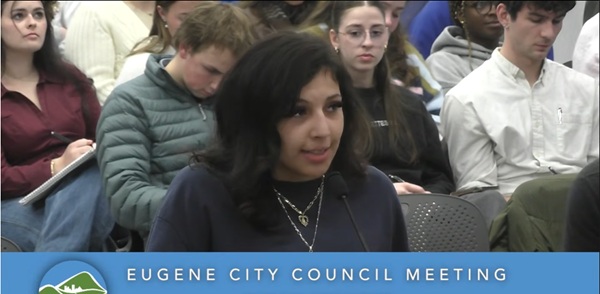
Presenter: Public comments at the Eugene City Council Jan. 26 demanded that officials stop the Amazon megawarehouse. Victoria Acosta:
Victoria Acosta: I’m here because Eugene is about to make a very Eugene decision saying we care deeply about the environment, community health, and local values, and then improving a massive Amazon warehouse.
I know the script: This project is inevitable.Your hands are tied and technically it checks all the boxes. But inevitability isn’t a law of nature. It’s just what happens when no one in charge says, ‘Actually, wait.’
This warehouse means more diesel trucks, more pollution, more traffic and harm to wetlands in a city that prides itself on being green. If this is sustainability, it’s the Amazon Prime version: fast, convenient, and someone else pays the cost.
We’re also told this will bring jobs, but these aren’t community rooted long-term jobs. They’re high-turnover, heavily automated positions for a company known for treating places like their temporary storage. Eugene is not a fulfillment center. We are community. Dr. Seuss put it better than I ever could:
‘Unless someone like you cares a whole awful lot. Nothing is going to get better. It’s not.’
So please care a whole awful lot. Slow this down. Demand real protections and prove that Eugene’s values aren’t just something we print on reusable tote bags.
Will Gibboney: My name is Will Gibboney. I’m adamantly against having the Amazon megawarehouse here in our city of Eugene, and here’s why:
- They’re going to build a 320,000-square-foot warehouse on 84 acres of farmland that includes nine acres of wetlands.
- Any warehouse jobs that they’re going to have will be replaced by robotics by 2030.
- There’s going to be a huge increase of traffic on Highway 99. It’s already challenging and dangerous just to go to Jerry’s. I don’t know the last time you went there, but holy cow.
- The fact that they were secretive in buying the land and not having any community input at all.
It is terrible that that happened, and that’s why I’m here tonight. I want to give my input.
Amazon also provides our fascist federal government data storage on data used to target immigrants. Do I need to say more about that? Why not support local businesses rather than a huge multinational corporation that frankly doesn’t care about me and doesn’t care about you, it doesn’t care about us at all.
As our elective representatives, I would urge you to do what you can to stop this construction. Or rather destruction.
Lastly, I’m sad that Amazon thinks that there’s enough local consumers of their products to warrant this tragic destruction of our environment in the first place.
Marilyn O’Malley: Hello, I’m Marilyn O’Malley. I boycotted Amazon for years and today I was challenged to look up factual information about Bezos and Amazon. When I actually started digging into it, I expected to find out that they had an absolutely horrible environmental record. That’s not what I found out at all.
I was surprised to find out that Bezos is an advocate and donor for the environment and he achieved his goal of running his company on 100% renewable energy seven years early. They do provide their own energy with solar and such, and they do have electric vehicles.
I would like assurance that that will be the case when they come to Eugene. I’m not going to assume that, ‘Oh, well of course it will be.’ I want assurance that they won’t be causing pollution.
I researched and found that the Amazon warehouse in Woodburn, Oregon is the largest one in the whole Northwest, and it only employed 1,500 workers, who worked with 6,000 robots. So it’s hard to believe that they will be hiring any more than 1,500 people here and quite possibly, not that many.
I really believe that the people of Eugene should know exactly how many people they do plan on hiring. In October, 2025, the New York Times reported Amazon plans on laying off half a million people worldwide. They’ll be replacing them with robots.
News reported on CNBC, Yahoo Finance and BBC and many other sources that Amazon is laying off 14,000 employees.
As per the employees Amazon does have, my research indicates that Amazon employees are under continual surveillance.
Ruth Wren: I’m Ruth Wren with Indivisible Eugene Springfield, and Mayor Knudson, I voted for you. You said, ‘I will stand with you and for you in all of our work.’ Yet in spite of many hundreds of calls, emails, letters, and people speaking here against the Amazon warehouse, all of the public’s concerns have been ignored.
Some are in favor of the warehouse because they think it will bring good jobs, but they’re not good jobs. Amazon is anti-union. Workers are under surveillance. They must meet high quotas and suffer a high injury rate. And Amazon plans to use robots in AI for three-fourths of its warehouse work by 2030. It already has over a million robots working.
And regarding traffic, why did the city accept Amazon’s own report stating that 2,600 trips a day won’t be a problem? We need an independent assessment. And even if their delivery trucks are 70% electric in 10 years, what about the extra demand on our grid for electric trucks, robotics, and AI?
But worst of all, Amazon Web Services powers ICE with cloud tech for data management used for hunting down kidnapping, deporting, and imprisoning immigrants, activists, and anyone who opposes Trump.
Tomorrow evening, you’ll speak at the Healthcare Workers Against ICE protest about the murder of Alex Pretti. If you’re against ICE, stop this warehouse. Don’t partner with this corporate collaborator. Please be true to the values you express. Halt to permit process, and require impartial traffic and environmental studies and an accurate report on the jobs.
Presenter: Bill O’Brien:
Bill O’Brien: The Amazon distribution facility, it’s 10 digits application. I believe it’s approved by you.
So, this is going to go through, I’m afraid, but I would like to stop it. And the only way you can stop it is through LUBA Land Use Board of Appeals and filing application, I believe is $350.
So you submit the $350 and I don’t know where the first stop is, whether it’s LUBA in Salem, or whether it’s an appellate court. And what can we base our appeal on here? Comprehensive plan change, zone change, conditional use permit, variance. Well, they did get a variance to pollute through the LRAPA and there was 400-some commentaries there.
How many people commented to LUBA? A few. So I hope more people will get on the bandwagon to prevent this monstrosity to occur.
Lori Harmon: Lori Harmon, and I am also here to talk to you tonight about the Amazon warehouse project. As you know, Amazon provides cloud computing services to ICE as well as the Israeli army.
What I would like to talk to you about though are not all of the moral or ethical reasons that we would like to keep Amazon out of this community. I think that we’re all really well aware of those.
Aand I think that we understand that there’s not a lot that you can do, you know? Contractually, there’s not a lot that you can do in terms of code. You can’t say, ‘Well, we don’t like you, we don’t want you here.’
So what I’m going to ask you to do is to take a look at the permitting process. So, according to the permit submitted by the project coordinator to the Department of State Lands, the project area is 84 acres.
The permit diagrams show that about two-thirds of that land will be covered with impermeable surfaces. So that’s about 56 acres of land that used to absorb water that’s going to create just a huge volume of surface runoff. Their current plan is to divert that surface runoff into two small rain gardens.
Those rain gardens in turn are going to drain into the existing public ditches and those ditches route water into a system of storm water drains that was designed to handle the volume of storm water that was being diverted into the dishes before those 56 acres were, you know, converted into impermeable surfaces.
Interestingly enough in the Department of State lands application, the contractor is not suggesting any upgrades to the public infrastructure. And my question around that would be, you know, is that because it might take too long to actually get the infrastructure that’s needed in place?
So I’ve been out to the proposed site on two occasions and I’ve actually looked at the storm drains which you can locate using the website. The city’s website conveniently has that information there, and I can tell you that they’re crumbling.
Presenter: Linda Kelley.
Linda Kelley: I had planned to talk specifically about the Amazon project, and I was going to be a little more nuanced with coming up against it, sort of, saying: We have a CRO (Climate Recovery Ordinance) and a (Climate Action Plan) CAP 2. We could require them to have solar and electric vehicles, etc., etc., and that that may be a pathway to go. After listening to some of the testimony tonight, I now feel less sure that we should be allowing them.
Jo Martorana: Hello, my name is Jo and I’m a student at the University of Oregon and I’m here to demand action to stop the planned Amazon facility. I could take up the whole time listing reasons that Amazon should not have a place in this city, but I want to focus specifically on the fact that they actively enable ICE in the technology that they use to terrorize our community.
I hear your words against ICE, but like many others said, there needs to be action behind them. Amazon’s facility stands for everything y’all expressed disapproval and horror over at the beginning of this meeting. If you stand with Minnesota and stand with our community, then stopping the plans for this facility is what needs to happen.
The feelings of horror and dismay can be used to do something tangible. You say things at the federal level, make things at the local level hard to navigate and it’s true. But don’t ignore things like this that could be within your power to change.
Stan Taylor: My name’s Stan Taylor. I am with Indivisible Eugene Springfield, and I want to start tonight by asking each of you to publicly declare your position on Amazon. Don’t hide behind a permitting process and say there’s nothing we can do. If you’re for it, tell us you’re for it. If you’re against us, tell us you’re against us, so we can, as the public, know how to hold you accountable.
You want to know, I’m going to put my former lawyer hat on here and say, there are lots of gray areas that can allow you to revisit this permit. Let’s start with the obvious one: Transparency.
State law 455.050 requires that, I’ll read, it requires that all building permits issued in the Oregon shall contain the following information, and the first is name and address of the owner of the building or structure constructed.
You know, we’ve only recently learned that Amazon is behind this. We never learned at the beginning, so we didn’t have the ability to protest, to have public hearings, no transparency for other reasons that are breaches of duty, of care of this community that are gray areas that can allow you to reopen this permit process.
And I want to tell you, the biggest reason I have for wanting you to reopen this permit process has already been mentioned, and that is that Amazon is the web service for ICE helping to trace down our neighbors.
And when you think about what’s going to come into our community through Amazon, they’re going to have drivers with trucks with 360-degree cameras collecting data. The drivers will also have AI glasses collecting data. That data goes into their database, just like their ring cameras. It will be provided to ICE.
You are providing the means by which they will be taking our neighbors away.
Charmane Landing: I am Charmane Landing. The deeper I look into the Amazon megawarehouse, the more I’m convinced it’s a bad fit for Eugene. Some of the issues are:
- The megawarehouse doesn’t match the vision or values of the Clear Lake Overlay.
- Amazon has a dismal working conditions record, and the promised entry-level jobs are temporary. They’ll be replaced by automation in a few years.
- Existing USPS and UPS Union jobs will be lost.
- Amazon kept its identity away from the public with only a short Zoom meeting between the developer and two local parties.
Other cities are saying no. In cases where they demanded higher wages or better working conditions, Amazon pulled out. However, the issue I find most alarming is the increased volume of traffic. One of Eugene’s most dangerous intersections is at Highway 99 and Aubrey, which at present is a fielded rural area.
Amazon will add nearly 2,600 vehicle trips per day into this already-dangerous Highway 99 area where the flow of traffic is 60 miles an hour. Eugene didn’t require the developer to submit a formal traffic impact analysis because a professional traffic engineer on the developer’s team submitted an analysis, but not to worry.
The study states the majority of vehicle entrances and exits onto 99 will occur between the two off-peak hours of 10 to 11 a.m. and 9 to 10 p.m. The majority means at least 2,000 vehicles will be entering and exiting Highway 99 during those two one-hour windows. There was no mention of enforcement or fines.
Our Mayor Knudson voiced her concern about safety in the Highway 99 corridor, and rightfully so, adding this high volume of delivery vehicles to an already dangerous corridor is adding fuel to the fire. This project will negatively impact many components of our infrastructure from our environment to our community.
I’d like to see industry and growth, but the kind that’s in accordance with the values cited in the overlay. I truly believe Eugene will come to regret allowing Amazon in. I respectfully ask that this application, at the very least, be put on hold for further study and community input.
Faye Rachford: Faye Rachford. Once again, I am here on behalf of the many citizens that are unnerved by the Amazon warehouse proposed project. There’s so many ways that this is a bad idea and everybody has already noted them, but here we go again.
The environmental impacts have been minimized and the studies not independently handled. There’s going to be runoff, air pollution, and the migration patterns will be disrupted. We have endangered species out there that I haven’t seen anybody do anything about.
I am demanding that the city wield whatever power and with whatever backbone you can muster to halt this permit until an unbiased, you know, not conducted by Amazon study, be done for traffic, the ropa, air pollution, the environmental study by intelligent scientists so that we will have faith in the results.
I don’t believe they would be paid by Amazon. I was going to welcome the new city manager, and also point out that the online office declares that the city of Eugene City Manager’s Office ‘provides services and programs to improve government and sustain Eugene’s unique quality of life.’
Amazon does not fit that in any way.
I would suggest (I’m hoping that she will review this meeting), that she hear us and that she prove it. I understand from a comment overheard that she believes that this is going to be great for employment. We all know the robotics, the 2030 thing, there will be very few jobs.
You have a very passionately disputed issue that was so poorly handled that it has outraged so many people in Eugene. So again, I am stating clearly: You’ll be remembered for supporting the citizens of your community, or you will be remembered for turning your backs on us.
Presenter: Deb McGee:
Debra McGee: In the early 1980s as a public school counselor, I was appointed to be the Title IX trainer and Compliance Officer for the Yakima Public School District. I was young and I didn’t understand no one wanted to do it, but I believed in Title IX, which basically said: No student on the basis of sex can be excluded from participation in any education program.
It was equal opportunity for girls in schools. This law changed business as usual. It challenged the status quo. It took a huge effort to infuse equality for girls into the public schools. Everyone had to change. The project is not done, but it’s better now. And lawsuits against the schools helped changes happen.
Here’s my point: First adopted in 2014 and updated in 2016, Eugene passed the Climate Recovery Ordinance. I quote: ‘By the year 2030, all businesses, individuals, and others living or working in the city collectively shall reduce the total use of fossil fuels by 50%.’ Another section says emission reduction levels should be 7.6% per year.
We are not on schedule to succeed in meeting these goals. So why would the city of Eugene issue building permits to businesses that increase our pollution when Council in 2014 passed an ordinance—which is a law—to lower pollution? Does the Planning Department know there is a law to reduce carbon emissions?
Do they have a filter they must put applications through to determine if a business violates the goals of the Climate Recovery Ordinance? Does the Amazon project meet or violate Eugene’s laws? You have the responsibility to cause the city and community to comply with the Climate Recovery Ordinance.
Mayor, city manager, councilors, staff in every department should ask:
- What does it mean to have a Climate Recovery Ordinance, and how does the decision that’s being considered intersect with meeting the goals of the CRO?
- Will you as our elected representatives ask staff to investigate how Amazon affects Eugene’s Climate Recovery Ordinance?
- Could the CRO be used to stop Amazon?
Presenter: Public comments suggest ways to oppose the Amazon megawarehouse, while criticizing the mayor and Eugene City Council for failing to defend Eugene values.