Girl Scouts ask city to restore CAHOOTS
5 min read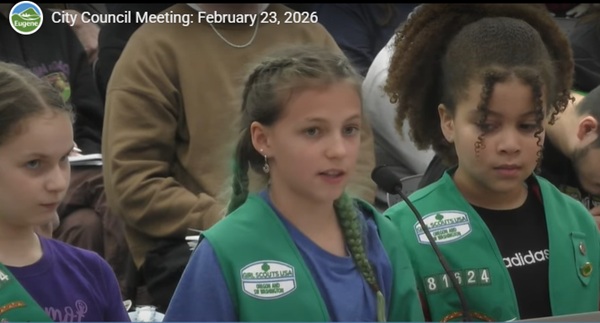
Presenter: Girl Scouts asked the Eugene City Council Feb. 23 to restore the CAHOOTS mobile crisis service, as other public comments noted that the loss of street wound care has led to an increase in amputations.
Girl Scouts: Hello, my name is Greta and I’m also speaking on behalf of Hazel, Rayna, and Maya. We are all Girl Scouts in Troop 81624. We are here because we see homeless people on the streets, and our troop wants to change that.
Sadly, we see unhoused people all around the city. Those people who are suffering through houselessness need better care because they don’t have help with their mental crises when they get hurt and when they’re harassed with no place to be.
We are worried that the new CAHOOTS won’t be the same as the old one we had in the past that provided these resources for unhoused people. They deserve good quality resources like we do.
We would like to see the new CAHOOTS be the same or better than the old one in the past. The new CAHOOTS should go everywhere in town and access all the camps to help the homeless population. They should answer 911 calls. They should have five vans instead of two, and they should have all the resources they need.
We would also like to see the city fund the new CAHOOTS. It would be useful to the city to install a new CAHOOTS because homeless people are part of the city too. If we support houseless people with their needs early on, we can avoid escalation.
It would also benefit the police to have the new CAHOOTS take some of the calls that go to the police so they can focus their attention on things that need it.
CAHOOTS medics help homeless people with their injuries. That helps decrease the percentage of deaths. We think that having a new CAHOOTS would benefit the homeless population and the city of Eugene. Thank you for listening.
JoJo Breslin: I’m JoJo Breslin. I was going to give some reasonings on why I think we need to expand the RFP that was sent out for a CAHOOTS-like service. I think Greta and her troop expressed that more than I could. So I hope you guys were listening closely to her.
Jacob Trewe: My name is Jacob Trewe. I also stand with the amazing Girl Scouts that were here just a moment ago. Your testimony was inspiring and thank you so much.
We’ve been without community response here in Eugene for over nine months. Nine months, and I was thrilled when the recent RFP, which stands for ‘Request For Proposal,’ was issued.
As a concerned citizen with an acute interest in getting alternative community response back in Eugene, I sent many questions to the finance department, who are the folks who field questions from folks like me and folks associated with WVCC (Willamette Valley Crisis Care), which I’m also a board member of.
I’d like to acknowledge the patience and hard work of purchasing analyst Darren Schmidt. Thank you, Darren.
One of the recent responses indicated that the proposed budget for this RFP was $375,000. Unfortunately this isn’t enough, even for a limited-scale pilot program. When you take a look at the peer navigator program, they’re contacted with the police.
If you were just to expand out those hours from the 9-5 Monday through Friday that they currently have, to seven days a week, 10 hours, that already breaks the budget, the $375,000 budget. It isn’t adequate for even the start of a community response program.
The RFP calls for 10 to 12 hours a day. When we start to get to 12 hours a day coverage, we’re looking at minimum, half a million dollars.
So $375,000 is inadequate to be able to cover under the RFP, even for a pilot program, if you’re wanting an entire year. If your plan was for half of a year, we could make that work, but for a full year, it is impossible.
I think folks over at WVCC have sent a message to that request and some clarifying questions around that. We need to get community response back here. So I’d like to make sure that that message gets passed along.
Athena Aguiar: Hello, councilors. I’m Athena Aguiar. As a former Girl Scout of 12 years, I just wanted to echo what the troop said. We need the return of a CAHOOTS-like crisis response ASAP.
The current inadequate RFP does not seem to be for a 24-7 crisis response service accessible through 911 that includes response to the downtown area, the most critical part of town for response service of this kind.
Right now, mid-acuity calls are being responded to by police officers who are far more expensive for the city than crisis response workers. We need a proper bridge to the return of alternative crisis response in Eugene.
Robert Parrish: Robert Parrish here, 20+ years as a community responder in Eugene and Springfield.
Last time I came before you to call attention to the problems with the RFP for alternative response. Today I’m here to illustrate how the RFP is more than a swing and a miss. It should be canceled, corrected, revised, and reissued.
Cancellation and reissue is the needed approach because this RFP asks for 12 hours per day, seven days a week, plus two directors. But it lacks the budget for this. At $375,000, it’s just 17% of the funding discussed in this council for returning alternative response.
Cancellation and reissue is the needed approach because the RFP is redundant with a service already fielded— EPD’s Eugene peer navigation initiative awarded to Ideal Option.
This RFP is not only redundant to that service in asking for 12 hours per day, it does not scale with the costs of the service the police modeled their suggestion on. This peer support service is no replacement for CAHOOTS.
Cancellation and reissue is the needed approach because this RFP is not responsive to the city’s own gaps analysis. It does not address mid-acuity behavioral health in Phase 1 and does not provide enough funding to allow trained responders to get to Phase 2.
It doesn’t address low-acuity social service calls besides frequent callers to 911, leaving too much of the community unsupported.
It does not address youth crisis, despite the recent end of the contract with Riverview Youth Crisis Response, making that gap more acute.
And some have insisted this RFP doesn’t need to respond to wound care and non-urgent medical calls, despite the gaps analysis calling for proactive outreach and hospital staff noticing an increase of serious untreated wounds resulting in amputations. This is with the services available today.
If a pharmaceutical company makes brand-name drugs, you wouldn’t expect them to advocate for the alternative to their own product. Similarly, Police and Fire may not see all the ways in which their community needs and asks for alternative response.
We don’t need another referral service. We don’t need peer support being tasked with case management but not paid as such. We need a sustained, stable replacement for what this community lost in April, 2025, perhaps plus peer support follow-up.
Cancel this RFP and make the next one realistically funded—and we don’t have to reinvent a completely different model to provide this community alternative response.
Presenter: Girl Scouts from Troop 81624 make the case for restoring the nationally-renowned CAHOOTS model of street response.