Indivisible threatens lawsuit unless city acts on Amazon megawarehouse
11 min read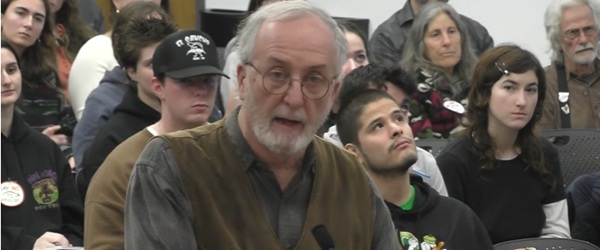
Presenter: Public comments Feb. 23 say the proposed Amazon megawarehouse in Northwest Eugene violates city code. Stan Taylor from Indivisible says if the city doesn’t take action, there’ll be a lawsuit.
Stan Taylor (Indivisible Eugene-Springfield): Stan Taylor. I represent Indivisible Eugene Springfield, and I want to talk to you tonight about violations of the Eugene City Code that the permit office has done in moving the Amazon project forward.
Eugene City Code 9.8670 requires a Traffic Impact Analysis (TIA) in four different circumstances, and three of these Eugene code provisions apply in this case.
First, it requires that a TIA if the warehouse will generate more than 100 vehicle trips per hour during the peak hours. The city says that the standard is not applicable because the developer’s traffic engineer demonstrated or promised that for less than 100 would take place between 7 and 8 a.m. and 4 and 5 p.m.
There’s two problems with this. Eugene code requires that these trips be estimated using the Institute of Transportation Engineers Trip Generation Manual, and that didn’t happen in this case.
Second, the Eugene City Code defines peak hours by counting the number of motor vehicles, bicycles, pedestrians at key intersections during two-hour periods in the morning and evening, not just between 7 and 8 (a.m.) and not just between 4 and 5 (p.m.) but four hours. And if you talk of all those four hours, it clearly violates the Eugene City Code.
In addition, Eugene City Code 9.8670 requires a traffic impact analysis if the warehouse will contribute to traffic problems in the area and in a location where pedestrians’ or bicyclists’ safety is a concern by the city, and that’s been well documented now.
So clearly what’s happening here is, there’s an opportunity for the city to go back and look at these areas and actually there are several more that I don’t have time to cover, but go back and use this as an opportunity to restart the permit process and apply standards properly.
It’s an opportunity for you and of course for us. If you don’t do that, it leaves us in the position of having to think about filing a lawsuit, asking for an injunction…
Laura Schulte: Hello everyone, I’m Laura Schulte. I’m sorely disappointed that the plans for the Amazon distribution center have made it this far.
I moved here in 2011, in part because of Oregon’s beauty and temperate climate, which has already changed significantly since then due to fires and climate change in general.
How in the world will it be helped by a huge center that not only negates a large stretch of wetlands, but also generates unthinkable amounts of pollution and vehicle congestion at a minimum.
The Clear Lake Overlay Plan was developed to be mindful and intentional about what goes in that space. I don’t see how this center matches that plan in the slightest.
Why not take the time to mandate further study that could give more assurance or make changes so that it does honor the overlay? The overlay states that it’s purpose is to ‘ensure any development fulfills the community’s desired outcomes for economic prosperity and increased employment opportunities while addressing environmental justice concerns.’
When will we address the environmental justice concerns? After it has been built? When it provides very few nonautomated jobs, causes dangerous delays and congestion on Highway 99, pollutes our water and wetlands and overtaxes our infrastructure, causing the need for infinite road construction.
Demand scrutiny now before it’s too late. Most times Amazon walks away when a community demands more of them. Gee, isn’t that telling of what kind of values they have?
Our land, air, wildlife, and all the beauty that makes Eugene and Oregon special can’t speak up. Our children and younger generations who will face even more impact from the climate impacts than we already are seeing currently can’t speak up. It is our and your responsibility to do that on their behalf.
Please look further than the property taxes and the terrible jobs and demand more for our planet and community. We can and need to do better.
Charmane Landing: I’m Charmane Landing of Lane County. A council member has said that applications by any entity need to be treated equally. I disagree.
There’s a big difference between discriminating against an applicant and applying honest discernment. As representatives, your role is to vet issues and thoroughly, thoughtfully make decisions that are in the best interest and well-being of your constituents.
There are many reasons why the proposed Amazon megawarehouse is not in the public interest and will be harmful. These are, and you have heard of them a lot):
1. Good local union delivery jobs will be lost.
2. Low-wage jobs will disappear due to automation.
3. Eugene has declared a humanitarian crisis yet welcoming Amazon works directly against this because it shares gathered intel with ICE.
4. It goes against the spirit of sustainability that citizens voiced in the Clear Lake overlay.
And 5. (which is very concerning) is the issue that 2,600 daily vehicle trips going in and out of a highway that is already the highest accident rate in all of Eugene, according to the latest Vision Zero plan. That’s Awbrey and Highway 99.
Amazon says the majority of trips on and off this site at 99 will be during two off-peak hours, the majority of 2,600 trips. The majority of 2,600 trips can be crammed into a two-hour period. Seems questionable. Who enforces this? What are the consequences for non-compliance?
Traffic on this section of (Highway) 99 is already traveling around 60 miles an hour. At the very least, a reduced speed zone, a turning lane, and a traffic light should be required.
And what about the mayor’s desire to make the entire Highway 99 corridor safer? Adding this many vehicles works directly against this.
The safety and well-being of all Eugenians is not worth the risk of allowing Amazon in, a company with the pressing goal of being faster and cheaper no matter the cost.
We already receive Amazon packages under the current system. A distribution center in Eugene just isn’t needed.
Looking ahead, the additional $6 million recently allocated for infrastructure to this area might make it more inviting to more beneficial industries. Many cities have declined Amazon. I ask you to do the same.
Hava Kronen: My name is Hava Kronen. Amazon uses euphemisms like ‘fulfillment centers’ to describe its warehouses. I have to wonder: What exactly gets fulfilled?
Jeff Bezos’s pockets are certainly getting filled. The shareholders’ pockets get filled. The wetlands will get filled, so there goes that protection for our environment.
The streets will get filled with nonstop trucks bringing more plastic and disposable crap. The air will get filled with cargo planes bringing more plastic and disposable crap to get trucked out and that all eventually fills our landfill.
Our air will get filled with more pollutants. Our waterways will get filled with more pollutants.
I have probably shopped at Amazon three times in my life. If I need something, if I need to buy something online, I will look for a smaller vendor. I don’t need it to appear on my doorstep within hours of my ordering.
What won’t be getting filled is our smaller businesses that rely on customers, because now those customers will be addicted to ordering from the comfort of their own home and receiving those items within hours.
And home properties in the vicinity will lose value because who wants to live where trucks and planes cause air and noise pollution? So that’s less money filling the property tax coffers.
I’m wondering where is the Chamber of Commerce on this issue? Aren’t they the protectors of our brick-and-mortar businesses? How can this be a boon for our small businesses? Small businesses drive our economy, not behemoths like Amazon.
There has to be a way to stop this abomination from being built under your watch. The permit process was held in practical darkness. How can you, not only as officials, but as residents of this city allow this mockery of the permitting process to continue?
JoJo Breslin: I’m JoJo Breslin. I do want to talk also about the Amazon distribution center. Obviously a lot of the community members behind me have various thoughts and ideas and I think that some of them are very fruitful and I hope that the Council considers them.
I think ultimately at the end of the day, I hope that there are lessons learned by the process that Amazon has gotten into the community and gotten its permits up to this point and the shady practices that kind of got them here and that we can hopefully deter future bigger corporations from doing similar.
Presenter: Bill O’Brien:
Bill O’Brien: …What I’ve seen is you have paused a contract with Flock cameras. That’s done with. So what does Amazon do? They have Flock cameras in their trucks, probably the vans, it’s there. Okay?
So you’re dealing with that again, that same issue. So what are you going to tell ’em that they do come here? No Flock cameras? Then you have all these other people getting in the loop too, like Palantir, you know, looking at iris, facial recognition, whatever.
We’re being surveilled. I don’t like it. I don’t like Amazon. Why I don’t like Amazon? Because China, Tibet, Israel, Palestine, they’re all part of monitoring people—through Flock, through them, whatever. They make cameras too.
$880 billion the four major tech companies are putting into artificial intelligence. That includes water to cool off their computers. It’s a big drain on the environment. I just don’t like it. There’s greed involved and I just don’t like what’s going to happen to the land.
Wyn Manselle: Wyn Manselle. Many people have spoken to the Amazon issue from the permitting and environmental angles, I think a lot more eloquently than I could. So I’ve been trying to throw out ideas, or throw together ideas of what we could do from another angle to put a stop to the project, at least provide a cooling effect, and probably get ahead of other companies that would probably do exactly what Amazon is trying to do.
Doing some reading, I ended up learning that many companies that have heavy warehouse-type work require their employees and provide their employees with helping vests that are considered exoskeletons to actually take the level of strain and damage that is on their workers’ bodies off of them.
Ford in 15 plants has seen an 83% decrease in injuries. BMW and IKEA have seen 25% reductions in sick days.
I’m wondering if the city could take action to be like, if you are bringing your company to our town and providing jobs of this sort, require you to give your workers proper PPE (personal protective equipment) in that sense.
Also similarly, I think that might help or at least delay the issue with the stated goal of Amazon to automate those jobs away eventually. I personally think it’s coming sooner than the 2032 year that they give us, because of increases in teleoperation.
And on that angle, like, begin thinking about, you know, what do you do with companies like that that are going to come and say, we’re going to automate away all of our jobs and we’re going to put robots in their place?
Is current business tax law really putting the appropriate value on that property when it’s entirely replacing human workers?
Presenter: Erica Lyon:
Erica Lyon: Hi, I’m here again. I’m sure you can guess why. Just here to see if you guys are going to do anything about the Amazon warehouse that’s being built next to the airport.
By now, you’ve heard enough testimony against it, you know the reasons why. So I’m just here to see if you guys are going to spring into action.
So I’m going to keep coming here every meeting until I see some progress and you’ll keep having to deal with me. So, I mean, if you’re okay with that, I guess do nothing, but, yeah.
Do your jobs, you know, find some way to stop the Amazon warehouse. We want to be a city that lives up to its values, especially of sustainability.
Shelly Devine: Hi, Shelly Devine. The Lookout article kind of implies that maybe y’all, not Matt, but maybe everyone else is kind of tired of some of us repeat podium offenders talking about the same thing all the time.
But I assure you that we’re tired of repeating ourselves. Don’t mistake us for people that don’t have anything else to do but incessantly attend these meetings and continue to advocate for our community, because I would love to discuss anything as innocuous as, like, beautification of public spaces or exciting grants available for sustainability projects or highly necessary trips to Nepal to foster feel-good connectivity with a sister city.
We’d love to break out in a round of Kumbaya, but what we’re asking for is for you to legislate our requests. Like, it’s literally what we elected you to do, and you can create an ordinance or two to stop the Flocking warehouse project. Like, do whatever it takes—legislate to stop yourselves from enlisting yet another mass surveillance campaign before we spend the next year harped on round two of that.
We want concrete action and legislation over inspirational feel-good language and posturing. .
Presenter: Faye Rachford:
Faye Rachford: I’m back again to speak about the Amazon project. I feel like we have bent over backwards to do your due diligence and have cited several code violations. Stan (Taylor) mentioned several of them again tonight that have occurred by , is it oversight or, I hate to say the word collusion, or is it just plain incompetence? I’m not sure.
We have pleaded, demanded, and expressed our serious misgivings for a project that violates the city’s declaration of good-paying jobs for the citizens in our community.
The environmental impact alone is reason enough to stop this project. There are endangered species in this location, and it is a throughway for migratory birds.
The air pollution that will be caused by the number of trucks moving in and out of the area have the potential to shut down one of the major revenue makers for the city: TrackTown USA. People can’t breathe. They can’t run.
I fail to understand with the information that we have presented to you, why you fail to act. Can you explain this? Can anybody explain this? These blank stares. I can’t tell you how it provokes.
Anyway. I wish you would think about the citizens in our community. No Amazon means no ICE means no detention centers. So please, stop this project.
Presenter: Councilor Lyndsie Leech:
Councilor Lyndsie Leech: I want to thank you all again for coming. Quick response: I hope you don’t think that we are staring blankly at you. We are listening very intently and we take it all in. And we do a lot of work behind the scenes to try to make sure that we’re responding with action to your concerns.
So please keep coming. We thank you very much for being here tonight.
Presenter: Acting City Manager Matt Rodrigues:
Matt Rodrigues (Eugene, acting city manager): Our planning and development group is working on a memo to provide the Council, hopefully this week, that provides information on what we may or may not be able to do. So I apologize we haven’t gotten that to you yet, but that’s being worked on.
Presenter: Public comments warn of city code violations, pollution, the loss of wetlands, incompatibility with the Clear Lake Overlay Zone, Amazon’s plans to replace human workers with robots, and the ability of Amazon delivery vehicles to conduct surveillance. The acting city manager says a memo on the Amazon megawarehouse is coming soon.