Lagging on climate goals, city considers home energy scores
7 min read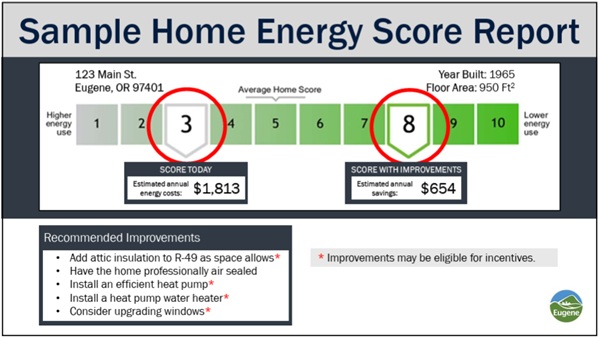
Presenter: The city of Eugene considers home energy scores. On Feb. 23, Danielle Klinkebiel:
Danielle Klinkebiel: My name is Danielle Klinkebiel, and I am a climate policy analyst in the sustainability program in Eugene.
Roughly 65% of homes were built before 1990—when modern energy efficiency standards were established. This means that many homes in the area lack insulation and efficient heating. These conditions drive up energy costs, reduce indoor air quality and comfort, and lead to more greenhouse gas emissions. Many of these impacts disproportionately affect low-income households.
Council has established a goal to decarbonize existing homes and buildings by 2045, to not only reduce the carbon impact of homes, but also to improve their energy efficiency.
Staff conducted a big engagement effort to understand opportunities and challenges for achieving this goal, and what we learned is that many people are unaware of how to improve their home’s energy efficiency. Expanding the use of home energy scores is one pathway to help achieve these priorities.
So what is a home energy score? It is a standardized tool developed by the U.S. Department of Energy to do a home energy assessment. It costs about $150 to $250, depending on the size of the home, and takes about an hour to complete.
A licensed energy assessor will evaluate a variety of features throughout the house, such as insulation, the heating system, the volume of heated space, the windows and more.
And based on this information, they’ll provide a score on a scale of 1 to 10 based on the energy usage of that home. You can think of this kind of like a miles-per-gallon rating for a car.
The report also includes energy cost estimates, recommendations for how you can improve the score, and links to utility incentives like rebates, tax credits, and loans.
So the home energy score is an effective tool for public policy because it is pretty affordable and the information is made really accessible. Many other cities, including four cities in Oregon, have implemented a home energy score disclosure requirement.
Basically the way it works is the seller of a home would get a home energy score before they advertise the home for sale. They would include the score report in the MLS database, and then any prospective buyer can view the report as they look at homes on Zillow or Redfin or places like that.
And a quick note is that this policy does not require the seller or the buyer to make energy improvements. It just provides information.
So there are three primary goals of the policy. The first is to increase transparency about energy features and costs in order to provide clear and consistent information about those things to the buyers in order to support them making an informed decision.
The second goal is to educate homeowners and buyers about opportunities for improving energy efficiency. And finally, to connect homeowners to resources and incentives to help finance upgrades.
There’s four cities that have done it: Bend, Portland, Hillsboro, and Milwaukie. There’s been 60,000 score reports done statewide.
In a lot of the other cities that were looked at, this tends to be an add-on service for inspectors, appraisers, those types of jobs where this is something that could easily fit into their wheelhouse.
And it is predicted that it would take about 16 to 20 people who are certified assessors in order to serve this policy and with minimal disruption to the real estate market so that you know, when someone wants to list a home, they can quickly call someone who can come do the assessment.
And typically cities have set aside a little bit of money at the beginning to help train assessors and get that workforce pool up to capacity before the policy launches. That’s just a strategy that other cities have used to create a smooth implementation.
Presenter: Councilor Randy Groves:
Councilor Randy Groves: First of all, for the people listening at home, you can find out how much a house you want to buy is spending on electricity and/or natural gas right now, without this. That’s available.
And so if there’s vacant land in a neighborhood you’re looking to buy in, check and see what could go in there in the future. I keep running into people that are surprised of developments going in, in their neighborhoods. And that information is available of what could go in there before you buy your house.
I want to get into the data a little bit. You were saying that cities that have implemented this are not seeing any problems with pricing or significant changes and that. Do we have any information on, let’s say, people over 65 years of age, which most are on fixed incomes, what the average age of the homes they are living in? Is that available?
I think it would be interesting to see that. I think it’d be interesting to look at income-based homes and knowing that people are on fixed incomes, how are they going to pay for some of this work? And I think it would be interesting to see the differences in different parts of our community.
We have parts of our community have generally older homes, and unless you’ve taken that down to the stud walls, you’re never going to get those to a reasonable energy level. But just to know how this is going to affect our community, I think we need more, at least I’d like to see more information on that. I still have some concerns on this.
Presenter: Councilor Alan Zelenka:
Councilor Alan Zelenka: The focus is on the operating cost of a house. The operating cost of the house is what people really need to focus on. Once you’ve bought the house, then you have to pay for it to live in it. And if you’re paying $1,800 a month versus $600 a month on energy bills, it’s a huge difference to your monthly cash flow.
And that’s where most people don’t think about. But this allows them to then understand at a more refined level that allows them to make those decisions. And there are lots of programs to provide for incentives to do those improvements in your house through EWEB and NW Natural.
Presenter: Councilor Mike Clark:
Councilor Mike Clark: I’m somebody who professionally funds home loans every day. I talk to multiple realtors every day. I am a loan officer. That’s what I do.
And I agree with you that the likelihood that us mandating an energy score would have an effect on lending is minimal. I wouldn’t predict what tomorrow looks like, frankly, on that, but I would say that’s probably true for now.
I would say, however, that for us to have information as a city and as a Council and at the same time, to make everybody who buys a house spend another $200 on a process that’s already really, really expensive, especially in our community—I question the wisdom of us doing that.
The value of the information for the sake of the harm it’s going to cause a lot of people, ’cause when housing is already incredibly high priced in our community, it’s already very hard to do.
And we haven’t talked about the difference in what it’ll cost the renters because that $200 being spent on a rental will be translated down to how much people have to pay who are renting a place and that’s going to—that impact is going to be substantial too.
I have the privilege to work with realtors every day. I talk to four of them today. I asked a lot of folks about this as well as a home inspector who does home inspections today, just knowing that this issue was coming up, as well as the Eugene Association of Realtors and their folks who communicated with me earlier today.
It was suggested to me anecdotally, although I don’t have any actual data personally, but it was suggested to me anecdotally that in Bend, a lot of folks just ignore this. I don’t know the truth of that, not living there.
I just want to ask my colleagues to think about the perspective for just a little moment: $200 may be nothing as a comparison to all the things one spends when buying a house.
But this is the same Council who said that $50 in application fees for an apartment is way too much and forced people to change what they charged for it, because we knew best that it was too expensive. But $200 isn’t, for essentially a bit of information. I find that interesting.
You mentioned that experience in your research showed that it didn’t affect the market. And you were talking about other places. And I believe this is true based on what communications I’ve had, but our local association of realtors and the engagement that they did with you, they gave you a different bit of engagement. Am I correct?
Presenter: Danielle Klinkebiel:
Danielle Klinkabel: They had concerns that this would impact the market.
Councilor Mike Clark: Because it’s a challenging market that we’re in, and one of my concerns is that those are the experts who deal with buying and selling houses in our market, and I want to trust them just like I would when I’d hire one to help me buy a house. They’re the experts.
And I would suggest that in a normal market, getting additional information may have a benign effect when you have the ability to make a decision or not on one place versus another. Or you know, say, this house is opposed to that one. We don’t have that luxury in Eugene.
Presenter: Some City Council members express concern about $250 home energy scores, in what they say is a challenging local market, noting that the information is already available elsewhere.