The geography of vulnerability: Eugene’s Highway 99
3 min read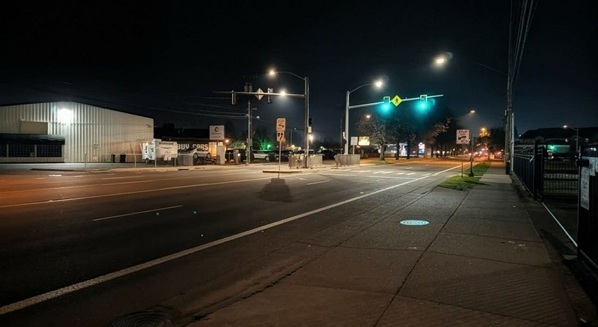
by Sarah A. Koski
For those who call the Bethel Highway 99 corridor home, this road isn’t just a thoroughfare—it’s a daily gamble with physics. This stretch of asphalt cutting through the heart of our community has become a zone of avoidable chaos, where high-speed transit regularly collides with the lives of our most vulnerable neighbors.
This is more than a road; it is the lifeline for Eugene’s social safety net. Within a small radius along the Highway 99 corridor, there is a dense concentration of essential services, including:
- St. Vincent de Paul of Lane County
- ShelterCare
- Carry It Forward
- Sponsors
- Community Supported Shelters
- Lane County Parole & Probation
These agencies serve hundreds of people daily who are navigating housing transitions, recovery, and reentry. Many of these individuals travel on foot, often carrying their belongings along a highway never designed for pedestrians. When a high-speed arterial bisects a hub of human services, the lack of protection isn’t just an oversight—it’s a crisis of equity.
The high-crash reality
While these social services are vital to the region, the statistical danger of this stretch is undeniable. According to the city of Eugene Fatal Crash Report (2022-2024), arterial streets like Highway 99 account for over 80% of all fatal crashes, despite representing only 20% of the city’s street network. City planners have noted that nearly one-third of all local pedestrian deaths in recent years occurred along this specific corridor.
This local crisis reflects a staggering state-level trend. A 2024 report by TRIP found that Oregon’s traffic fatalities increased by 88% over the last decade, one of the steepest jumps in the nation.
Impaired driving: The perfect storm
Although public perception often places the burden of safety on pedestrians, impaired driving remains a primary catalyst for these tragedies. Data from the Oregon State Police shows that roughly 31% of all traffic deaths in the state involve an impaired driver. In 2024 alone, Oregon law enforcement made over 14,600 DUII arrests.
The risk on Highway 99 is compounded by a high density of alcohol outlets and bars lining the thoroughfare. This concentration of liquor licenses in a high-speed zone creates a perfect storm, where easy access to alcohol feeds directly into the impairment statistics of the high-crash network. In an area where sidewalk infrastructure is sparse and pedestrian volume is high, the margin for error disappears. Addressing safety in Bethel requires us to view the corridor not just as a set of lanes, but as a complex, high-risk ecosystem.
The capacity myth and the path forward
When residents call for increased patrols or sobriety checkpoints, the Eugene Police Department often cites a lack of capacity. To support an already time-taxed department, we must look toward outside-the-box solutions and state partnerships.
The Oregon Department of Transportation (ODOT) and Oregon Impact provide High Visibility Enforcement grants specifically designed to fund officer overtime for DUII saturation patrols. If the state is willing to subsidize the cost of removing impaired drivers from our streets, the question for the City Council isn’t, “Do we have the money?” It is “Do we have the political will to prioritize Bethel?” I believe we do.
A ‘yes-and’ solution
In the spirit of hope, conversations around Eugene’s Vision Zero directive have recently revived. In her 2026 State of the City address, Mayor Kaarin Knudson signaled a pivotal shift, challenging Eugene to “begin thinking differently about Highway 99.” She reimagined the stretch as a “safer, greener, multimodal boulevard” rather than a mere highway—a public realm designed to connect the community safely.
The $10 million in street improvements completed in 2025 laid the groundwork, but continual solutions, like deterring impaired driving, must be the next. We owe it to the nonprofits doing the heavy lifting—and to the families who have lost loved ones on this asphalt—to demand a roadway that prioritizes human life over through-traffic.
Sarah A. Koski shares compassionate reporting on the intersection of transit and homelessness from the trenches of Eugene, Oregon. Subscribe to Eugene’s Homeless Heartbeat at sarahcascadia.substack.com.