Amazon offers good-neighbor agreement, Bethel asks about enforcement
16 min read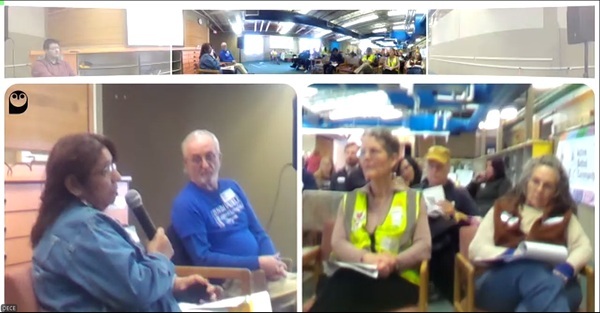
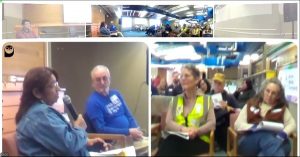
Nancy Forrest (KEPW News): Last Saturday from 2-4 p.m. the Active Bethel Community convened their general meeting for March. Sixty people were in attendance. A portion of the meeting was devoted to a panel that shared information regarding the proposed Amazon warehouse at Prairie Road and Highway 99 in Northwest Eugene.
The first speaker addressed concerns regarding increased traffic, higher accident rates, and compromised air quality in the neighborhoods in that area. Jennifer Eisele:
Jennifer Eisele (Beyond Toxics): Beyond Toxics is an environmental justice advocacy organization, and we have a long history of working with the folks in West Eugene.
The highway along the Highway 99 corridor over to Trainsong and around the River Road area has the worst air quality in the city.
A number of people have reached out to us asking, can we help with Amazon? As an organization our focus is pretty narrow, we’re really only looking at public health. and environmental justice issues. I just want to be very clear that we are not trying to obstruct development. We just want development to be considered very thoughtfully and not causing harm to public health.
So one thing has been a concern is the diesel emissions and increased traffic in West Eugene. So we have through our attorneys, have done public records requests to the cities. There is a non-disclosure agreement, so it has been very difficult getting information regarding the permitting.
And when we do receive information, it’s copyrighted materials, so we have to sign for it and we can’t share it outside of our organization. We have received the traffic study that was prepared by Amazon’s traffic engineers. It’s called ‘Last-Mile Delivery,’ and it discusses the vehicle traffic that will be in and out of the facility.
We haven’t really heard if there’s a portion of those vehicles that will be electric vehicles or what type of vehicles. It does say there will be, I think less than 100 diesel trucks coming and going from the facility.
We have sent letters to the city, asking if they’re going to require a traffic impact analysis from the number of vehicles. What we’ve seen in the media, what we’ve seen with the traffic study is there will be up to, I think a little under 2,500 vehicles a day entering traffic on Highway 99.
It seems like there should be better traffic controls. Our attorneys have looked at the Eugene City Code and said, where can we require a traffic impact analysis or what people could question as far as Eugene City Code?
Okay, so there are sections of Eugene City Code where they have authority to require traffic impact analysis. Their Frequently Asked Questions (FAQ) says that they are not going to require traffic impact analysis because the number of vehicles entering traffic per hour on Highway 99 doesn’t meet a certain threshold.
And, it quotes the heavy traffic hours as only one-hour windows, twice a day. And according to Eugene City Code, those are four hour windows, not one-hour windows. So they’re kind of out of compliance with their own code. That’s the simplest way I can explain it to you.
Stan already has that information and I think has done public comment a few times about that.
Another section of the City Code that people could question is a hazardous materials analysis for the construction of the project. And that would open up a public meeting, where people could come and do comments, but that hasn’t been done either, and the city has not explained why they haven’t done that.
The other thing that could be questioned is the high traffic hour there. In the engineer’s report for last mile delivery, there’s something in there that says all employees will be coming and going from the facility between 1 a.m. and 2 a.m. and then during the same window in the afternoon.
So apparently they’re going to be working 12-hour shifts and coming and going in the middle of the night and the early afternoon only.
That kind of was a red flag to me. So I don’t know if that is the shifts that everybody’s going to be working. But I thought that was interesting because that’s the information that the city used to reach their conclusion that shift change was not going to impact high traffic hours. So I thought that was interesting.
Air quality, you know, we tried to do comments when LRAPA had the permitting open and LRAPA granted the permit anyways, but looking forward, the zoning in this area, there’s a whole bunch of empty space out there that is zoned for exactly the same thing as an e-commerce facility.
So we are working with Neighbors For Clean Air to introduce an indirect source rule, which would require e-commerce facilities to take out separate emissions permits for diesels. It’s specifically for e-commerce facilities.
We’re going to petition LRAPA and that will open up a public comment period soon, and it probably wouldn’t apply to Amazon, but it will apply to new e-commerce facilities, specifically in LRAPA’s area of control.
Presenter: Lin Woodrich:
Lin Woodrich (Active Bethel Community): Awbrey Lane and (Highway) 99 has the highest traffic accidents in the Eugene area. That’s exactly where the Amazon facility’s going to be.
2,600 or plus or minus trips per day. 50% of their comings and goings onto Highway 99 there during the hours of 10-11 a.m. and 9-10 p.m. That would mean 1,300 trips in and out during those two-hour periods.
One vehicle every four seconds. And there’s no turnout lane. There’s no reduced speed zone. So I thought that’s a concern.
Nancy Forrest (KEPW News): Noting that final permitting decisions have not been made, Jennifer added:
Jennifer Eisele (Beyond Toxics): When Amazon declined, the Amazon representative said that they have an interest in establishing a good neighbor agreement. So I think some of the things that should be focused on for the good neighbor agreement would be green infrastructure.
Maybe rooftop solar, you know, investment in, I don’t know, 50% electric vehicles as part of their fleet. There’s a lot of things that people could be asking for that would help reduce emissions in the area as well.
And ask them for a traffic impact study. Ask them to contribute to Eugene’s transportation fund for improvements on Highway 99.
Nancy Forrest (KEPW News): The next speaker, Stan Taylor from Indivisible Eugene, focused on the lack of transparency and oversight by the city of Eugene, and talked about a serious mismatch with Amazon’s corporate interest and local values.
Stan Taylor: I’m with Indivisible Eugene Springfield, and we are an activist organization that looks at issues through the lens of resistance to authoritarianism. And part of our analysis here is in that context. So part of our resistance is in that context.
When we can begin to look at the permit, one of the things that we hope to do is to get the city to take into consideration the portions of the Eugene City Code and the state code that they seem to have missed, that they seem to not be following.
There are several sections that they should go back and review and as they review or give them the opportunity to make sure different elements are met, like a traffic impact analysis and a hazardous materials analysis.
It doesn’t mean that the permit wouldn’t eventually be issued, but it would mean that all the provisions of the city code would be followed. In other communities around the country where the city has required things like traffic impact analysis and hazardous waste materials analysis, Amazon has decided not to go.
So there’s no guarantees, but there’s a potential path which the city could follow. And the alternative is there’s a potential path for a potential lawsuit to try to enjoin the city from issuing the permit until it follows the provisions of the city code.
So, what I’ve been saying to the city council for the last few meetings is there are avenues for them to pursue that are essentially going back and following the code as it’s written.
You know, one of the other provisions that seems to me that the city hasn’t followed is the state permit requirement. The state requires that the permit can be issued, the identity of the owner of the land and the project needs to be divulged.
What we’ve seen with Amazon and with the city enabling Amazon in terms of the project is that there have been non-disclosure requirements that have been imposed on the agents of Amazon such that until very recently, we didn’t know who actually was the builder and owner of the project. So it’s been very difficult for the public to weigh in.
In fact, the requirements that are in the code for public notice require that the city notify the property owners within 500 feet of the property and the neighborhood associations within 300 feet.
As it turns out, there’s no neighborhood association in this industrial corridor. The two closest neighborhood associations are you, the Active Bethel Community neighborhood association and the Santa Clara community, which we’ve already talked to.
They’re the ones that will be most impacted and yet the city didn’t see fit to give them notice. What happened was that there were two signs placed by the city, not on Highway 99, where they would be highly visible, but back on Awbrey Lane and the other road on the other side, set back in the property where virtually no one drives and where people didn’t see them.
So when the actual hearing was held there were two people. It was an online Zoom meeting. There were two people that showed up for it. The meeting lasted 13 minutes and it was done. That’s the public notice that has been given. And up until recently, no notice about who actually was building the project or who was involved, which we see as really problematic.
We believe that this kind of project should require public involvement early on, and it should be clear to the city, to somebody who’s engaged in issuing a permit or the permitting process that when you’re giving notice, it shouldn’t just be the technical notice that’s written into the code. It should be effective notice, people should know so that they can engage. And that didn’t happen here.
The Clear Lake overview got created back in 2017-2018 originally as a light industrial area with the intent of attracting light industrial activities that were really in line with Envision Eugene.
If you read the introduction to the Clear Lake overview, it states beautiful values, environmental values, values of good jobs with good wages, protecting the environment, although those kinds of things are included in the preamble or the first paragraph to the Clear lake overview.
It’s our opinion that the warehouse that’s going in doesn’t meet any of those kinds of, uh, frames. But it’s been several years since the Clear Lake overview was originally formed, and Amazon is the first to try to take advantage of it. So this goal to engage in development is part of what the city has wanted to see happen. The problem is that this development is not the kind of development we want for a variety of reasons, but let’s start with some of the basics.
People talk about, ‘This is going to provide property taxes for the city.’ If you’ve read Chris Wihtol’s Bricks and Mortar in Eugene Weekly, the amount of money that the city’s going to take in for property taxes from Amazon is $290,000 per year.
They have a $930 million city budget. That $290,000 is less than one-third of 1% of the budget. So you’re not talking generating large amounts of revenue for property taxes to help the city really meet its budget shortfalls.
And you’re not talking a lot of jobs. Reports on that are, it’s going to be about 300 jobs, so it’s not a huge number of jobs.
And then if you look at that, at the Amazon history for their jobs (and I just happened to have), this is a injury productivity tradeoff done by the United States Senate Committee on Health, Education, Labor, and Pensions in December, 2024, and here’s the opening paragraph on key findings.
Amazon manipulates its workplace injury data to portray its warehouses as safer than they actually are. Amazon claims that its warehouses are nearly as safe as the industry average, but it does so by cherry picking data rather than grappling with its unique, dangerous warehouses.
The committee review of the company’s public reported data found that Amazon chooses misleading comparisons in an effort to obscure the fact that the company’s warehouses have significantly higher injury rates than both the industry average and non-Amazon warehouses.
And analysis of the company data shows that Amazon warehouses recorded over 30% more injuries than warehouses in the warehousing industry average in 2023.
So you’re talking jobs that are not safe and the major reason for that is Amazon has a policy of heavy surveillance of their employees, and the heavy surveillance is designed to increase productivity, but that surveillance and that push to increase productivity is what results in higher injury rates and higher health problems on the job.
So these are not not good jobs that you’re talking about. And actually also, Amazon pays on average less than the warehouse industry averages. So they’re not high-paying jobs, they’re limited number, poor jobs in terms of safety and health, and surveilled—a type of 1984 kind of control of what’s going on.
There’s more. If you go onto Amazon’s website, you’ll find that they plan to replace 70% of the workers with robotics by the year 2030.
Well, and if it’s going to take a couple of years to build this warehouse, by the time we get to it be online and ready to go, if it’s roboticized, there may be virtually no jobs there.
At this point, we really, really don’t know, but we do know that Amazon has a business strategy intending to replace 70% of their warehouse workers with robotics. That is their model that they’re very proud of, that they’re working toward.
So again, when we start talking about jobs, those jobs that they exist at all may quickly go away.
And then of course there’s the question of the drivers for Amazon. So the Amazon is trying to deliver all of its own packages. So in order to do that, they’re setting up their own delivery system.
And what that means is that the workers now that are delivering Amazon’s packages for the United States Post Office and Federal Express jobs that are unionized with pension benefits will be replaced by drivers that don’t have union backing.
The trucks that they’re driving will have a heavy surveillance on the trucks, so that the drivers are monitored while they’re driving, instructed the routes they’re supposed to take. And again, this monitoring is designed to increase the productivity of the employee by massing surveillance.
Now, on top of that, they’re talking about the drivers wearing AI glasses so that we’re on the job so that when they go and deliver packages, the spot that they’re delivering the packages to will also be part of the data that’s being collected by Amazon.
And, here’s where things get tricky, is that we think of Amazon as a package delivery company, a warehouse and package delivery company, or a video delivery company.
But in reality, Amazon makes most of its money through Amazon Web Services, and that’s the selling of data. And the selling of data that they do, among others, is to the Department of Homeland Security. So the data that they’re collecting is to help them round up our neighbors, our immigrant neighbors, and send them to the detention centers. Not a pretty picture.
And in fact, Amazon data centers are also providing data for Israel in their war against Gaza. Now if you’ve been paying attention to the war in Iran, what you’ve seen in the last couple of days is Iran has been using drones to destroy Amazon web service centers in Bahrain, United Arab Emirates, because they’re providing data for the fighting of the war in Iran.
This is why Indivisible Eugene Springfield feels that Amazon is a terrible fit for our community, not only in terms of the lack of being a good source for jobs and revenue, but because on the whole they’re supporting types of activities that are destroying people’s lives, literally.
Nancy Forrest (KEPW News): Active Bethel Community invited Amazon to participate on the panel with the goal of providing balanced, accurate information about the proposed project to Eugene citizens and local neighbors. Amazon said they would attend, but at that last minute provided this statement instead. Per Amazon representatives:
‘Unfortunately due to a scheduling conflict, we will not be able to attend the community meeting on March 14.
‘Regarding the project, the facility is expected to bring new jobs and contribute significantly to the local economy, while also improving delivery service for local customers and small businesses. Amazon is committed to being a good neighbor and working with local partners as plans progress. I look forward to sharing more details with you as they become available.’
Attendees were especially eager to ask questions and to get answers from the Amazon representatives in their absence. Many took the time to write out their questions on paper.
Lin Woodrich, the chair of the events committee of the Active Bethel Community, committed to sending those questions to Amazon with the intention to follow up and report back to the community in the near future.
There was a little bit of time at the end for a couple of questions.
Active Bethel Community member: Have you reached out to other communities that have had one of these warehouses and it have issues come up that we can predict will happen here?
Stan Taylor: We haven’t actually talked with other communities that have the warehouses. We’ve done the research to find communities that have resisted them and the reasons why Amazon pulled out when that resistance was there.
Active Bethel Community member: Thank you for being here. I have three questions. One is, who and how was held hostage by a non-disclosure agreement? And how did they come under such pressure that they had to sign? ’cause they were hostage.
No. 2 is: We’ve talked about the packages leaving the warehouse and how are they going to get there?
Are we modifying the airport, all of a sudden everything’s going to be flying in, or we have more trucks bringing packages in from somewhere else?
And question No. 3 is: What other permits are going to be required by Oregon state lands, Department of Environmental Quality, Water Quality?
This is mostly pasture land now and after we leave here, if we drive out there, there’s a lot of ponded water. Is that going to have effluent from the Amazon warehouse? Where are those sheep going to graze?
Jennifer Eisele (Beyond Toxics): The traffic engineers report did say they were going to be, I think, less than 100 diesel trucks delivering to the facility.
Active Bethel Community member: Double, 40-50 feet long.
Jennifer Eisele (Beyond Toxics): Yeah, there was an open comment period, you know, for the DEQ, the wetland, like, we did comments, but their stormwater plan isn’t in place yet.
Stan Taylor: As to who was held hostage, all of their agents were held hostage. Their real estate agent was held hostage. The developer refused to disclose, so everybody that Amazon hired basically signed non-disclosure agreements to keep the project people from knowing who was doing the project.
My question is. Why did the city agree to that? Because state law, ORS 455.050 says all building permits issued in the state shall contain the following information: No. 1 is the name and address of the owner of the building or structured to be constructed.
So, this law was passed for transparency purposes at the state level. But what we’ve seen here is that there has been no transparency in terms of who the owner really was until recently. And of course, that’s prevented the public from being able to, to weigh in. There are other questions that still need to be answered.
And I’m not an expert, but for example, studies show that then you have large areas paved over. That there is increased flooding as a result of that painting. So the surrounding properties are likely to see an increase in flooding, and it’s not clear to me other than the ditches that are at the side of the property and the culvert go into those ditches.
How the city plans to handle it, my guess. Councilor Groves said as a result of the last legislative session, Clear Lake Road industrial site that in its project was allocated $5 million lottery bond funding from the state.
So there’s no development that’s going to be taking place, not fully clear to me yet what that that is.
And additionally, Speaker of the House Rep. Julie Fahey requested and secured a $1 million allocation to support the expansion of the Eugene Airport. So we’re going to see more development there.
And the kind of questions that Jennifer was asking about indirect source requirements on whatever might be built there might be able to make it so that we have some better control of what goes in. But you should all know that that industrial corridor is going to be expanded, the airport’s going to be expanded, and you can can bet that that’s going to have an impact on where you’re living.
Active Bethel Community member: I’m pretty sure this is all going to go through and there’s going to be a facility built, and it’s going to be run and maintained by Amazon.
I highly doubt they’re just going to have 12-hour shifts throughout the days. That’s ridiculous. And I highly doubt their expected or their, planned-for daily traffic impacts.
So what is something that the city can do to punish or fine or whatever, Amazon should they, and when they break those promises?
And do we have people in the city government that would be willing to make sure that Amazon is following the plan and what we need them to be doing to be a good neighbor.
Nancy Forrest (KEPW News): At this time, there is no good answer to this question. Amazon appears to have drafted plans for this project without a robust, transparent public process, so it’s reasonable to question who in power will insist that Amazon follow the law, engage in public processes, and behave as a good neighbor.
Amazon’s record elsewhere is cause for concern and citizen engagement, especially when local leaders appear to be working in secret with the corporation instead of insisting on maximum transparency while focusing on the health and wellbeing of their own constituents.
As we learn more about this project, we will keep you informed.
This story was produced by Nancy Forrest for KEPW 97.3 FM in Eugene.