KEPW reports from Springfield general strike rally Jan. 30
19 min read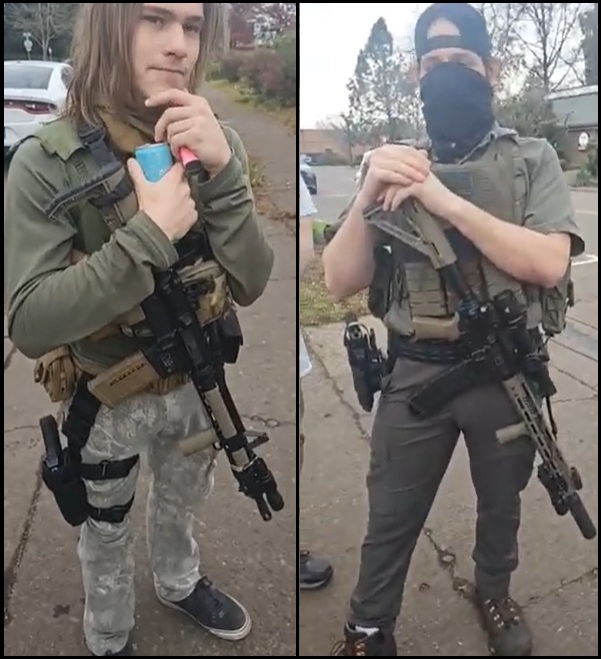
Presenter: Organizers called for a general strike and rally at Springfield City Hall Jan. 30, and KEPW’s Jana Thrift was there.
Jana Thrift (KEPW): KEPW 97.3 FM in Springfield at the government shutdown rally, and we’re looking at somebody that is a balloon man gnome. He’s a balloon gnome with a sign, it says: ‘Gnomes against Noem.’ Okay.
I’m pretty excited that KEPW is here and able to be a part of bringing this kind of actions to you in your home if you’re not able, or for whatever reason, you know, we can bring it to you, live off the streets in our local community.
We’re, like, here along with people all over this country, right? There are people all over this country that are showing up right now in this general strike. I happen to know that there is a big thing going on in Salem. Last time I was like, ‘Wow, we had people in Newport.’
So many people across the country making a difference at this protest that is a nationwide walkout, government shutdown, calling for no work, no school, no buying of products in solidarity with Minneapolis, and the loss of Alex Pretti, the loss for all of us. And I just want to hear from the youth, tell us, Zia, what you think about all these things.
Zia: Well, I know that lots of things are coming and I have friends that are nine, eight, lots of friends. They’re standing up for a reason and we’re fighting for a reason. And it’s not a matter of being scared, it’s a matter of being there for people.
And I think that we have to fight for what we want, and if we don’t, then this whole community, all that we have gained for, fight for, it’s just nothing unless we stand up and fight where we are. So stand with us, fight with us, do what is right for this country today.
Jana Thrift (KEPW): So there you go. A nine-year-old speaking there. And I want to just give some special thanks to organizers like Johanis Tadeo who’s making it happen—like, look at the people that have showed up today. Thank you Johanis, for doing that.
Johanis Tadeo (SAFER): No, thank you. I’m one person of many people that helped put this together, and it’s so beautiful to be able to see all these incredible people here in solidarity to stand up against ICE. So thank you so much for all the listeners. If y’all happen to drive by or see any of protestors, beep, show some love and support. And thank you all again for being able to tune to KEPW.
Jana Thrift (KEPW): Thank you for being here. There’s Rob (Fisette), so many different people that participated in making this happen and appreciate all of them, but I just had to say thank you to Johanis ’cause I knew that he had a big piece of this and I have so much respect for the work that he does in our community, because putting together protests is only a piece of it.
He runs a Latinx after-school program for Latinx students. He’s helping students find a voice and be able to be heard on KEPW and elsewhere. He’s helping them learn about all these things that are so important to learn about, like, tell, tell us more about that program, Johanis.
Johanis Tadeo (SAFER): So, I help run a radio station called La Voz Libre and Radio de La Communidad, a student-run BIPOC radio group, where students from the community want to be able to highlight amazing, beautiful people in our community that shine so much and are these hidden gems, as well as being able to document all these different things that are happening that sometimes don’t get documented, you know, and these are, this is our lives.
So we want to be able to share that with everybody and be able to build that support. So for folks, I believe it’s on Thursdays from 6 p.m. to 7 p.m., please tune in to La Voz Libre, Radio de la Ciudad, on KEPW.
And thank you so much, Jana, for your words and your heart and for always being there to document all of these events so that folks know what’s going on.
Jana Thrift (KEPW): Thank you. Thank you. Lupe runs the radio station. Lupe, tell me more about your radio station.
Lupe Andrade (KEQB 97.7 La Que Buena): Yes. We are our Spanish regional Mexican FM station here in Lane County. We’ve been on air for about nine years and I am the local Spanish radio host there and we play a lot of fun music. So hopefully, yeah, inviting everybody to tune in.
Jana Thrift (KEPW): And what are those call numbers?
Lupe Andrade: KEQB 97.7.
Jana Thrift (KEPW): Wait, all you have to go is just a click away. Yes. (Yes!) We’re so close. Nice meeting you. Thank you.
Okay, so tens of thousands are marching in Minneapolis right now, and right here it started as looking like maybe 100, I would say between 200 and 300 people are here at the Springfield City Hall right now. They’re about to start the rally.
Rob Fisette (Lane County Immigrant Defense Network): I want to introduce Kriscia Rivas, an organizer with the Party for Socialism and Liberation. Give it up for Kriscia. (applause)
Kriscia Rivas: My name is Kriscia. I’m going to tell you a little bit about my story and then share with you some calls to action.
In 1983, my parents didn’t come to America for opportunity. They came here to survive. They fled a war that U.S. imperialism created. (That’s right. Yep.) They fled bombs, poverty, and violence stamped with ‘Made in the USA.’
They crossed borders because staying meant death. They came here not just chasing dreams, but chasing life. They wanted their children to be free. But tell me, what kind of freedom is this? (Right.)
Right now in this country, my people are not free. My community members are being detained, kidnapped, disappeared, families ripped apart at dawn. My neighbors are being killed as they fight to end the deportation machine—murdered in broad daylight.
But this administration thinks fear will silence us. Will it? (No.) They want us to be scared to fight in this. But we are not going to be scared, are we? (No.) We are angry. We are organized, and we are done with ICE.
Right now, look at Minnesota. Schoolteachers defending their students, nurses defending their patients, workers linking arms, joined together to say enough. Today is a historic demonstration of the power of the people, la gente. Today, the whole country is standing with the Twin Cities to call for an end to ICE and Border Patrol’s reign of terror against our community and demand justice for Alex Pretti and all victims of this deadly federal rampage.
We won’t be scared to fight this. We have each other and together we will win. The administration says that ICE is here to detain criminals. I see images of five-year-old Liam Ramos. And I don’t see a criminal. I see my little cousins. I see my little brother. They’re not criminals. (They’re neighbors!) They’re our neighbors. They’re our friends. Children aren’t criminals. Immigrants are not criminals.
When there are hundreds of thousands of people in the streets all across our nation, demanding nothing less than the abolition of ICE, it is a complete betrayal for Democrats to sell us out and write checks to ICE and DHS. Is that okay with us? (No!) The only way to truly deescalate is for ICE, CBP, and all other federal agencies to immediately withdraw from our communities.
They need to end this campaign of mass deportations and be defunded completely. We didn’t shut down entire cities across this country to buy body cameras for our killers. We need to abolish ICE now.
I’ll end with this: My dad always says this old proverb, as someone who’s survived war, crossed borders, and still had to fight just to survive. He says this because he is scared of what might happen if I stand up against ICE. He says: Una golondrina no hace verano. ‘One swallow does not a summer make.’
But we are not one. We are thousands. We are hundreds of thousands. We are millions. We’ll be heard together, we will win, and they will not silence us. Solo el pueblo salva el pueblo. Thank you.
Rob Fisette: Our next speaker is a volunteer with Rapid Response Lane County, Latiffe.
Latiffe (Rapid Response Lane County): Let’s talk about where we are and what time it is. We are living through a moment when immigrants are being hunted, detained, disappeared, murdered. And we know it doesn’t stop there. They’re also after the judges, the lawyers, the protestors, and the journalists.
But this is not just enforcement. This is an industry. It’s a pipeline, and that pipeline has two engines. State violence and corporate profit. (That’s right.) The truth is that cages, raids, transport, surveillance—none of this is free. This is an industry. Contractors profit, private detentions profit, surveillance profits, and the pipeline only grows if we accept it as normal.
So today we move from grief to power, from outreach to strategy, from witnessing to collective action because dignidad, dignity is not a slogan. Dignidad is the baseline means our immigrant neighbors are not disposable. Dignidad means that no one is kidnapped from their home, their job, their check-in, their street, their doctor’s appointments. (No one! No one.)
We know power doesn’t have to look like domination. Real power looks like community—people deciding together that dignidad is non-negotiable. And then we build the structures to defend it. We don’t wait for permission. We don’t ask for this machine to grow a conscience, and that’s why we, people across the country, we, the people, are talking about something bigger than a protest—a national strike (Strike!) Strike, that’s right.
A national strike is a collective refusal when working people, students, tenants, consumers, and communities coordinate to withhold what the machine needs to function—our labor, our money, our spending, our compliance. When enough of us stop, the machine cannot pretend that this is business as usual and the pipeline cracks.
This is long work, and it does not depend on any one leader. It depends on all of us becoming responsible for each other and for the dignified world that we’re bringing into being. We are the midwives in this moment helping to deliver the reconstruction of this country. We take fear and turn it into labor, into breath, into birth, the birth of a country where dignidad is the baseline for all of us.
Because if we say that we want immigrant safety, then we have to stop funding the systems and the corporations that profit from immigrant harm, and we have to build local networks strong enough to protect people when the state comes. Because this machine depends on isolation and convenience, because massive corporate power doesn’t stay neutral.
It shapes the world that makes raids possible, detention possible, and disappearance possible because the same corporate model that squeezes workers and hollowed out our local economies also fund politicians, contracts, and systems that criminalize immigrants, and then they sell us solutions to manage the chaos they create.
Do we keep feeding it? (No.) Do we build together? (Sí.) Now refusal is not enough. The lesson is we replace, we create alternatives that make us harder to control and less dependent because dignidad requires autonomy.
If you commit to buying one thing a week from a local business, a local market, maker, bookstore, or restaurant, raise your hand. This is community defense. Local economies are part of immigrant safety because when money stays local, people are less isolated, relationships are stronger and support moves faster when someone is targeted.
Do we keep feeding it? (No.) Do we build together? (Sí.) If you commit to visiting a local bakery or baking for your neighbors, raise your hand. Because dignidad is also people being fed, right? People being cared for, people not being left alone, especially when fear is the point.
Do we keep feeding it? No. We build together. (Sí.) If you commit to finding a local farm, joining a CSA, shopping at a farmer’s market, or setting up a food exchange in your block, raise your hand.
Because when raids increase, people skip work, they skip appointments, they stop driving, they stop shopping. Food security becomes safety. Mutual aid becomes protection. Do we keep feeding it? (No.) Do we build together? (Sí.) And I want to tell you what this looks like when we stop waiting for institutions and start practicing dignity as protection.
A couple of us in our block got together and we put out postcards to 35 of the neighbors on our block to say, ‘Hey. We want to have a garden party. Are you in? Text us if you are.’ Twenty-five of the 35 people responded.
Now I know I can reach out to my neighbor for big things like when neighbors, family members pass away and they need caring. We’re there when I need a cup of sugar, they’re there. When we hear the whistles, we will be there. Right?
And this is what the pipeline is terrified of. Not just the protest, but neighbors who are organized, people who know each other’s names, who can move resources fast, people who can show up when someone is targeted.
So here’s the next commitment: If you are willing to build a block network, a group chat, a porch pantry, a block canvassing event, a whistle distribution event, or even a monthly potluck, raise your hand.
If you’re willing to learn your neighbors’ names, check on the elders, care for your immigrant neighbors, share rides, share food, and show up when someone is being targeted and blow your whistles, raise your hand.
Do we keep feeding it? (No.) Do we build together? (Sí.) So this is courage, dignidad in motion. Courage is showing up in the street, and courage is changing how you live. It’s changing how you interact with your neighbors and how you care for your neighbors. Courage is training convenience for connection. Courage is refusing to be isolated.
Courage is building a world that keeps immigrants safe while we fight the one that profits from their pain. So we don’t leave here today with just feelings, leave with one commitment, and leave ready to build because when we move together, they cannot disappear us. Dignidad always.
Jana Thrift: At least 500 people now are sitting in the plaza outside of City Hall here in Springfield and here come the youth.
Youth: Hello everyone. My name is (cross talk), I’m 17 years old and I’m a student here in Springfield. I’m scared. My friends are scared too. But there comes a moment where fear can’t just stay inside us anymore. There comes a time when fear has to push us closer together to build courage.
And what you see right here today, this is courage. This is power, right? This is what it looks when we use our voices, refuse to let them be silenced, especially by politicians who once told me: ‘You can sit here when you grow up,’ but I don’t want to sit there meaning if I have to be quiet while the hearts of Springfield is being attacked, while our community live in constant anxiety while families are being haunted, we are here because lives has been already lost.
People like Santo Reyes who died shortly after being taken in ice custody, Geraldo Lunas (Campos), whose death in detention was ruled a homicide, who died after being held by ICE without answering questions. And Alex Pretti and Renée Good killed during immigration enforcement actions.
These are not numbers. These are people. These are families that never got their loved ones back, and recently a five-year-old was taken. Five years old.
I think about that kid a lot because I was five when I came to the us. I remember that fear coming back to Springfield where I was born, still scared, still looking around, still holding my baby penguin backpack. That backpack still filled with the last clothes I had from Mexico. And when I think about a five-year-old, I know that could have been me.
My uncle had to sit me down and talk to me about carrying my passport. A kid being told to carry proof that he belongs in the place he was born. And even then, people are still being taken.
When I was younger, I didn’t understand why things felt different. I used to ask, why did the lady followed us around the store? Why did the man drive by and yell a slur and flip us off and speed away. Why, when I wore my identity on my clothes, did a school security guard say I look like a gangster and tell me I could get killed. I was just a kid.
And now I see stickers that say ‘Springfield is the place,’ but too many leaders have chosen silence. Quiet in Springfield, quiet when our names go unspoken, quiet while our community is getting targeted. (Shame!) We should be protected. We should be celebrated. Instead we’re ignored. We’re not invisible. We are not criminals. We’re not disposables. We are students. We are families. We are artists. We are Springfield.
We’re still here, and we will not be quiet. Justice for the ones lost. My generation must speak up and get loud. Thank you.
Rob Fisette: Our last speaker is Lupe Andrade with 97.7 La Qué Buena.
Lupe Andrade (KEQB 97.7 La Qué Buena): I’m so proud of you guys. I thank you so much to everyone who showed up today. Thank you so much. And my name is Lupe Andrade, host of La Qué Buena, and today we are making history! Yes, we are here outside of Springfield City Hall because what is happening in this country is not normal and it should never be treated as normal. Never.
We are here in support with our immigrant families, with our workers, with our students, with our neighbors, and with everyone who believes in dignity, safety, and human rights. (Yeah. Yeah, that’s right.) In Minnesota, students at the University of Minnesota took the lead and called for an economic blackout—no work, no school, no shopping, to protest against ICE and demand accountability for recent deaths.
Your courage inspire us. You guys inspire me. I see a lot of young people. I see a lot of students here today, and I’m so proud of you guys. Yes. When students stand up, communities organize and people pay attention. They pay attention and they will pay attention.
This is how movement grows and this is how change begins. What we’re seeing today is, it is not about public safety. It’s about fear. They’re trying to intimidate us. They’re trying to silence us people punishing our communities for simply existing.
What ICE is doing is an assault on our Constitution, on our basic rights, we are seeing people targeted because of the color of their skin, because of their accent, because they are daring to exercise their rights. (Shame, shame) Shame. And today we refuse to look away and we refuse to stay silent. We refuse to pretend that this is normal because it is not.
Our families have lived here for years. They work hard. We pay taxes. We raise our children, they build communities. We are not criminals. We’re not the enemy. And this has to stop.
In recent years, a record of people have died in ICE custody during encounters with federal agents. We’re seeing it every day. They’re being shot, they’re being denied medical care. Some are treated as disposable, like our friends said. We’re seeing families violently torn apart.
We are seeing children separated from their parents like Liam, only five. Years old. Shame. Shame on ICE and shame on this administration.
We’re seeing neighbors who are trying to protect one another being harassed, attacked, and even killed like Renée Goode, like Alex Pretti, and like Keith Porter. And we demand justice for Geraldo Lunas Campos, who was killed while in ICE detention, and for all many others whose names we may never ever hear. But we have to speak for them, for their families. No one should lose their lives simply because of where they were born.
And some people ask, some people may ask: ‘What is this rally going to change? Is this worth it?’ Let me tell you. Yes. People asked the same question when Martin Luther King marched. They asked it when Cesar Chavez organized the farm workers. They asked it when women fought for the right to vote. That’s right.
History teaches us something very clear: Change does not begin in government buildings. (That’s right.) Clearly. (That’s right.) It begins with people.
We’re here today because silence has never protected our community. Unity has. (Yeah.) Our voice matters. Your presence matters, and what we’re doing today matters. I’m here because one day I want to look at my grandchildren in the eyes and proudly say and answer them when they ask: ‘What did you do when our people were being targeted?’
I want to be able to say, ‘I stood up. I showed up even when it was cold, even when it was raining, even when it was uncomfortable. Even when some people said it will not make a difference because history moves when ordinary people like you and me refuse to stay quiet.’
We’ll not stay quiet. And today we are here for our youth. We are here to teach them that injustice should never be accepted. That no matter the color of your skin, your language, or where you come from, you deserve dignity and protection.
We’re not asking for special treatment. We are asking for basic human rights. We’re asking for our families to be safe, for our children, to grow up without fear for our communities to live without terror.
Thank you for making history with us, and thank you for proving that courage still lives in our community. (Viva la raza.)
Jana Thrift (KEPW): All right, so that’s Springfield, Oregon protest and car caravan and everybody’s getting ready to caravan… So I’m just wondering why did you feel like it was necessary to come here armed today?
Protesters exercising Second Amendment Rights: To show my Second Amendment right. Back to the Founding Fathers. This isn’t today’s age. Yeah, I’m talking to the Founding Fathers. Trump didn’t make the Second Amendment.
Jana Thrift (KEPW): Right. But he is definitely threatening your Second Amendment because I promise you why first they come for the immigrants and then they come for everyone else.
Protesters exercising Second Amendment Rights: That’s why I don’t like Trump. Exactly. That’s why we’re here. So you have the right to do what we’re doing. We’re exercising a constitutional right to the freedom of speech. We’re executing our constitutional right to bear arms, to assemble. We can also support our constitutional right to due process. And it doesn’t matter what side of an imaginary line you were born on. We’re all stuck on this rock together, right?
So, and it’s a joke. Oh, absolutely. The brown people versus us is a ploy that they’ve used for thousands of years. It’s not new, it’s not novel. (Mm-hmm.) No, we’re on the same side. We don’t have to be opposed. (Right.)
Jana Thrift (KEPW): Exactly. I’m with you.
Questioner: Why do you feel the need that you have to have a big gun?
Protesters exercising Second Amendment Rights: Well, for this, I will answer it like this. The primary reason I came out here with a rifle today is because people I voted for and people that the person I voted for put into his position said that you can’t carry a firearm in a protest. So I’m here protesting against that, and particularly my guns.
Questioner: You’re not anti-, or you’re not protesting against ICE?
Protesters exercising Second Amendment Rights: Partially.
Jana Thrift: Oh, you’re saying because Trump said, you can’t have guns in protests.
Protesters exercising Second Amendment Rights: Him and Kash Patel both said that. And I’m pretty sure Kristi Noem had something to say about it too, right? Yep. (Yeah. I think that’s a valid point.)
Jana Thrift: I think this is really interesting. What is the other piece?
Protesters exercising Second Amendment Rights: Well, we are here in support of ICE’s overall mission. I don’t support the way they’re doing a lot of things.
Questioner: That’s really good to hear.
Protesters exercising Second Amendment Rights: I absolutely don’t. I believe things that are happening are obviously abuse.
Questioner: Thank you.
Jana Thrift (KEPW): And you know what? I have a lot of respect for you, dude, because you are analyzing the situation and you’re not just saying everything is okay and I guess I’m just like, I feel like somehow we’ve got to bridge the gap.
We’ve got to be able to have the people show up and stand up for their Second Amendment right and say that what we’re struggling with is a situation where people’s rights are being taken and the safety nets for all communities are being stripped, and the Constitution is being challenged, of course.
And in my view, the things in the past that have managed to turn things around when it seems like they need to be turned around, such as the abolition stuff came with people standing up, getting in the street, saying, ‘This isn’t okay,’ talking with each other.
How do we unite? How do we say what’s happening is wrong and somehow we’ve got to figure out a way to change it. Because it seems like the only way we’ll do it is if we unite and we stop dividing ourselves like this.
Protesters exercising Second Amendment Rights: That makes sense. I don’t know. Me either.
Jana Thrift: Me either. And then the real question is: How do we find the common ground? ‘Cause I have a feeling that we have more common ground than either of us know. And I think we can find it. Like, just having this. Conversation with you guys. I had no idea the reason you showed up here was ’cause you believe people should be able to bring their gun to a protest without getting murdered.
Protesters exercising Second Amendment Rights: Yeah, I feel like every one of you guys should be armed to the teeth on that sidewalk.
Presenter: KEPW’s Jana Thrift reports from Springfield that Americans are finding common ground, in uniting to protect all of our constitutional rights.