Public comment: Fix dangerous Hilyard, Patterson street design
13 min read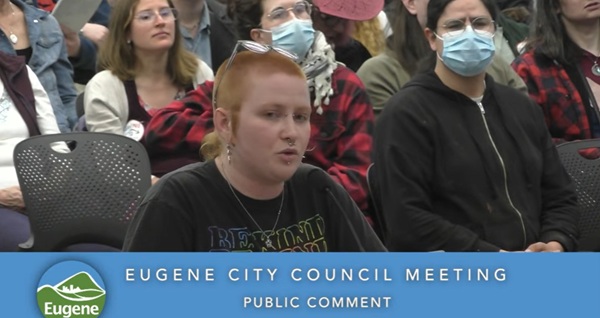
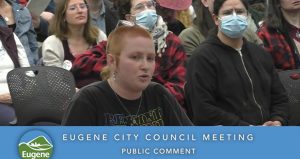
Presenter: Public comments ask the city to improve safety near the UO by converting Hilyard and Patterson to one lane each, or by restoring two-way traffic. At the City Council April 13, Emily Beatty:
Emily Beatty: Hi. My name is Emily Beatty. I’m a member of the Graduate Teaching Fellows Federation, which is the graduate labor union at the University of Oregon where I am a fifth-year PhD student.
I’ve been a bike commuter in Eugene for the last five years, and for four years before that in Philadelphia, I’ve come to urge the city to take urgent, if not immediate action, that ensures the safety of our whole community.
I don’t feel inclined to make a poetic argument about why this matters. The fact is people’s lives are at stake. Recently, our union lost a member, Erick, to traffic violence. He was hit by a car, found by other GEs (graduate employees) of the University of Oregon, and I’ve heard waited far too long for emergency services to locate him. And he tragically passed away far from his family in Kenya.
So again, I’ve come to urge you all to take immediate action. We’re welcoming people from all across the world to study and live in Eugene, but we fail to create the infrastructure necessary to keep them safe.
Every day as pedestrians and bikers we’re expected to take full responsibility for our safety, even though these conditions are largely out of our hands, we have to predict how drivers will act, whether they’ll let us pass, give us enough room to get work, get to work, or home safely, or whether they will blatantly disregard the law and put our lives at risk.
And all we ask from the city is to utilize their leadership access to resources and access to other bodies of power, including the University of Oregon, to make our streets safe.
This isn’t something to be solved overnight, of course, but there are things that take minimal effort to achieve. For example, hiring a crossing guard, painting a crosswalk in general, or installing a stop sign.
And there are experts in our community ready and willing to help you all enact the more drastic and long-term changes necessary to reach zero traffic deaths in our community.
Jacob Schmidt: My name is Jacob Schmidt. I’m the vice president for external relations of the Graduate Teaching Fellows Federation union, representing over 1,000 graduate employees at the University of Oregon. I’m also a cyclist and a historian. But enough about me.
Back in January, a beloved member of our union and our community here, Erick Munene Njue, was killed by a speeding driver on Patterson Street at the corner of Patterson and 22nd.
In the immediate wake of this, members of our union, particularly international students who are here on student visas, reached out to us as their union, asking: What can we do?
And so we did what we could. We organized and we got big outpourings of support: huge memorial services, memorial marches, op-eds in newspapers, flowers, ghost bikes, murals. We’ve had meetings, we’ve had community forums, meetings with the mayor and the city manager.
But what we haven’t seen yet is any physical change to the intersection at which Erick was killed. We know that physically changing street layouts is the only effective way to prevent traffic violence and traffic deaths.
And I’m here tonight to call on the city to act and to act quickly to make the physical layout of 22nd and Patterson Street—and eventually many, many other intersections around town—safer for those who cross them daily.
The objection to these kinds of actions tends to be the cost, but anyone who knew Erick or anyone else killed by traffic violence knows that the cost of the status quo is infinitely higher than any amount of concrete, paint, or bollards.
So we calling the city to enact smart street designs, street designs that have been proven effective the world over. The city of Hoboken, New Jersey has had no pedestrian deaths in the last eight years simply from daylighting intersections, bringing the curbs out further, slowing traffic, creating greater visibility for people crossing the street.
We also call on the city to re-examine policies that require death or serious injury to do anything, right? We know the city that we want to live in. We should be pursuing a positive vision of building a livable, walkable city. A city where students from around the world, where people, the countries around the world can send their best and brightest to live here, to be full members of our community and to return home alive.
Scott Lambert: My name is Scott Lambert. I am a rank and file member of GTFF 3544 at the University of Oregon, and a physics PhD candidate at the U of O.
I am here to talk about traffic safety. I used to run with Erick Njue. He was among the most joyful people I have ever met. It was a devastating loss when he passed.
Today after picking up Jacob from the airport, I saw a scenario on Pearl Street identical to the one that killed Erick Njue. Luckily, in this case, no one was killed, but I saw a car slow down in front of me, or two cars slowed down in front of me. A pedestrian started to cross the road and the car who was second in line swerved to go around the car that had slowed down.
So I’m here to echo all of the recommended improvements that Jacob said: physical curb bumpouts or similar changes that physically require cars to slow down. I think the city can afford to make that investment, given the lives that it will save.
So Jacob didn’t mention this, but I think it’s worth mentioning improvements to public transit to make it more attractive to more people and reduce the number of people who are driving in the first place.
If I want to get groceries at WinCo right now, getting there on public transit takes two to three times longer than driving. Given that math, a lot of people just are not going to take public transit. Public transit is safer and less environmentally destructive than small vehicle transportation.
I also wanted to note that Erick was biking when he was killed. Bikers take on the risks of navigating traffic and benefit the city by reducing carbon emissions and dangers to pedestrians, drivers and other bikers.
As such, cyclists should be regarded as performing a service to the city and prioritized in the construction of our physical transit infrastructure as such.
Finally, we do not want more cops or cameras. Those will not solve the problem of traffic safety.
Anabelle Rampersaud: My name is Anabelle. I am a grad student at the University of Oregon, and I’m a member of the University’s Graduate Teaching Fellows Federation, and my statement is also an urge to the Council to improve safety of our streets for bikers and pedestrians.
So I commute daily by bike, and every day I navigate the one way couplets surrounding the university streets like Patterson and Hilyard, that are two-lane, one-way streets. And these have been extremely difficult to cross, not just for cyclists, but for anyone on foot.
I’ve experienced the same situation that led to the tragic death of Erick, a fellow GTFF member, earlier this year, wherein one car stops for a pedestrian while the car in the adjacent lane continues through.
And in these moments, crossing the street becomes a negotiation with traffic and it shouldn’t be. Crossing the street should be a safe and predictable act. No one should risk their life to cross the street. And this is not about the individual behavior of drivers. This is about street design.
So we know from research that street design shapes risk for accidents. One-way couplets like Patterson or Hilyard, and car speeding and they reduce visibility and that creates some really dangerous conditions.
But we can fix that quite easily. We can make travel safer for everyone by converting one-way couplets into two-way traffic or one-lane traffic. And this could calm speeds and also allow for protected bike lanes.
We also need safety improvements at key crossings, like 22nd and Patterson. Things like curb bumpouts and user-activated warning lights. These are all solutions that are research-backed and have been proven to save lives.
And for me, this is really personal. I’m a low-income and I don’t own a car. And so when our streets are unsafe, it disproportionately affects people like me who rely on walking, biking, or transit.
Street space is public space, and it should be designed for people of all kinds, not just people in cars. So I urge the Council to take steps towards creating safer streets for everyone.
Jasmine Hatmaker: Hello, my name is Jasmine Hatmaker and I was born here in Eugene. I’m here tonight to talk about road safety.
As an adult I lived in Southern California, Southern Florida, Arizona, and downtown Waikiki, which all have very dangerous driving and you see a lot of accidents.
When I decided to move back home, one of the things that it might surprise you to know is that I look forward to being back here with safer driving. And so it was really disappointing to find out how dangerous driving has gotten here.
I know there are budget concerns that the city is currently going through as well as the state, but we need to do more to prioritize road safety, especially if our goal is to have safe walkable and bikeable neighborhoods that are transit oriented, 8% of our problem streets and intersections are responsible for 72% of fatal and serious injury crashes.
There are low-cost changes that would increase safety now, like reducing on-street parking in areas that block the line of view for drivers and pedestrians where crossing takes place.
Please do more now before more of our community members are injured or killed. Thank you.
Noah Birnel: Hi, I’m Noah Birnel. Last time I was here I recited the number 50. I’ll recite it again. That’s around the number of people killed in the last three years by traffic violence on the streets of Eugene. I’m not going to try to repeat what other people have been here—many from GTFF.
We’ve heard some city staffers talk about, ‘Well we have a data-driven approach to responding to,’ they don’t use the word traffic violence ’cause they’re allergic to that, but, traffic accidents maybe.
It’s not really data-driven to say, ‘Well, we wait until someone dies on this particular street.’ We know what kinds of streets are unsafe. There are cities all over the country and all over the world doing good work on improving the safety.
So we don’t have to reinvent the wheel. We don’t have to die. We don’t have to be the worst, and you guys have the ability to make policy and it is already Oregon state law that street corners are supposed to be daylighted for 20 feet.
Eugene does not seem to be following that law in terms of how they mark up parking spots. I am just asking you to direct your staff to look into what do we need to do to make our streets safer.
And I’ll say part of that is pedestrian infrastructure, which means you should not be permitting fences that block off sidewalks, but that’s another issue.
Kendsie Channing: My name is Kendsie Channing. I live at Spencer View Apartments. My husband is a PhD student at U of O and a member of GTFF. But I happen to serve as the executive director of our community bike shop, Shift Community Cycles.
So on the day of Jan. 25 these seemingly separate worlds overlapped with Erick’s death at Patterson and 22nd, because of traffic violence.
It was and still is a terrible act of violence that affects the daily lives of my neighbors as they cross the street to get to school and impacts who I’m seeing in the bike shop and who’s willing to ride a bike these days.
The city committed to a Vision Zero policy over a decade ago, yet we haven’t seen an increase in safety. There’s still vulnerable road users on bikes, walking with strollers, using mobility devices, trying to cross the road, that have been killed.
In fact, since August, we’ve lost three community members who have been on bicycles, in the same way that Erick was with the double threat of two lanes of traffic moving in the same direction, and one car stops and the other doesn’t.
It doesn’t align with the city’s Vision Zero initiative, and I’m asking for accountability to help uphold the Vision Zero policy that was put in place to prevent the deaths of my neighbors, my friends, and my fellow vulnerable road users who use a bike to get around every day.
My kids are also starting to ride bikes. This one’s on a little trike right now that only stays on the sidewalk, but her big sister is ready to ride to kindergarten next year.
We have so many community members who don’t have the option of using a car, and we need to create a safe environment for everyone, for every member of our community, no matter what their transportation mode is.
When we commit so much space to cars, we’re committing less to building community. If we could have a street mural, a parklet, a meeting space, or more trees in a lane instead of cars moving in front of our apartment, that would promote the safety and community that we should all have a right to living in this town.
Meredith Jacobson: My name is Meredith Jacobson. I am here also as a member of the Graduate Teaching Fellows Federation. I am a PhD candidate in environmental studies and I’m also a new mom.
I’m here among my peers who have already spoken to ask the City Council to prevent more senseless deaths on Patterson Street and around the city by prioritizing immediate infrastructure changes to promote pedestrian and bicyclist safety.
While my family and I live in the Whit, my 1-year-old attends daycare at the Co-op Family Center at Spencer View Apartments. And while I didn’t know Erick personally, I share my community’s devastation at this tragic, senseless and preventable death due to the speeding motorist, and more importantly, due to unsafe city planning that leads to these preventable deaths.
My husband and I transport our daughter frequently to and from daycare in a bike trailer. We bike because we want to work toward a livable future for our daughter. We bike because we want her to imagine a world that isn’t reliant on cars.
We bike because we don’t want to pay skyrocketing gas prices on a University of Oregon graduate salary. And we don’t want others to have to do so either. And we want streets that are safe for all who need them. And we also bike because it is joyful.
Trying to bike across Patterson already felt treacherous before Erick’s passing, and now it feels terrifying. And as a mom, I feel like I have to make impossible choices between living the life I believe in for and with my child, and also protecting her from immediate danger.
Meanwhile, when I do drive and come across pedestrians seeking to cross streets like Patterson, I worry that if I stop, I may inadvertently cause the situation that was fatal for Erick, by a car speeding around me and ignoring the person trying to cross.
I believe that the only viable solution is to reduce the roadway to one lane, to slow drivers down to a speed that is safer on a road that runs right past a major housing complex and daycare center.
A crosswalk and other traffic calming measures should be put in immediately. In the meantime, I really ask that you prioritize this as much as you can, as one insufficient but important way to honor Erick’s life. Thank you for your time.
Erica Lyon: Erica Lyon. So there’s been plenty of discussion tonight on building safer, better streets for bicyclists. And I couldn’t be more encouraged as a bicyclist myself to see this sort of civic engagement on this issue, which has long needed to be addressed.
However, there’s been some reluctance to call traffic violence what it is, which is traffic violence, not only because of how our streets are designed, but also because of how drivers behave.
One example is just last Thursday when I was at ‘Signs Of Fascism’ protest there on the corner of High Street and 6th Street right across from the 5th Street Public Market, and a white truck driver came within a couple inches of jumping the curb and could have easily killed one of us.
It was an act of aggression. He was seeing how closely he could come to us without actually causing any harm. It was aggression. And not only that, but at pretty much every single protest I’ve been to, there’s been at least one truck driver that’s coal-rolled us.
And if you don’t know what that term means, it’s where they spew out this big black smoke, black exhaust into our faces, harming our health and harming the planet.
And I see this regularly from truck drivers, not only at protests, but I’ve even been coal-rolled just while I was biking down the street just by myself, just minding my own business. I’ve been coal-rolled and that’s not, I even mention the number of drivers that are revving their engines at all hours of the day and night, including when I’m trying to sleep and actually.
I had the privilege of being in Germany last summer and I learned that there, it’s actually illegal to cause undue noise like that because it’s disrespectful to the peace of people around you. So we should have something similar here.
They even make motorcycles to be quiet. Then it becomes, so you can’t rev the engine loudly and obnoxiously.
So let’s please also design better city streets and smart design, but also the behavior of the drivers also needs to be addressed.
Presenter: Public comments April 13 urge the city to take quick corrective action after a fatal vehicle-bicycle accident at 22nd and Patterson.