Independent media stars in ‘Steal This Story, Please’
12 min read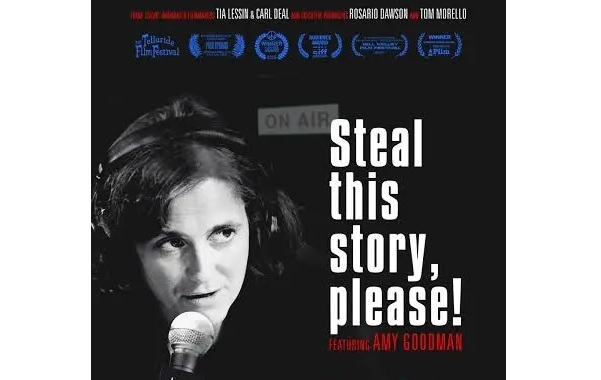
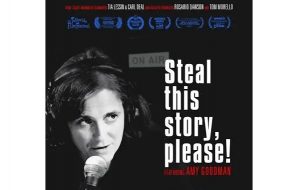
Presenter: KEPW 97.3 Eugene PeaceWorks Radio features the podcast of Current Affairs Magazine. Here’s Part 2 of a two-part series featuring the new documentary about Amy Goodman and Democracy Now!
Nathan Robinson: Welcome to Current Affairs. My name is Nathan Robinson. I’m the editor-in-chief of Current Affairs magazine. I’m joined firstly today by my colleague, our digital editor, John Ross. Hello, John.
John Ross: Hi, Nathan.
Nathan Robinson: And we are also privileged today first to be joined by the filmmakers Carl Deal and Tia Lessin. They are Academy Award-nominated documentarians, the founders of Elsewhere Films, known for the films Trouble The Water, Citizen Koch, as well as being producers on a number of Michael Moore’s classics like Fahrenheit 9/11.
Their new film is ‘Steal This Story, Please,’ about the life and work of Amy Goodman and the history of Democracy Now! Carl and Tia, first, welcome to the program.
Tia Lessin: Thank you so much for having us, Nathan. We’re grateful to be here.
Nathan Robinson: So this new film, which profiles the entire body of work over the last 30 years, I want to start with Carl and Tia, obviously, this film is your concept and you got to go through the entire archives of Democracy Now through making it.
And so I want to start with just asking you both, you know, why you felt that Democracy Now! was such a fitting subject for a whole film. And, you know, you are obviously using Amy’s career here, not just to show us what she has done, but also to show us what serious journalism looks like and Democracy Now! as a model.
You begin with that incredible scene of Amy kind of chasing down one of Trump’s climate advisors, trying to desperately try to get him to answer a question. So I wondered if you could talk about, you know, what makes Democracy Now! and Amy’s work special and distinct from corporate media and such a fitting subject for a film.
Carl Deal: You got it exactly right in terms of, you know, what the film is and what the film shows, and, you know, for us, when we make a film, it’s because we want to say something and we want to have an experience that we can share with the audience.
And so specifically with respect to Democracy Now!, making this film gave us a chance to (in a horrific way) to relive the last 30 years, you know, relive our adult lives and our experience of the horrors we’ve brought to the world as a country in many ways, but also to experience the flip side of that and to understand the resistance to that and to those resistance movements that Amy and Democracy Now! have always given space for over the years.
And so, you know, things have changed a lot, even in the short time that we started making this film. And we never would’ve anticipated the landscape that we’re living in right now, in 2026, even as it applies to media.
And even though, as we see in the film, Amy and her team at Democracy Now! have been calling out the corporate media and the laws that have resulted in just such an incredible narrowing of the news media landscape, and we got to spend 30 years sort of deepening our understanding of the moment that we live in right now.
Tia Lessin: As we were watching Amy transform this scrappy radio show into this extraordinary network, we were seeing the opposite happen in the corporate world, in the corporate media world. In 1996, the same year that Democracy Now! came on the air, the same year that Fox News came on the air, Bill Clinton and Newt Gingrich teamed up to pass the Telecommunications Act, which lifted all the restrictions, all the caps of ownership in local media.
And so what used to be hundreds of local stations operating in communities across the country accountable to those communities has increasingly in the last 25 years, been consolidated into just a handful of stations, print outlets and radio outlets.
And so this incredible consolidation has happened in front of our very eyes. And we have just a few corporations and billionaire owners controlling the outlets. And their first priority is not to the news. It’s not to the journalists who work for them, it’s to their shareholders, it’s to their board of directors.
And so we’ve seen them capitulate time and time again to the president right now and trade in the integrity of their news organizations for the special favors that they get from the administration.
I mean, we have a president of the United States who has called the press the enemy of the people.
Not only that, but journalists are increasingly facing harassment, physical assault, their materials are being seized by the federal government. They are facing arrests. Lawsuits by not only politicians like Donald Trump, but by corporations who want to silence their coverage. And so to me, there’s no more important time to talk about the freedom of the press, to talk about the importance of journalism than now.
And there’s no better way to do it than to tell the story of Amy Goodman and Democracy Now!
We have a scene in the film in 2008. When Amy’s covering the Republican National Convention, it’s four years after the invasion of Iraq. The war is still going on, and there are people in the streets of Minneapolis protesting and many of those are the veterans and they come up to Amy and they embrace her, because they are so appreciative of her coverage. They are not being covered by the mainstream in that moment. They still, to this day, get forgotten.
John Ross: There’s another moment in the film where Amy is accused of being not a journalist but an activist.
And it sort of made me think about how, you know, in corporate media there are of course all of these pressures, whether it be advertisers, maintaining access to powerful people. Now we see more billionaire ownership. And it sort of made me wonder, do you think that the distinction is not between media and activism, but between media that challenges power and media that sort of accommodates and coddles it?
Carl Deal: Well, you’ve just taken my answer to your question. Yes. There’s nothing wrong with being an activist. The way that it’s used is to demean to, to marginalize, and to disrupt people who are truth-tellers in a certain way and who are telling a story that they don’t want to be heard.
And so, you know, for me, the distinction isn’t, you know, are you an activist or not an activist, but who do you serve? Do you serve power or not?
And you might also ask the question of those who like to throw that word around in demeaning ways: Who do you serve? And you’re actually the activist because you’re serving power, you’re serving the corporations that own you and you’re playing their game. You know, you have a very clear agenda or you’re working within an institution that has a very clear agenda and you know, so my opinion is that those are the activists.
Tia Lessin: I would just add that there are a lot of journalists who do want to ask the hard questions that are interested in forcing accountability, and they are just compromised because of the institutions they work for. So Amy is not only, you know this journalist who asked the hard question, she’s also created this model that allows her to do that without interruption, because she’s not accountable to corporations, she’s not accountable to government funding. She’s accountable to her listeners, and that really is the difference is: Who are you accountable to? Who do you serve? as Carl said, and: What compromises are you forced to make?
Carl Deal: And Nathan, let me say that we see and we hear and we feel Amy’s passion when she talks about what she does and why it’s important.
And you know, an answer to your question about whether she makes the distinction between activism and journalism. And I’ll just quote David Isay from the film to describe what we just heard Amy do, is: If she believes something, she’s going to fight for it and get it out to the world. And to me that’s just straight-up journalism.
It’s not advocacy. It’s just a pure belief in what’s good and fighting for that with everything that she’s got. That is a perfect description, I think, of what drives Amy’s kind of journalism.
John Ross: One question I had for you both Carl and Tia, is, after making this film and looking back at 30 years of Amy’s work, what do you think would be missing from the historical record today if Democracy Now! hadn’t existed?
Tia Lessin: Hmm. That is such a great question.
It wasn’t lost on us that we’re watching all this footage in this time when the historical record is being erased in front of our very eyes. It’s being taken out of the museums. It’s been taken out of our public schools, it’s been taken out of our colleges and universities by a regime that doesn’t believe in facts and doesn’t believe in science, and doesn’t believe in history, or at least, you know, wants to change the telling of the story.
So Amy and Democracy Now!, her team there, have helped us build that historical record every single day through their reporting, through their eyewitness footage, through their interviews.
And you know, I think about the story about the imprisonment of the Palestinian activist Leqaa Kordia. And I remember hearing the interview with her lawyer in December, and Amy had the lawyer on, she couldn’t get to the woman in the prison, but she had her lawyer speak about it and it, I was reduced to tears, you know, hearing about it.
And this was a story that wasn’t being told by other commercial networks. And the press really ignored this, but you could hear it on Democracy Now! And it was important, and 25 years, 50 years, 75 years from now, that voice will stand as a reminder of the horrific conditions that political prisoners were placed in, in this moment.
Carl Deal: Thank goodness for the incredible job that Democracy Now! does of making everything that they’ve ever aired available at a keystroke. I mean, how frustrating is it for us if you’re doing research on something and you’re looking for something, you want to look for something on CNN, you hit a paywall, or they don’t keep anything more than six months.
There is a record of these voices for 30 years that you can access at democracynow.org. And that’s an incredible service to the greater good.
Tia Lessin: We’ve won eight audience awards for this film, which tells me not only, you know, that Amy is beloved (which we know), but that there is a hunger out there for political content, that’s for films that speak to this moment.
And for me and Carl, it’s just been incredibly cathartic to be on the road with Amy with this film. It’s a way that we can do something in this moment and channel our outrage and our pain and our fear about these troubling times.
And to see audiences respond in the way that they do—with laughter, with tears, with, you know, getting up afterwards and wanting to do something. I mean, that is just exhilarating. And you can’t have that impact with people in their living rooms or watching on their telephones. It has to happen in the theater.
And so we’re excited about not only having audiences see the films around the country, but actually seeing it with them. We’re going to so many Q&As—we’ll be on the West Coast, we’ll be in the Midwest, we’ll be on the East Coast and all those listings are on the stealthisstory.org website.
We are putting this film out. We are self-distributing and we need folks to show up.
Carl Deal: Not only is the film on this run being used to support and bolster community media and independent journalists and institutions everywhere that it’s playing, but just by nature of it playing in these art house theaters, it’s helping bolster arts, ’cause you know, art is dangerous now and it’s also under attack.
And these very institutions, these theaters that are playing this film that are daring to play this film, you might say are themselves suffering from a lot of these cuts and they’re losing funding right alongside the independent reporters in independent media.
So it’s all coming together in sort of a perfect storm of resistance here.
Nathan Robinson: You know, I mentioned that the film is not just a profile of Democracy Now! and Amy’s work, but it’s kind of the case for independent media. And Amy mentioned that the title there, and one of the extraordinary things that you show in the film is that there are a number of instances over 30 years where the corporate media failed, Democracy Now! is the only outlet on the story, with very few resources.
And then sometimes it even gets picked up in the press. Democracy Now! is able to get people to pay attention. So you show that, you know, it’s not just that you’re out there in the wilderness covering these things, you can actually make something into a story that wouldn’t have been a story if there hadn’t been an independent journalist out there. It’s extraordinary.
Tia Lessin: That’s right. And we see that at the very beginning of Amy’s career in East Timor when she was with her colleague Allan Nairn, who was writing a piece for the New Yorker, and Amy was covering for WBAI radio in New York. And you know, they just happened to be there when the civilian protesters were targeted by the Indonesia military and were massacred.
And Allan and Amy survived that massacre. They were the only media on site, except for another TV journalist from York, Yorkshire TV, who happened to film the entire massacre, and they were able to get this out to the world. And because of that reporting, because of their coverage, they broke this logjam.
The mainstream media had not covered the genocide in East Timor for nearly 20 years, and all of a sudden Amy and Allan’s voices were out there. This footage was out there and a solidarity movement grew in response. So we see the power, time, and time, and again of Amy’s reporting and the power of independent journalism.
Nathan Robinson: The film is ‘Steal This Story, Please!’ and profiles the work of Amy Goodman and the staff of Democracy Now! over the course of the past 30 years.
As you mentioned, it has, you know, obviously many moments such as the massacre in East Timor that are very difficult to watch, but it also has lighter moments. And it’s fun. It’s inspiring. It will outrage you, it will excite you.
It will reinvigorate you. We recommend that everyone watch it. So we were so delighted and honored today to be joined by filmmakers Carl Deal and Tia Lessin. Thank you Carl, Tia, so much for joining us on Current Affairs.
Carl and Tia: Thank you. Yes, we appreciate it and thank you. Keep doing what you’re doing. Thank you so much.
Nathan Robinson: Just as a reminder, there’s lots more great Current Affairs material coming out on this channel all the time. If you subscribe and if you go to currentaffairs.org, you can check out all of our excellent online articles and our wonderful print edition.
It’s full of all kinds of incredible essays and art and little amusing surprises, including fake ads. (There are no real ads in Current Affairs.) CurrentAffairs.org/subscribe to get the print edition and use the special code, that’s 15OFF, and you’ll get 15% off of your first year’s subscription.
Presenter: That is Part 2 of a two-part series featuring a new documentary about Amy Goodman and Democracy Now!
For theaters nationwide, see the film website, StealThisStory.org. For local showtimes in Eugene, see the Metro Cinemas website.