Meet the candidate: Eric Dziura for EWEB commissioner
7 min read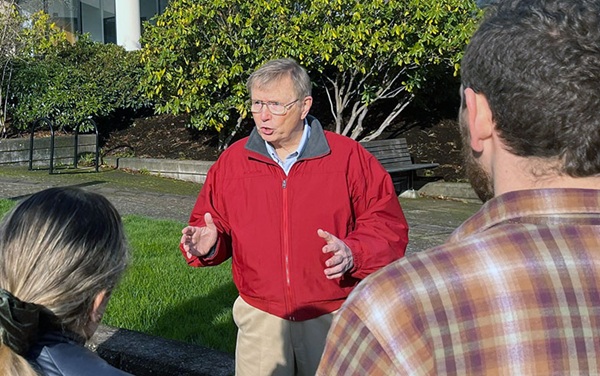
Presenter: ‘Meet The Candidate’ visits with Eric Dziura for EWEB at-large commissioner. Please tell us about yourself and why you’re running.
Eric Dziura: Hi, my name is Eric Dziura and I’m running for the EWEB board of commissioners at-large. I’ve spent more than 40 years in public service, 21 years in the U.S. Army and Navy, followed by 21 years teaching at public colleges and universities, including community colleges here in Oregon.
I spent nine years on public boards in Oregon, including a school district and a library district. And I’m also very actively involved here in Eugene, in the community.
I’m the treasurer of the Active Bethel Community Neighborhood Association. I’m chairman of the Eugene Airport Advisory Committee. I’m a board member with the City Club of Eugene, and I’m a student mentor at Shasta Middle School.
I’m running for the at-large position because EWEB is one of the most important institutions in Eugene. It provides services to every household, every business, every nonprofit, every organization, all the fire departments and so forth. It provides clean water and (hopefully) reliable electricity.
EWEB is a publicly-owned utility, which is great for us because the money that we spend to purchase our electricity and water, none of that money goes to shareholders.
It all goes to doing what needs to be done to deliver clean water and reliable electricity to tens of thousands of Eugenians and actually a few people outside of Eugene.
For this to work, we, the public, has to have a way of guiding the combined utility so that it’s operated in a manner that lines up with the wishes and desires and concerns of the ratepayers.
And the mechanism for that is a five-member elected board of commissioners. The position that I’m running for, the at-large position, it represents the entire city of Eugene. The other four board members represent two wards each.
And then the other thing that is important to note is that the incumbent in the at-large seat has chosen not to run for reelection.
So that means that come next January the EWEB board is going to have at least one new board member. And, given the importance of EWEB, and the services it provides and its wide-ranging reach over or connection with our lives, and also its wide-ranging reach geographically, we need to have experienced, dedicated, thoughtful people to step forward and run as board members.
So that, in a nutshell, is why I’m doing it.
Presenter: What’s the most important issue in this election? How would you address it?
Eric Dziura: As I said, it’s a combined utility. Water and electricity. Either one of those individually are very complex undertakings. But we’re doing both. EWEB is doing both. One of the most important things we need to pay attention to right now (amongst all the things we need to pay attention to) are the costs of the services that we receive from EWEB.
Right now in our country, there is an affordability crisis. Housing prices are too high. Rental prices, particularly here in Eugene, are too high. Gasoline is too expensive. Groceries are expensive, and people, ratepayers, are very, very concerned about anything that puts more pressure on their budgets.
So this is a—very much a—kitchen table issue. For a long time we were lucky because electricity rates didn’t rise very fast. We were doing a much better job of conserving energy, and so that kept the price down.
But in the last few years, demand for electricity has risen sharply and that’s going to continue to be the case for some time to come. Everybody knows what the term data center means. AI is both a blessing and perhaps a burden.
But in any case, in order to do AI (however you feel about it), you need these massive data centers that consume huge quantities of electricity and also no small amount of water. That puts pressure on electricity prices.
A couple of other things that put pressure on electricity prices are electrification. We’ve been trying very hard to switch from using other forms of energy to using electricity only to the extent that it’s possible to do so. Because electricity is relatively cheap and we can make it renewably and we can also do it without producing carbon. And so, that benefits our climate.
But of course if we’re electrifying everything, that means we’re increasing demand for electricity. That puts pressure on prices. And then there are also environmental and climate factors that tend to increase prices as well.
And EWEB is currently in the middle of upgrading, replacing aging equipment at 10 major substations around the city of Eugene. Eugene is also replacing and upgrading water storage tanks and pumping and other components due to aging and they’re also improving earthquake resilience.
And of course all of those things cost money. My approach to dealing with the costs is disciplined long-term planning. We have to look far ahead because of the magnitude of all these changes that are happening, and plan out as far as possible, and then making sure that the investments we make are essential, that they’re introduced incrementally, not all done at one time, so that we can spread out the cost over time.
That’s very important. And then they also have to be clearly and transparently communicated to the ratepayers. People need to know that this is coming and they need to understand why.
And also they need to be able to have time to give their input, if they object to what’s being done or if they have ideas about things that they think should be done.
The bottom line is we need to avoid sudden rate spikes, while still building a resilient system that people can depend on.
Presenter: How do you differ from your opponent? Eric Dziura:
Eric Dziura: I have a lot of experience with board governance and direct community engagement. As far as board experience goes, my opponent doesn’t have that yet. This is the first time he’s run for office and I congratulate him for doing so.
I have nine years of board experience, and I’ll tell you a bit, a little bit about that. As a board member and later chair of a school district with 25 schools and almost 14,000 students for five years in Medford, Oregon, I know how to communicate openly and transparently to gather the information necessary to manage a $120 million school repair bond.
And also, at other times, make difficult decisions during times of reduced funding, which unfortunately here in Oregon happens periodically. Every once in a while, we’re cutting funding for schools. And of course the school districts in Eugene and Lane Community College are undergoing severe cuts.
And so you need board members who can navigate those processes correctly and fairly and openly and transparently.
I’ll also mention that I was a board member and chair of the Jackson County (Oregon) Library District, which has 15 libraries, and it’s scattered over 2,300 square miles in Jackson County, and there are 220,000 residents.
As a member of that board, along with my fellow board members and our dedicated staff, we navigated the pandemic and kept providing services throughout to our patrons.
We didn’t close our doors except for maybe about a month and a half during the entire pandemic. We found ways to work the system so that we could continue to provide those services.
The other thing that we did during that time was, we also successfully resolved important issues related to the banned book movement, and also balancing the access needs of both our homeless and housed patrons.
Those were very important issues to our community. And fortunately, we had a good board and a good staff, and so we managed to navigate those as well. So those are the kinds of skills and understanding of the mechanics of a public governing board that I would like to bring to EWEB as well.
The second thing is, my opponent does have some experience with community engagement. He serves on a city committee and I, again, I congratulate him for doing that.
I’m a little bit more widely engaged. When I first moved here to Eugene, one of the first things I did was to join the board of the Active Bethel Community Neighborhood Association. And I’ve been doing that ever since I moved to Eugene about two and a half years ago. It’s a very active community, neighborhood association, and I’m very proud to be part of that.
I’m also chair of the Eugene Airport Advisory Committee. The airport is a major economic driver in our community, and I’ve been very proud to serve on that. Our airport staff are fantastic. I’ve been doing that for a couple of years and it’s an amazing organization and it’s very sustaining on the economic front.
I’m on the board of City Club of Eugene, which is an organization that provides for civic engagement and calm, reasoned discussion, which is kind of hard to find these days. We put together 35 programs a year. It’s a Eugene institution and I’m very proud to be a member of that organization.
And then finally, for a few hours a week, I mentor students at Shasta Middle School.
Presenter: Eric Dziura, is there anything else you’d like to add?
Eric Dziura: My website: It’s Eric4EWEB.com. That’s it. And you can find out more information.
If people wanted to volunteer, the most useful thing that they could do right now is write letters to the editor. And I can certainly provide help with that. You can contact me via the website. And of course donate. Contributions are also very important as well.
Presenter: ‘Meet The Candidate’ visits with Eric Dziura, running for the at-large position on the EWEB board of commissioners.