Veterans For Peace honor Aaron Bushnell
5 min read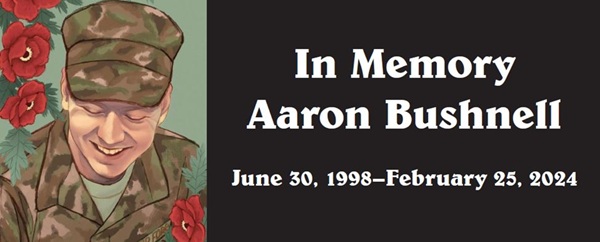
Presenter: Veterans For Peace remembered Aaron Bushnell in Eugene Wednesday, and KEPW’s Todd Boyle was there:
Todd Boyle: Feb. 25, the second anniversary of Aaron Bushnell’s self-immolation, Veterans For Peace held vigils nationwide, including in Eugene. Bushnell’s last words were played on the PA system: ‘Free Palestine.’
Thus it is appropriate the local Veterans For Peace Chapter 159 held a large banner, ‘Free Palestine.’ Shelley Corteville, chapter president, offered some thoughts on the full measure of his devotion and on the complicity of Americans and veterans in the wars and genocides around the world that Bushnell said he would no longer be complicit in.
Shelley Corteville (Veterans For Peace): So Aaron Bushnell was only 25 years old when he decided to self-immolate. And that’s really young, really young. And to make that kind of a decision, I just can’t even imagine how difficult that had to have been.
Many of us veterans know about moral injury and how we come to that. And when we talk about, ‘Remember your oath,’ Aaron Bushnell thought about his oath, and part of that oath is not being complicit in illegal war, illegal acts.
Right now in this country, we’re involved in all kinds of wars, illegal wars. We are a huge part of the genocide in Palestine. We send arms, we send money. We are in that war. We are creating that genocide.
We could very well be in a war with Iran very soon, but we’re in all kinds of wars. We’ve been in all kinds of wars. The American public just seems to be asleep. Aaron Bushnell could no longer be complicit in that.
For a lot of us veterans, some of us come to that idea of complicity while we’re in the service. Some of us come to that idea after we’re out of the service. For some of us, it takes many years, and for some of us, we never come to that at all. But it can be very difficult. You’re in the service, you’re asked to do things. The American public is really clueless and really wants to bury their head, really doesn’t want to know what the military does in your name, which is really frustrating.
So in that sense, it makes perfect sense to me that Aaron Bushnell would feel that self-immolation was the only way to wake up people in this country to a genocide.
One of the things that he said to his friends, you know, ‘You sit around and you think, and you ask each other, what would you do if you were alive in the time of slavery? What would you do? What would you do if you were alive in the civil rights era?’ Because he certainly wasn’t. What would you do? He said, ‘You’re in it right now.’
What goes on overseas, what goes on globally goes on here. What has been going on here for decades has been going on globally and we’ve made it okay. Killing in our streets—it didn’t just start happening. It’s been going on for decades. Been pretty okay to kill Black and brown people on our streets. Been pretty okay to have a genocide in a foreign country. Pretty okay, as long as it’s not our people, white people.
It’s not okay. We have to all wake up. I think of Aaron and I think, ‘My God, there was one of my brothers. A young man, a 25-year-old, went into the military to get an education.’
You know what we call that? For those of you that never served, we call that the ‘poor draft,’ the ‘poor people draft.’ You know why? ‘Cause we go in because we can’t afford an education any other way. That’s how we think we’re going to get educated.
So if you haven’t joined the movement in any way, join it now.
I was going to read to you Aaron’s last words, but I think what I’d rather really rather do is I would like for you to hear Aaron’s last words. So I’m going to hold my phone up so you can hear what he says before he self-immolates, because I think hearing it from him is more important than hearing his words from me:
Aaron Bushnell (June 30, 1998 – Feb. 25, 2024): I’m an active-duty member of the United States Air Force, and I will no longer be complicit in genocide. I’m about to engage in an extreme act of protest, but compared to what people have been experiencing in Palestine at the hands of their colonizers, it’s not extreme at all.
Shelley Corteville (Veterans For Peace): It saddens me that people—a lot of people—ask me, ‘Wow, who is Aaron Bushnell?’ People never heard of him at all or forgot about him, which doesn’t surprise me, because we do forget. It doesn’t make us bad people. We just do forget.
Aaron’s not the first person to self-immolate. Five people did it during the Vietnam War. Aaron’s the second person. In the December before Aaron self-immolated, a woman self-immolated in Atlanta in front of the Israeli consulate, but they did not want to give her a name for fear that people would continue to do this.
It’s important to remember that there are a lot of things we can do. We don’t all have to go to protests, but we have to do something.
We’re in a lot of wars. We have to do something. Don’t let Aaron’s sacrifice be for naught. That young man did the only thing he thought he could do to wake people up. He did not want to be complicit.
I don’t want to be complicit. I want a healthy world. That’s why I do what I do. I know what it is to feel complicit. And I know what it is to deal with that every day. Don’t be complicit. Thank you.
Presenter: Eugene holds a candlelight vigil for Aaron Bushnell, who set himself on fire to protest the genocide in Gaza on Feb. 25, 2024. Field recordings for KEPW News by Todd Boyle.