
Legislators vow to support local emergency physicians, challenge ‘carpetbagger takeover’
13 min read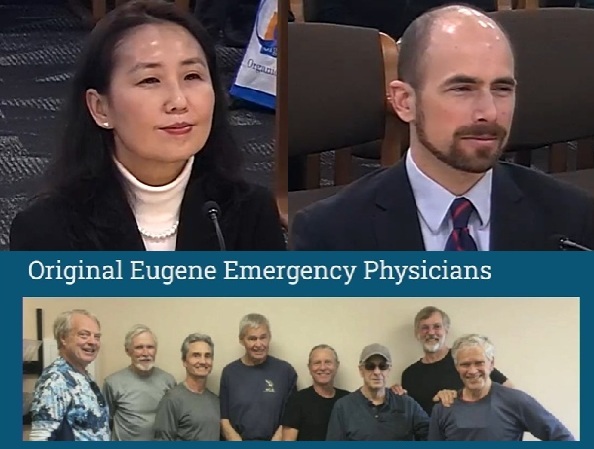
Presenter: Lawmakers pledged Thursday to support Eugene Emergency Physicians (EEP) against what one senator called a ‘carpetbagger takeover.’ In the March 5 committee hearing, EEP’s Dr. Julie Seo and Dr. Jeremy Brown:
Dr. Julie Seo (Eugene Emergency Physicians): My name is Dr. Julie Seo.
Dr. Jeremy Brown (Eugene Emergency Physicians): And my name is Dr. Jeremy Brown.
Dr. Julie Seo: I am a board-certified emergency medicine physician and have served the Eugene-Springfield and Cottage Grove area for the past 20 years. We are here today as a physician, an Oregonian, parents, and neighbors who has cared for this community at its most vulnerable moments.
We speak on behalf of our partners at Eugene Emergency Physicians, also known as EEP, some who are here with us today.
Dr. Jeremy Brown: For 35 years since 1991, our independent physician-owned group has grown with the community from the nine original members to 41 providers today. That include 32 board-certified emergency medicine physicians and nine physician assistants.
We’ve had a track record in the last 35 years contracting with PeaceHealth Hospital. We’ve used an exclusively W-2 employment model and provided full benefits to all of our providers and partners. We’ve never used any locums or temporary staffing or outside providers, and all of our providers live locally in the Eugene-Springfield area.
All the providers in our group are highly trained and have trained at trauma as well as stroke-certified centers.
Some of the departments that we work in include RiverBend Hospital, which is a Level 2 trauma center serving all of Lane County from the Coast Range to the Cascades, including Corvallis, all the way to the California border, and has recently grown to 85,000 annual ED (Emergency Department) visits.
We reached the highest daily census recently with 293 patients seen in a single day, and it now represents one of the busiest emergency departments in Oregon as well as within the PeaceHealth system.
We also staff the Cottage Grove Emergency Department, which sees 15,000 patients annually through a critical access care model. And we formally staffed the PeaceHealth University District until its closure in 2023.
Our group also works with PeaceHealth to provide relief shifts out at PeaceHarbor Medical Center in Florence. In the summer of 2024, we provided up to 115 shifts at that facility.
In total, we’ve covered 150,000 shifts over the years between these sites. We are Lane County’s safety net and front line of public health and disaster response.
Dr. Julie Seo: In 2022 during the mass shooting at the WOW Hall in Eugene, 12 additional emergency medicine physicians came to the hospitals within minutes voluntarily. Because we live here, we care about the community, our colleagues, and our department. We have responded similarly over the years to the 1998 Thurston High School shooting, and in the 2015 Umpqua Community College shooting.
We are medical directors for the local EMS, fire agencies, and health nonprofits. We serve on the hospital leadership, quality improvement, and credentialing committees. We teach various EMS, medical, PA students from across Oregon schools to invest in the future of Oregon health.
Members of our group are represented on various boards and committees with the Oregon Medical Board and Oregon Health Authority. We are deeply ingrained in the emergency medicine ecosystem.
Dr. Jeremy Brown: Emergency medicine is a form of organized chaos with high acuity time-critical and dependent trust built over years and decades.
Just last week, we treated a patient who was critically injured on the job. Because our team has trained and worked together for years, the pre-hospital EMS, emergency physician, ER nurse and staff, trauma surgeon, and anesthesiologist who were present provided lifesaving interventions including blood transfusions and chest tubes within minutes. The patient was able to walk out of the hospital just days later.
Dr. Julie Seo: And now we would like to give you a brief timeline overview of why we are here today.
In October of 2023, PeaceHealth announced the closure of the University District Hospital in Eugene. EEP voiced concerns that closing University District will increase ER volume at RiverBend and create a health desert for Eugene.
On Dec. 1, 2025, PeaceHealth University District Emergency Department closed. ER visits continued to rise at RiverBend, and in March of 2025, RiverBend reported strain. One can correlate the increase in wait times at RiverBend with the University District closure.
Concerned about increased ER wait times and ER boarding issues and other issues, PeaceHealth announced a Request For Proposal (RFP) opening up the ED contract of the three Lane County Hospitals nationally.
EEP participated in that proposal and on Feb. 4, 2026, PeaceHealth awarded ApolloMD with the contract, who have never staffed in Oregon. In a unified statement, all 41 providers of EEP signed a statement of no interest with ApolloMD as it does not align with the values of EEP.
The statement states, ‘I affirm that I am not interested in employment, independent contractor engagement, or any professional relationship with Apollo MD for the period of no less than 90 days following June 30, 2026. Accordingly, I request no recruitment, solicitation, or contact from Apollo MD or its representatives during this period. This statement is made in my individual capacity and reflects my position.’
The following week, EEP published an open letter to the Lane community: ‘We wholeheartedly welcome a path forward with PeaceHealth that allows us to continue practicing here under the local banner and staffing all of their Oregon emergency departments. We want to stay in the place we call home, in the roles we love, doing meaningful and vitally important work.’
The rest of the month of February, various professional organizations and legislators wrote letters of support for EEP and inquired regarding the legality of ApolloMD contract acquisition.
In addition, the medical staff of RiverBend held an emergency meeting regarding this decision and held a vote to reinstate Eugene Emergency Physicians.
Last week, 335 physicians at River Bend—98% of medical staff—voted in favor of retaining EEP. A formal letter from the medical staff states: ‘We formally request the following:
- ‘Restoration of Eugene Emergency Physician as a provider for the Emergency Medicine Services at PeaceHealth Sacred Heart Center at RiverBend effective July 1, 2026.
- ‘Reversal of the decision to bring on ApolloMD as a provider for emergency medicine services at PeaceHealth Sacred Heart Medical Center at RiverBend effective July 1, 2026.’
Dr. Jeremy Brown: We have the support of the Oregon Chapter of American College of Emergency Physicians, the American Academy of Emergency Medicine, the Oregon Nursing Association, Eugene Springfield Firefighters Local 851, U.S. Rep. Val Hoyle and numerous state senators and representatives, including, we’ve met with Sen. Manning and Sen. Prozanski here today, the Eugene and Springfield mayors, as well as Eugene and Springfield City Council, and many more.
We would like to read statements from some of these letters for the record.
From the American Academy of Emergency Medicine: ‘Incumbent emergency physicians are knowledgeable in the local factors required to deliver the safest and most efficient care to a hospital’s patients. They know how to push the right buttons to save lives and can effectively interact with the nursing and medical staff to deliver high quality care. We believe the local democratic ownership of your group is worth vigorously preserving.’
Dr. Julie Seo: From the Oregon Chapter of American College of Emergency Physicians, they write: The situation in Eugene reflects a national trend that Oregon ACEP believes deserves serious attention. Emergency medicine is experiencing rapid consolidation with large CMGs (contract management groups) displacing independent and democratic governed physician groups across the country.
Oregon has not been immune, and this transition is one visible example of a pattern reshaping our specialty.
Oregon ACEP supports models of emergency medicine practice in which physicians have meaningful democratic governance of the group in which they work. This governance creates accountability to the community, investment in long-term outcomes, and a culture in which physicians are partners, not simply labor to be deployed and redeployed across markets.
Dr. Jeremy Brown: A letter addressed to Sarah Ness, PeaceHealth President and CEO: this decision carries consequences that extend well beyond a contract. These consequences are far -reaching and affect the livelihoods of patients, physicians, hospital staff, and all families involved. These doctors and their families are part of the fabric of our community. You cannot replace that.
Health care is not a line item in a spreadsheet, and lives quite literally depend on the integrity of Southwest Oregon’s Emergency Care. This was written by Representative Val Hoyle.
Dr. Julie Seo: A letter from the Oregon House of Representatives inquiring ApolloMD and PeaceHealth: ‘In that spirit and in the light of ApolloMD’s expanding presence in Oregon, we are requesting documents sufficient to demonstrate that the Oregon physicians entity or entities associated with ApolloMD’s operations are structured and managed in compliance with Oregon Law, including SB 951.
It is a request for transparency so that we could assure Oregonians of compliance and avoid unnecessary uncertainty as SB 951 is implemented. This was signed by Representatives (Ben) Bowman, (Lisa) Fragala, and (Nancy) Nathanson.
Dr. Jeremy Brown: In a letter addressed to the Sacred Heart Leadership team: Replacement of local democratic physician-owned group by a large multistate corporation raises important questions regarding compliance with Oregon’s corporate practice of medicine laws arising from the passage of SB 951 in 2025. These provisions protect medical integrity by ensuring licensed Oregon physicians, not corporate interests, lead patient care.
And this letter was written by Sen. (Floyd) Prozanski and (James) Manning present here today, as well as signed by Rep. (Julie) Fahey, (Nancy) Nathanson and (Lisa) Fragala.
Dr. Julie Seo: Replacing the stable, locally-committed, 41 provider team with a new externally managed staffing company, which may be reliant on temporary or rotating coverage.
Introduced risk to surge capacity, disaster response coordination, workforce retention, and continuity of care. EEP has averaged retention of nine years and have rapid communication response to surges and can respond since we live in the local area.
Our community has already experienced healthcare disruptions when Optum, owned by UnitedHealth Group, acquired the locally- owned Oregon Medical Group. Many primary care physicians left and patient found it harder to access primary care.
Today, six years later, patients still struggle to find providers and increasingly rely on emergency department for their health care and even medication refills.
Now at this vulnerable moment, we have been informed that EEP will be replaced by ApolloMD, a national staffing company headquartered 3,000 miles away in Atlanta, Georgia.
Dr. Jeremy Brown: Oregon SB 951 reflects this legislature’s recognition that certain corporate structures in healthcare can affect patient access and outcomes.
As a result of the Optum takeover, there was a legislative effort forcing Optum to fulfill even basic health care to patients, such as refilling their medications through OMG. And that was a spillover that we saw into the Emergency Department as well.
They made moves to block non-compete clauses that Optum inserted into providers’ contracts if they left the group that they wouldn’t be able to practice locally. All of this contributed and led to Senate Bill 951.
Oregon has long required that medical practices be owned by licensed physicians and that clinical decision making remains under physician control, not corporate ownership.
Senate Bill 951 was passed, into law June, 2025 with bipartisan support, was originally introduced by Rep. Bowman, , and was notably opposed by significant corporate interest, including Amazon, UnitedHealth Group, the American Telemedicine Association, as well as many more that brought lobbyists to the capitol.
Dr. Julie Seo: Studies have shown the concerning effects of corporate involvement in emergency medicine.
Journal of Emergency Medicine reported potential downsides of this trend include unfair or unlawful termination of emergency physicians, restrictive covenants, quotas for productivity, admissions testing, and patient satisfaction, and raising costs of health care.
Dr. Jeremy Brown: In this article published in the Annals of Internal Medicine in 2025, they evaluated that hospitals that were acquired by private equity reduced salaries and staffing levels. They increased patient transfers to outside or other hospitals. They decreased ICU lengths of stay and increased ED mortality.
Dr. Julie Seo: And the American Medical Association in 2023 reported that private equity acquisition was associated with increased hospital-acquired adverse events including falls, central line associated bloodstream infections, and surgical site infections.
Dr. Jeremy Brown: In this 2026 article in the Annals of Emergency Medicine, they found that physician-owned employment models staffed less than half of ED visits in the country, that there was an increasing concentration of staffing models regionally, and that there was a high concentration within private equity and national partnership categories.
We respectfully ask this body to consider whether emergency medicine department transitions of this magnitude, should receive state level review. Part of why we ask you to look into this—and this is a statement by ApolloMD CEO Patel—‘We are not owned by private equity.’
But we believe that publicly-available records may indicate a different story. This is from a website that tracks financial information from private equity, showing that as recently as Nov. 5, 2025, ApolloMD was receiving funding from ValorBridge (Partners), which is a private equity group. There are also significant ties between Apollo MD and ValorBridge, which is a private equity group.
Chris Durham is listed as a chairman and, co-founder of ApolloMD, as well as represents a partner at ValorBridge. And we believe that this relationship requires further evaluation to understand why Apollo MD is denying private equity involvement.
ApolloMD, as a result of the proposed transition, recently created a new company, Lane Emergency Physicians, to represent their local physicians and interests. We’d note that this business was registered in Georgia, and the authorized official, Johne Chapman is also shown as the owner of similar companies that are set up in multiple other states for Apollo MD to similarly practice.
It’s unclear whether this remains in compliance with Oregon law and look forward to further questions about this.
Dr. Julie Seo: Eugene Emergency Physician respectfully asked this body to consider whether emergency department transition of this magnitude should receive state -level review, whether full transparency regarding ownership and decision making control of the companies involved should be required, and whether there should be authority for oversight, including if necessary, the right to seek judicial relief when a transition may maturely affect emergency preparedness and public safety infrastructure.
This is about ensuring that Lane County’s emergency system remains stable, locally accountable, and disaster -ready. Please take into consideration the urgency of this matter as Eugene Emergency Physician are trying to navigate this uncertain times.
Maintaining this healthy, experienced group of 41 emergency providers who live here and serve here strengthens Oregon’s health and emergency preparedness. Thank you for your time and your commitment to protecting the safety and the health of our state.
Presenter: Sen. Floyd Prozanski:
Sen. Floyd Prozanski: Thank you very much for your presentation and there’s two parts of it really concerns me where you’ve had these transitions and going into this type of, care service where basically it’s contracted out of state and you have people that are not tied to the community.
If we have—and we hope we don’t but we know we will—these type of crisis situations where we need to have all hands on deck and being able to when you have a mass shooting, needing to have physicians that are qualified there in minutes, I do not see that being able to be accomplished by this type of model when they basically are bringing people in to fill shifts.
They may be on a rotation, and to be very frank with you: They may only know their direction, from where the hotel they may be staying in, to the hospital, and that’s about it. And so I’m very concerned about that.
The other is the charting and showing that ED mortality is going up in these type of scenarios. And Mr. Chair, that is something we should be very concerned with, that we’re putting patients at a greater risk of not getting the services they need, and unfortunately, in some cases, resulting in their death…
Mr. Chair, I think I should just put on the record, PeaceHealth RiverBend is in my district. We have no hospital in the city of Eugene. We have no emergency department in the city of Eugene. And I will be very frank, we fought and we disagreed with the closure of the University District Hospital. And we had a lot of assurances when that transition was occurring, that it would stay open.
It doesn’t exist today, and I’m very concerned that we’re going to see ramifications from this type of operation coming in. To have a organization that they’re managing from basically Georgia is very, very concerning.
We are trying to find ways of determining whether this transaction is actually legitimate under state law. We have in fact made contact with the Oregon Health Authority, we’ve asked them to start looking into stuff.
They have told us that they think that they may be limited as to what their authority is. We’re (I’m going to say) pushing back to wanting to make certain that they have in fact introduced the concept of actually utilizing what was Senate Bill 951, which is now state law, to its fullest to ensure that this type of corporate transaction is one, legal, and two, it’s in the best interest of the community.
And I think the other thing I need to put on the record is that I do know, individuals and actually have neighbors that are members of EEP. I know the commitment they have into their community our community.
And for me to think that we were going to see these individuals needing to maybe relocate, lose the ties to our community and rely on— again, I’m going to just say it the way I see it—carpetbagging physicians coming in is not the way that we should be doing. It’s not the Oregon way.
Presenter: Sen. Lisa Reynolds:
Sen. Lisa Reynolds: I’m a primary care pediatrician. I’m in my, I think, sixth year in the legislature and have been obviously watching this train crash happening, and this is the most, I think, egregious thing we’ve seen in Oregon so far. Maybe, not the most—-I mean the Optum takeover obviously was pretty awful—and we absolutely have to fight this.
This is terrible care for the community and terrible treatment of professionals who’ve devoted their life to this important work. And so I just, I’m wrapping my arms around, you know, what are the levers we have here, but yeah, we’ve got to do something…It’s terrifying.
Presenter: Sen. James Manning:
Sen. James Manning: Thank you again for coming up and thank you for all you do. And as far as I’m concerned, this is not over. I intend to travel down as many roads as I can to try to find some way to make sure that, in the words of someone, this ‘carpetbagger takeover’ does not occur in our community.
Presenter: The Senate Committee on Veterans, Emergency Management, Federal and World Affairs hears a presentation March 5 from Eugene Emergency Physicians, citing studies that linked private equity to higher mortality rates in Emergency Departments and ‘a decreased capacity to deliver care.’