Public comment: The world has never needed dance more
12 min read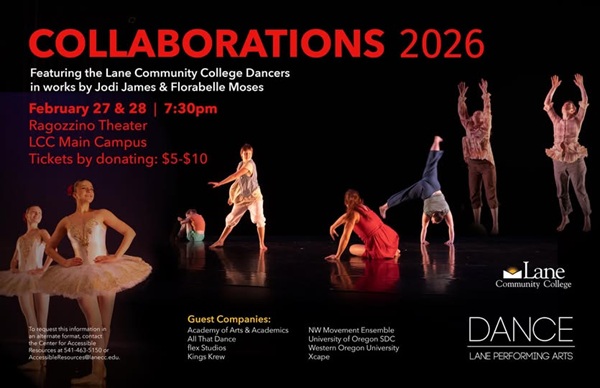
Presenter: Public comments at the Lane Community College Board of Education asked for support for the dance program, saying: ‘The world has never needed dance more.’ On March 4, Elliott Smith:
Eliott Smith: Hi, my name is Elliot Smith. This is my second time returning to the board as a dance student advocating for our dance program.
For many years, LCC has had a world-class dance program. LCC’s dance program greatly enriches the Lane community, training many local teachers and founders of dance academies, which are important to Eugene’s culture and economy.
They hire dance teachers, photographers, rent space, and purchase and renovate buildings. LCCs dance program elevates both the artistic foundations and the economic vibrancy of Lane County. It is worth noting that the arts sector is the third-largest in Oregon, larger than construction and agriculture.
LCC has made dance an achievable field of study for many who have taken a rigorous course of study before transferring to University of Oregon or other four-year dance programs. The world has never needed dance more. In a time of financial strains, social and political challenges, and increasing dehumanization with the rise of tools like AI, dance grounds us in our humanity.
As rates of depression increase, dance has been shown to be an effective intervention, and the LCC dance program is a core element of career development for students.
It teaches the value of showing up on time, teamwork, effective communication, and kindness even under the pressure and expectations of a performance, thus preparing students to enter the workforce, whether their full-time career is in dance or not.
We have watched with concern as the program has been diminished in the recent years. What was a thriving program that fulfilled two years of university dance requirements now offers few classes. In spring 2026, only ballet is being offered.
LCC students and the Lane community deserve a dance program that enriches the human experience on a personal and community level. Lane cannot become merely a vehicle to train students under an extremely narrow definition of career readiness that administrators perceive will benefit businesses.
Dance enriches the human soul and lifts up the community spirit, strengthening Lane County spiritually and economically.
The diminishment of the program and LCCs administration’s conduct in contract negotiations with our professors create concern that LCC leadership is not fully sufficiently focused on the good of the community.
We therefore demand the following concrete actions to restore a thriving dance program and an LCC focused on benefiting the whole community from economic, social, and human lens:
- A full-time dance faculty member to steward a thriving dance program
- Classes that fulfill two-year dance requirements for transfer to four-year colleges and universities
- End to early class cancellations in the dance program and across LCC
- Swift and equitable resolution of contract negotiations with LCC faculty.
Ethan Guillen: Hello. My name’s Ethan Guillen and I’ve been a student here in the music, dance, and theater programs for the last six years. What Elliott just read is a petition that we’ve been circulating in the community and here at school it has over 300 signatures so far: 100 current students and 60 former students.
As we’ve been talking to people about what’s going on here, we were buying posterboard at Hirons and somebody asked what we were doing. They said, ‘We’re making a protest sign.’ And they asked why. And we said, ‘Because Lane has been killing the dance program.’ And they said, ‘I can’t believe that. Can I sign your petition now?’
Because Lane is known for its dance program. And in our recent concert that we had last weekend, we had all of the students from the program who are performing, including folks from Western Oregon and UO, come out in solidarity to talk to the audience about what has been going on.
As I go around school over these years, you know, I see everybody on their phones. I originally went to school at a time when we didn’t have phones. People are attached to their screens.
When I see people come into the dance program at the beginning, often they can’t look you in the eye, but something that dance brings to them is the ability to be seen, the ability to engage with the world.
That’s not what we’re being pushed to, which is to be doing, you know, writing our papers on AI. There’s a constant dehumanization of what is happening in the world currently. And dance is something that actually grounds us and it’s so valuable.
I always look like I’m dressed to go to the gym because I am one of these teachers that we mentioned who trained here and now teach in the community. That’s why I always leave here early, because I go and teach a dance class.
There’s so much value in what the dance program here has done over the years. We’ve had world-class people here—people who are choreographing on Broadway, have been here at Lane working with us and choreographing for us, and that’s just simply not happening anymore.
And the question that keeps coming to mind is who gets to decide that a program is over? When Bonnie Simoa, the former head, was retiring, there was an attempt to get somebody to replace her, but the administration refused. So now it’s reliant on part-time folks who are doing the best they can, but also the administration isn’t allowing there to be enough dance classes.
It was said there’s ballet offered in the spring. Ballet’s wonderful. We’re happy to have it. That’s not a curriculum. Ballet is also not the most accessible dance form, so we’re not asking for crumbs. We don’t want a few classes here and there. We want an actual program that cultivates the sort of artistic and connective tissue of the community that we’re a part of.
Hales Wilson: Hi everyone. My name is Hales Wilson. I’ve been a part-time student at Lane since 2022, and I work full-time directing an outdoor school for many years. The Lane dance program has been an incredible world-class arts program, preparing students for a dance career and continuing at a four-year institution.
This program also supports the mental health of students to engage in embodied and experiential learning, a need that students have more now than ever. You already know that now, more than ever, students are not reading, not completing assignments. Students are not engaged. They’re distracted by technology and the stress and the current sociopolitical climate.
What we need now more than ever is access to embodied arts, experiential learning, community, and high-impact practices that challenge us to be present in our own bodies and in our own learning. The Lane dance program exemplifies this. I can tell you firsthand that these dance classes changed my trajectory as a working professional and as a human.
I not only dance, I not only learned technique that restarted my dance career, I’m now a company member in a dance company, and I facilitate dance classes in the community. These dance classes showed me how disembodied I was and how this was a barrier to being present, regulated, and effective in my day-to-day.
After several terms of consistent dance, most of my recurring symptoms for PTSD were gone, a condition that I thought I would take a lifetime to return to a baseline. I now use what I’ve learned in dance classes to supervise my own staff and to support youth in outdoor science education. By employing tools of regulation, embodiment, and community connection, this has improved their focus, their behavioral concerns, and learning outcomes.
I’m now accepted in the University of Oregon couples and family therapy program to become a therapist that focuses on somatic embodiment and dance therapy. This is all because of my experiences in the dance program.
Currently, basic technique and core classes are not being offered and students cannot complete requirements for graduation. The Lane Community College administration has not replaced the previous full-time faculty since spring of 2023.
The Lane dance program is not only a two-year dance program. It is the only two-year dance program in Oregon, which provides invaluable career and academic support for emerging artists and connects Lane to the larger arts community.
Dance students are filling up courses and they’re asking for more. So why are courses being cut when students want more dance classes?
I ask the board to ensure that LCC administration hire a full-time dance faculty program to steward the program and that students are involved in the hiring process, and that dance classes are offered to match the student demand, and current dance faculty are included in these decisions.
Frankie Hart: Hi, my name is Frankie Hart and I’m talking on behalf of the dance program. I came to the school because I had heard of your teachers here and the experience here. I came to the school because I looked online and I saw what you offered, and I wanted to come and be a part of it.
That is not happening anymore. To see that illusion and come here and have it be shattered is heartbreaking because I get the opportunity to work with excellent teachers. They have changed my view on how I carry myself in nine weeks.
I’m a completely different dancer than who I was 12 years ago. That’s when I started, I started dancing 12 years ago. There’s so much growth that happens in 12 years. There’s so much growth that happens here, in this space, because of your teachers. And to hear that their opportunity to teach people these grounding experiences are being taken away is so sad to hear because I have managed to use techniques from Bonnie to help me with my panic attacks.
I dropped out of school in high school because of my panic attacks, and I went straight into college because I wanted to get better education than what I was receiving before, and I wanted to find a community that I felt safe in. I found that here, and it is being taken away.
I also can’t afford to do dance outside of this program. Since moving here to Eugene (I moved here in October), I have been unable to find a job. But because of your program, I’ve been able to stay dancing and stay grounded and stay secure in who I am because I know I love it.
And to know that I might not have that opportunity anymore to do the thing that I came to do, I feel it puts me at a loss, a total loss, because I love this place and I want to be here next year and I will not be a student here next year without this program.
I also wanted to say that the ballet program is beautiful and I’m so excited to be taking it next term. But it by itself, as others have said, is not curriculum, and it needs to have more.
It needs to have the basics of movement. You need to have the anatomy classes, you need to have the contemporary. That is a real curriculum. That is what students want and are asking for.
Madeleine Sisson: My name is Madeleine Sisson and I’m a former student at Lane Community College, as well as the director of marketing for Blue Lotus Chai.
The LCC dance program has not only shaped my personal life, but also my professional career at an executive level. Maintaining a strong organized leadership structure for this program is critical for our community.
During my time at Lane, I have taken several dance theory courses, including contemporary choreography and anatomy of the moving body. These classes have had a direct and profound impact on my work as a professional in the business development and marketing industry.
The skills cultivated in dance, creative problem solving, physical and mental discipline, embodied leadership, teamwork, adaptability, and the ability to communicate ideas with clarity and intention are the same skills I rely on in my everyday high-stakes professional environment.
Choreography taught me how to structure complex projects and project management skills. Contemporary technique gave me the ability to be an embodied, thoughtful team member. Anatomy and the anatomy of the moving body grounded me in mindful awareness, which directly strengthens my ability to be a leader in the workplace.
Dance is not simply an art form. It is an education in resilience, collaboration, design and innovation—all essential skills for the modern workplace.
Beyond my own experience, dance is an integral part of Eugene’s cultural ecosystem. Our city is home to a vibrant performing arts community, and LCC has long served as a foundational training space for dancers, choreographers, and arts educators who go on to contribute meaningfully to local organizations, schools, and local government.
Without structured leadership in the dance program, we lose not only classes, we lose one of the rare community anchors that supports both artistic expression and professional development. Canceling classes has a profound ripple effect. Students lose access to the physical, emotional, and artistic support that dance uniquely provides.
Working adults like myself who rely on LCC’s flexible program to continue our education lose access to movement-based learning that helps sustain our mental health, creativity, and work-life balance.
I urge the board to recognize the benefits of this program and to restore organized direction and add stable class offerings that provide the two-year transfer degree to other universities.
Thank you for your time and for your commitment to supporting the students of LCC.
Jodi James: My name is Jodi James and I teach in the dance program at Lane Community College.
I have read the description of the new culture and belonging faculty fellowship program. It speaks of cultivating a respectful, inclusive, and accessible learning environment. It prioritizes historically marginalized populations, first-generation students, socioeconomic diversity, and the capacity to understand difference, power and privilege.
It seeks to recruit and retain faculty who can work effectively across cultural contexts. I support those goals, but I need to say something difficult. The dance program is already doing this work.
Just this past weekend, the dance program hosted its annual ‘Collaborations’ dance concert. This concert is a celebration of community, LCC dancers performing faculty choreography, and dance studios and companies in the Eugene-Springfield area offer brilliant and diverse works of art to the program.
In working with LCC dancers, I witnessed firsthand students from across Oregon rural and urban communities moving together on one stage: students of different racial and ethnic identities, different gender identities, different socioeconomic backgrounds, first generation college students, students of all ages and abilities; students navigating invisible adversities, beginners and advanced performers.
They did not perform as separate entities. They performed as an integrated whole. They trusted one another and found mutual understanding. They lifted each other up and supported each other.
They negotiated difference through rehearsal. Through the art of dance, strong connections and friendships were formed. They learned to collaborate across skill levels and lived experiences.
They created a cohesive work of art that could not exist without every voice and everybody present. This is not theoretical culture and belonging. This is embodied culture and belonging.
In our studios, students practice equity in real time. Advanced dancers mentor beginners. Students notice when someone is missing and reach out. They build leadership. They build empathy. They build resilience. They learn how to function across difference, not in a discussion board, but through shared risk and shared creation.
If the college is investing in an associate vice president and two faculty positions under the banner of culture and belonging, while simultaneously dissolving a program that has long cultivated exactly that, then we must ask: What do we actually value? Is culture and belonging something we describe or something we protect?
Eliminating the dance program—while expanding administrative and designated faculty lines under the same banner—sends a message, whether intended or not, that lived community is expendable while structural language is prioritized.
If we are serious about increasing access, supporting historically marginalized students, and cultivating environments where difference is understood and honored, the dance program should not be disappearing. It should be recognized as a model. Protect the dance program.
Presenter: Public comments March 4 advocate for the dance program at Lane Community College.