Max Wilbert: We must rebuild the forest defense movement
17 min read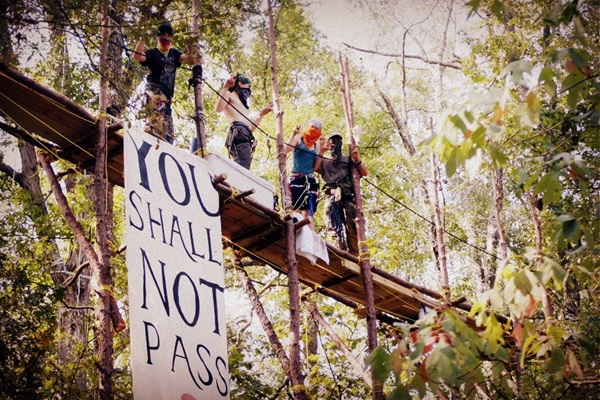
Presenter: KEPW News visits with Max Wilbert, author of the newsletter Biocentric, at maxwilbert.substack.com.
Max Wilbert: Thanks for having me, you know, there’s a lot of different issues to discuss. Obviously the war on Iran is in this sort of tenuous pause. The climate crisis is accelerating, faster than ever.
And here where we live in Lane County, there’s this initiative to protect the watershed to protect water throughout the county that is already facing some big attacks from logging interests, from corporate and business interests of all sorts, and even from sort of mainstream-aligned ‘environmental groups,’ which are critical of this Rights of Nature approach.
But, you know, a big concern for me at the moment is this Bureau of Land Management (BLM) plan to quadruple logging on BLM lands in Western Oregon, which would involve clear-cutting a ton of old-growth forests, some of our most treasured places in this region.
You know, we’re talking about Marys Peak and Alsea Falls and Crabtree Valley and Valley of the Giants and Hardesty Mountain and these beloved areas that really represent not just the quality of life in this area, but they’re sequestering carbon, they’re stabilizing the climate, they’re filtering water. They’re providing habitat for all the different creatures who still live here around us. And that’s all under threat in coming months and years. So there’s a lot of issues.
Presenter: How can people oppose the BLM logging old growth? Max Wilbert:
Max Wilbert: Well, there was a public comment period that just ended, a lot of people submitted public comments on this. I’m very skeptical of public commenting as a general practice.
There is a great activist named Jane Anne Morris, who passed away a while back. But she talked about public commenting as mostly being like a black box. You know: You take your comments, you put them in the black box, and then they disappear and for the most part, nobody reads them and they don’t result in anything.
In my view, public commenting is a sort of really brilliant way to make people feel as though they can be involved in the process of decision-making in situations like this, while actually reserving the power to make decisions for the agencies.
And you know, obviously these agencies are a political battleground. They’re not static, they’re not always the same. They’re sometimes under certain political leaders and appointees and staff where they might listen to comments, they might make more pro-environmental decisions, they might protect places.
And that’s great when it happens, but obviously that’s not the situation now under the current regime or emperor, as I’ve taken to calling the president of the United States empire: Emperor Trump, you know, just like Emperor Biden and Emperor Obama and Emperor Bush before.
He’s trying to maximize economic growth and so all the decisions that are being made within these agencies are about that right now. We’re seeing that across the board with mining projects being approved very quickly, environmental reviews being truncated or skipped entirely, with the undermining of Endangered Species Act and other laws that supposedly exist to protect the environment. They were never very strong in the first place, but they were something, and those are being completely dismantled.
Most recently the so-called ‘God Squad’ met under Trump’s orders and basically exempted oil and gas drilling offshore in the Gulf of Mexico from Endangered Species Act protections.
So, quite a number of species which are endangered and live in the Gulf, they’re just ignoring the Endangered Species Act completely. And this is a legal process. This is written into the law as it is. So it’s not actually illegal to do that. It’s just, this is how power works.
So this is the type of thing that we’re going to be facing when it comes to the BLM, which is why I think we need to go far, far beyond public commenting. Some people are putting pressure on politicians, legislators, at the local level and the state level and the federal level. And I think that’s certainly worthwhile. It’s better than sitting back and doing nothing.
But I really think that it’s going to come down to direct action. I think a lot of our movements really need to rebuild a sense of our own power, our own ability to influence the world, direct democracy and sort of the clearest, most straightforward sense of we don’t like something happening and we’re going to stop it because the reality is the vast majority of people in the area are opposed to this BLM logging plan.
So we’re talking about an incredibly unpopular policy being pushed on us from above, from outside. And either we rebel to stop that or we just accept it.
And that’s really what happened in the ‘80s, ‘90s, early 2000s, when there was a super robust forest defense movement throughout Eugene, Lane County and the whole Pacific Northwest.
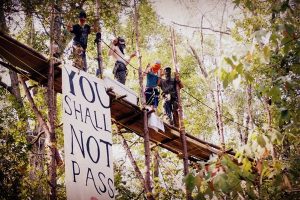
You know, you have thousands of people going out into the forest and blocking forest roads and setting up tree sits and protesting and rallying and building political pressure and at one time there were, I believe, five tree sits taking place in Lane County alone. Five simultaneous tree sits, aka, you know, blockades of logging projects, taking place in Lane County alone.
That’s what we need to be building towards if we want to actually stop these projects, that’s what’s going to create the political pressure that forces congressional representatives and other politicians to take meaningful action on these issues. It’s not just going to be, ‘We sent a bunch of nice letters,’ although, like I said, I think that’s better than doing nothing.
But I think we actually need to exert ourselves in the world and take that type of direct action. So I think that’s coming. I’ve been having conversations with folks about it. But we’re starting from a difficult place. The forest defense movement really kind of faded over the last 15-20 years in our area. It kind of fell apart.
There’s a lot of experience out there. A lot of the folks who were part of those tree sit movements and forest defense movement in the ‘90s, they still live here and they’re still around. They’re just older now. A lot of them have families and responsibilities.
So we really need those folks who have the experience to get together with the young people who have the energy and the time and the ability to get up in a tree and spend a month or two months, or six months or a year living up there, and make this happen.
So that’s my call, if folks want to be part of that, find me, Max Wilbert, you can find me online and reach out. But, you know, we need to make this happen. It’s (I think) the only way that we’re going to actually protect these forests in a serious way.
There are a lot of people I think are thinking in the same direction and you know, I have my own limitations on what I can and can’t do at any given time, but I’m going to try and help as best I can to facilitate that, moving forward to facilitate that movement growing and expanding.
And, you know, I might be up in a tree myself at some point. I have a climbing background. But you know, I have a young kid at home too, so I have to make my decisions based on that.
But, you know, I’m ready. If I can get support to try and get up in some trees, I’m ready. I know a lot of other people are wanting to support this. We need to take that feeling and make it into action.
We’re also used to, in this modern time that we live in, writing things on the internet and writing comment letters. And doing all these things, again, it’s better than nothing, but we really need to translate that into real-world action. So that’s the type of, little bit of behind the scenes organizing and facilitating that. I’m just trying to help with this BLM Forest Defense effort.
I’m just a guy who’s concerned about this and wants to help make it happen. You know, we all need to take responsibility. For this as well, we, we all need to sort of put our stake in the ground and say no more. You know, you’re not going any further. And I am going to stand in the way.
So I don’t want to give people the impression that like, I’ve got it all figured out. I’ve got the strategy, I’ve got the plan, I’ve got the people, I’ve got the resources. I don’t, you know. Maybe you do have a piece of that puzzle and maybe we can get together and help build, you know, the whole picture, because if it’s just a small number of us, we’re not going to get anywhere. We really need , to do this together.
So, again, if you’re listening to this, if you’re in the area or if you know the people who, who are ready to get in the trees or support this in one way or another, reach out to me and let’s get connected.
Presenter: So, if the Rights of Nature provision were in place, would BLM be allowed to clearcut old growth? Max Wilbert:
Max Wilbert: Well, it, it really depends. So let’s look at the current initiative process that’s going to be on the ballot in May in Lane County, which is the Lane County Watershed Bill of Rights.
And, you know, I’m not a lawyer, so I’m speaking on this not as an expert and I’m not part of the local group that’s organizing for this initiative.
But I work for an organization called CELDF, Community Environmental Legal Defense Fund, you know, great group. They’re supporting me to fight these forest issues, to support all kinds of campaigns across the country and do some work for CELDF the organization as well.
But CELDF has really been a pioneer in this Rights of Nature movement and helped organize the first Rights of Nature law that passed in the United States in 2007. That was one of the first in the world, at least in sort of a western legal construct.
Obviously the whole sort of concept of respecting nature and having a system of rights or responsibilities towards the natural world, I mean, that’s an ancient thing. You know, we can’t claim any credit for that. It’s an ancient idea that many cultures have had in order to live sustainably.
But in terms of taking that ancient responsibility and translating it into a modern law, we were really one of the groups that started that whole process and the first in the U.S.
And so, when I look at this initiative in Lane County to protect our watersheds here, it’s a pretty broad open-ended initiative. If you read the text of it, what it actually just says is it puts a mechanism in place whereby it becomes illegal for entities and individuals to harm the watershed.
And it puts some mechanism to redress that in place where there would be fines where then the money would go directly towards restoration of the harm that was done and it leaves it open-ended beyond that.
And the reason for this, the reason why it’s not super specific, why it’s not sort of a regulatory approach—where we would say, ‘If you do X, Y, Z harm to the ecosystem, here’s what has to happen, and if you do A, B, C harm, this is what happens’—we’re avoiding that approach entirely because we think that a broad approach is better when it comes to fundamental issues like this, like the destruction of the planet.
You know, it’s similar to free speech. The First Amendment doesn’t say, you know, here’s what you can say, here’s how you can say it. Here’s what you can’t say. Here’s all the details.
It’s very simple. It’s a very brief thing. It says, you know, Congress shall make no law abridging the right to freedom of speech and so on. So. It’s very simple and courts have had to interpret what that means in different cases, and we’re taking the same approach towards this Rights of Nature watersheds thing.
It’s a broad approach. It’s meant to be something that will have to be figured out over time. What does enforcement look like? How do we change our culture and the way we actually do things? How’s this interpreted in the community? Because that’s how change actually happens. That’s how sort of a principle becomes actualized in society.
So this is what people are going to get to vote on, in May, is this Lane County Watershed Bill of Rights, and I want to be clear to people who are listening, this type of law is actually illegal. It’s not legal in the United States for a local community to pass a law that says you can’t pollute the water.
It’s not legal to do that. And what that means essentially is that we don’t have a functioning democracy in this country. The reason it’s not legal, there are many reasons, but one of them is that, this is considered an infringement of corporate rights, right? Corporations are considered persons under the U.S. legal system.
And so if we pass a law that says corporations can’t pollute water, corporations can’t build bottled water plants, corporations can’t build data centers, something along those lines, those corporations can sue. And they can say, ‘This is unequal treatment. This is a violation of the 14th Amendment. This is a violation of case law.’
And usually they’re going to win those lawsuits because corporations just simply have more rights and more power under our legal system than we do as individuals and even as communities.
So, this really is what the whole Rights of Nature movement in this country is grappling with, is this fundamental battle between corporate power and communities and environmental protection.
We’ve seen this battle play out over and over again. One of the biggest recent examples was in Toledo, Ohio, where they get their drinking water. We get ours from the McKenzie, they get theirs from Lake Erie.
And back in 2014, Lake Erie got so hot, there was a big heat wave. Lake Erie got so hot and there was so much fertilizer and pollution from factory farms flowing into Lake Erie, there were massive algae blooms and the algae blooms created toxins, and those toxins made the water undrinkable. You weren’t even supposed to use the water for taking a shower.
So Toledo, which is a big—it’s a sizable city, it’s the size of Eugene, if not bigger—all of a sudden had no drinking water, had no ability to take a shower, everyone’s relying on bottled water.
And so people start to organize and they ended up passing the Lake Erie Bill of Rights, which you know, similar to the watershed initiative here. It created a mechanism that said that Lake Erie has inherent rights to exist and flourish, and naturally evolve and be free from pollution.
And, it was a recognition that the community is completely dependent upon this natural ecosystem, this natural community. That people want it to largely be protected from these industrial sources of pollution, these big corporations. So that law passed, people voted for overwhelmingly over 60% of the population, voted in favor of the Lake Erie Bill of Rights.
And within hours of that law being enacted on the books, a group of corporations sued to overturn it. And they actually won that lawsuit. The corporations won, the people lost. And so that law got overturned. And the reason for that, again, is that corporations have more rights under this system than we do, than communities do.
Local democracy really doesn’t exist when it comes to our ability to actually stop these harms. There’s a lot of different reasons for this, beyond what I’ve discussed already. One is supremacy, which is the whole idea that a local community can’t make laws that are more restrictive than the state.
We can’t preempt the state power, and that includes federal power. And, you know, there are some good reasons for this, right? Like, if you think about after the slaves were freed, you have the emergence of Jim Crow and you have, the southern states really, enshrining racism at the state level with these various, state level initiatives.
And so the federal government started to establish, with the Civil Rights Movement, started to establish the Voting Rights Act and these different bills to protect the ability of descendants of freed slaves to participate in civic life and to vote and to access the education system and so on.
But this is something different. This is basically the state and the federal government saying: We already have environmental protection standards. You can’t go beyond those. You can’t create more protections for the environment in your area, either. You basically, you have to stick with our rules. You can’t establish your own.
And this is, again, about corporate power. It’s about this idea that for communities to make these laws that restrict corporate rights, that that’s an infringement on those corporations’ right to exist, to do business, to make a profit, to do the things that they want to do, like fracking, like clear-cut logging and so on.
So I want to be really clear about this, right? I told the story of the Lake Erie Bill of Rights and how it was overturned in the courts because I want people to understand that this initiative is an attempt to rebel against this reality. It’s an attempt to revolt against this system that we live in, which is destroying the planet.
Supposedly we have environmental regulations at the federal level, at the state level. We all know that those have been inadequate because we have endangered species declining. We have a climate catastrophe that’s getting worse and worse. We have all these different ecological issues, plastic pollution, PFAS and all sorts of different chemicals.
We have proliferating data centers and their water use and the pollution issues those are causing in places like Umatilla County, we have more and more urban sprawl, have all these different issues. So it’s obvious that our environmental ‘protections’ aren’t working at the state and federal levels.
These regulations are really just facilitating, they’re sort of smoothing the path for corporations to do their work, to continue to move forward with their projects. So these Rights of Nature initiatives, they’re an attempt to revolt against that. They’re an attempt for a community to stand up and say, ‘No, we assert our right to local democracy. We assert our right to local decision making. We want to protect our water.’
Lane County is the perfect place for that. We’re an environmentally-conscious community. We’re in general people who spend a lot of time compared to other communities recreating out in the beautiful lands that we have around here; on the rivers and in the mountains, and going to these lakes and spending time in these beautiful places.
You know, a lot of people live here because of the nature that we have and we want to protect it. We want to see it flourish and thrive for future generations.
I say this because one of the common critiques that is leveled against this initiative and more broadly against Rights of Nature is: It’s not realistic, right? It is illegal. It’s violating the constitutional rights of corporations. It’ll lead to lawsuits against the city.
And those people are absolutely right. They’re absolutely right. And my question more broadly for those people is: What’s your plan for changing this situation, then?
What’s your bold, transformative plan to address the crisis that we’re facing, the ecological crisis, where Lane County is probably going to have about half as much water as we have now within the next, you know, by mid-century, within the next 20 years or so, 25 years, half as much water.
Half our water will be gone. Half our water will be gone—half as much in the Willamette, the McKenzie, all these little streams and rivers and lakes throughout the county, the wetlands drying up.
That’s the crisis that we’re facing. Business as usual is not working. So, really, these Rights of Nature initiatives, they are a form of civil disobedience. They are a form of community civil disobedience, the community as a whole standing up and saying: ‘These are our values. This is what we believe in. This is the change that we want to see, and we are going to pass laws, to attempt to make that.’
So now, does that create challenges in terms of legally defending these rights? Absolutely. But that’s actually the point. The point is to create a confrontation. The point is to create a conflict. The point is to bring the issues to public consciousness to make it clear that we don’t live in a functioning democracy in this way.
Because really, you know, the initiative process and whatever results from it, whatever the outcome is in terms of lawsuits, in terms of any court rulings, you know, even whether it passes or not, that’s really just the beginning. That’s really just the beginning of the process.
Because the bottom line is we need to protect our water. We need to protect our rivers, our lakes, our watersheds, and the whole water cycle that supports them— where we have rain coming in off the Pacific and we have these forests and these deep soils which capture that rain and hold it and allow it to infiltrate into the groundwater.
And we have, at least in certain areas, we still have, the beavers and the beaver ponds and these wetlands that help store that water through the dry season and keep the water cycle intact. You know, that’s what this really is about: Will these be protected or not?
And so I really see this initiative process as one skirmish in a much broader battle to try to protect the land and the water. And what will come of it, I don’t know. But I would really encourage people to vote in favor of it in May, and see what comes and understand that just because a law passes does not mean that law will be enforced. It doesn’t mean that law will not be challenged.
Voting really, in my view, should be sort of the least form of civic engagement that we’re taking part in as communities. It’s easy. It only takes a few minutes and, you know, we only do it, once or twice a year. So we need to be doing far more on these issues.
And I think this initiative process is really just one part of a much larger social change process. It’s a way for us to plant our flag and say, ‘Not here. Not this water, not these forests—we’re going to stand up for them.’
Presenter: KEPW visits with Max Wilbert, author of the newsletter Biocentric, at maxwilbert.substack.com.
Tree sit image courtesy Wikimedia Commons, shared by Laura Borealis under the Creative Commons 2.0 Attribution 2.0 Generic license.