Public comments ask city to block Federal Building fence
18 min read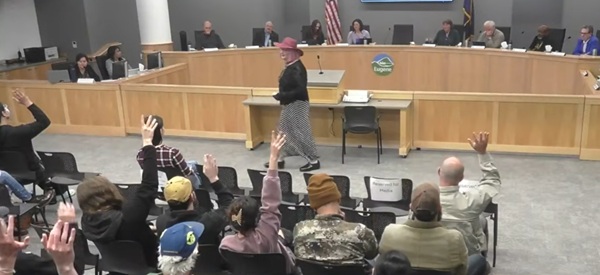
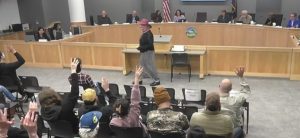
Presenter: Public comments at the City Council Monday night addressed the proposed fence around the Federal Building. April 13, Emma Serena Lavin:
Emma Serena Lavin: Hi everybody. I’m going to start with a couple questions for our audience. How many people in this audience believe that if they were able to and no one stopped them, this administration, this federal administration, would build actual death camps?
And how many people in this audience believe that they themselves would be likely to end up in one of those death camps?
So my question for you is: Is that something that you want to be associated with in any way, shape, or form?
The next question I have too is, well, they seem to care nothing—as a matter of fact, not seem, we know at this point that they care nothing for political procedure. So why do we pretend that they do?
Does it give us the advantage to pretend that they do or does it give them the advantage? Walls are actually not symbols of strength, but of weakness. And how many people think that what would happen behind ICE’s big, beautiful wall would actually be random acts of kindness?
So tell ICE to go take its wall and shove it where the sun doesn’t shine.
Presenter: Shasha Brisby:
Shasha Brisby: The proposed fence around the Federal Building will endanger immigrants, protesters and uninvolved members of the public. This danger makes it imperative for the city to decry its construction through denial of permits, public denunciation, and any other avenues available to it.
For dozens of our community members, the Federal Building has been the last thing they’ve seen of our beautiful city before being dragged away by ICE agents. The threshold of that building is often our last chance of getting legal aid to our neighbors, our last chance to alert their family and friends, and our last chance to raise the alarm when our friends are violently ripped away from us.
The proposed defense would kneecap these efforts, preventing documentation by legal observers, blocking attempts to render aid to victims, and slowing the community’s response to ICE violence. This fence will embolden and enable ICE, giving them a wall to hide behind as they brutalize our neighbors. The proposed fence will also endanger nonviolent protesters.
Allowing violent federal agents to dictate when and where the public is allowed to voice their discontent is a recipe for escalatory crackdowns on free expression.
The plaza that the GSA are touting as a zone for First Amendment rights is the exact same plaza where three months ago, a dozen agents in riot gear and two snipers were deployed in broad daylight to suppress and brutalize a lone trans woman who’s been protesting there since July.
It is the same plaza where agents stirred a brush fire, and used chemical munitions to disperse a nonviolent protest later that week. The federal government thinks safety is when they can control and suppress dissent, and this fence is the latest attempt to do so when weapons are deployed.
Now, protesters can expand into the plaza and along the sidewalks, flowing around the building and away from the danger. If instead, protesters are forced to pack into just the plaza—with sidewalks potentially obstructed—use of violence will force protesters to flee into oncoming traffic, endangering motorists and bystanders.
Given the clear danger the proposed fence represents, it’s vital the city do everything in its power to prevent its construction. If a right-of-way permit is filed for, it must be denied not, because of who the applicant is, but because issuing it would directly endanger your constituents, enabling ICE to escalate the humanitarian crisis you yourselves declared.
If a right of way permit isn’t filed for, and the GSA builds on to city property (likely as they’ve repeatedly shown an ignorance of property lines), they must be fought. Regardless, your public condemnation of the proposed fence would demonstrate your continued dedication to protecting the immigrants under your care.
Jackson Smith: Hello, my name is Jackson Smith. I’m a student at the University of Oregon, and I have attended a number of peaceful protests at the Eugene Federal Building in the past few months, and eventually I have found myself at the Jan. 28 Federal Building protest.
I was among the protesters who were tear-gassed at the peaceful assembly at the building, culminating in my need for medical assistance.
The proposal for a fence, denying protesters their rights of the plaza, misunderstands the cause behind the escalation of events.
At the Federal Building, it was DHS that first charged protesters around 1 p.m. on the 28th of January. It was DHS that sent out a second sort and brutally captured a peaceful protestor. It was DHS that threw a flash-bang and began tear-gassing—beg my pardon, and began unleashing chemical weapons against us.
A fence that prohibits protesters forgets that all levels of escalation are on the behalf of rogue government agents. I urge this council not to protect these agents, and I urge this council to protect this community and deny any permits to build fences at the Federal Building. Thank you.
Ty Warren: Hi, I’m Ty Warren. I want to talk about the Federal Building, the proposed fence. You’re probably going to hear from a few people this evening about that and talking about the problems that the fence will bring up, which is access, sidewalk access, potentially there’s disabled access.
It will also limit the ability of legal observers to watch the activity in the building. It limits the ability of protesters to watch what’s happening in the building and who’s leaving and who’s being kidnapped because our neighbors are being kidnapped out of that building. As someone said earlier, the Federal Building is often the last thing some people in our community see.
The only people that that fence will protect is ICE and DHS. And if you as a council have decided that immigration enforcement is a humanitarian crisis, then you need to be very vocal about your standing against it, right? So it’s not a matter of simply not issuing permits.
That’s not what I’m looking for. I need you to be vocal about standing against this, right? It needs to be an attitude. It needs to be a way of presenting yourself to this community.
It’s about not complying in advance, right? If you ever wondered (and I know that we ask ourselves this question a lot), but if you ever wondered what would happen when a fascist government is taking over what you would be doing, you’re doing it right now.
So think about that and just don’t issue permits on city property for this, but also be very vocal and against this and condemn the fence entirely.
Anna Lardner: My name is Anna. My pronouns are she/her, and I’m an organizer with Trans Alliance of Lane County. You’re going to hear from a lot of people today about the reasons why you should not be colluding with the feds to build this fence, but lost in this is the toll of the fence. Lost in this is the toll of the detention system, of the kidnapping system of the border system.
We all know the names Alex Pretti and Renée Good, but we don’t know the names of the dozens of Black and brown people who have died in this last year. I’m going to name now 17 of those names—the 16 that we know of that have died in detention, as well as one who died shortly after release, because that is why you need to deny anything associated with this fence and why, when you look back on this time, you can ask yourself: What did I do to protect these people?
Geraldo Lunas Campos. Luis Gustavo Nunez Caceres. Luis Beltran Yanez-Cruz. Parady La. Heber Sanchaz Dominguez. Victor Manuel Diaz. Lorth Sim. Jairo Garcia-Hernandez. Nurul Amin Shah Alam. Alberto Gutierrez-Reyes. Emmanuel Clifford Damas. Pejman Karshenas Najafabadi. Mohammad Nazeer Paktiawal. Royer Perez Jimenez. José Guadalupe Ramos-Solano. Nebane Abienwi. Alejandro Cabrera Clemente.
I understand that some of you may have opinions about the protesters in Eugene. You may have disagreements about tactics. You may have disagreements about things that happened, and I invite you to come and talk to protesters about that. Don’t deny the fence permits for them.
Deny the fence permits for these 17 people and all the other people who are dying in ICE facilities due to deliberate medical neglect.
Presenter: Jan:
Jan: On Feb. 9, Eugene City Council declared a humanitarian crisis due to federal immigration actions. The resolution reads: ‘The City Council affirms its commitment to human rights, due process, family unity, and human dignity, and condemns actions that result in detention or deportation without meaningful access to legal protections.’
Mayor Knudson also signed a letter from Gov. Kotek with 30 other Oregon city mayors addressed to then DHS Secretary Kristi Noem and Tom Homan. The letter demanded an immediate halt to federal immigration enforcement. After hearing those statements, you would think that the city of Eugene would want nothing to do with the process of constructing a fence around the Federal Building.
Because a fence in this context will make it more difficult for community members to be safe during ICE office check-ins. Harder for legal observers to document ICE kidnappings and easier for ICE to hide the fact that they’re kidnapping our neighbors at all. Instead, the city has been exchanging emails with the feds starting Feb. 19, discussing construction of the fence just 10 days after it declared a humanitarian crisis.
EPD Chief Skinner confirmed that his department will be part of the fencing process in some capacity, and that the city of Eugene is helping to facilitate the operation by shutting down streets and handling any necessary permits.
Some have said, well, the federal government can do whatever it wants with federal property, it doesn’t need permission from the city. I’d argue if the city truly cares about its immigrant constituents, it would at the very least publicly condemn this move by the feds and dig in its heels to slow the process.
Others have said that blocking the streets and providing permits is what the city would do for any property owner. But I’d argue that if a regular business tried to construct a fence like this in such a public space, the city wouldn’t give them special treatment and backdoor channels for communicating with city officials. They would have to do the runaround of dealing with permits, regulations, city codes.
But because it’s the federal government, the city wants to keep things convenient and comfortable for themselves, even if it means more of their constituents are kidnapped.
We are living under a fascist regime where masked men are kidnapping Eugenians in broad daylight off our streets, and from their regular check-in appointments, this being one of the reasons why humanitarian crisis was declared by this council.
Despite this, the city has decided to work behind closed doors following no public process for the sake of transparency, and even EPD slapped on an $11,000 fee on a records request of the project, essentially acting as a blockade to any transparency.
Naphtali Renshaw: My name is Naphtali Renshaw. I’m a local pastor, nonprofit director. I’m on the leadership teams of a number of local organizations and nonprofits.
I was tear-gassed in January and I have been on site for five and a half hours after DHS tackled a 15-year-old and drug them into the Federal Building. I want to speak to my friends here.
Dear friends, I know why you are here. You are here because you believe that public leaders should be held accountable for the promises we make to our citizens. You believe that sanctuary is more than a string of empty words, rather it is a sacred commitment to not concede or collaborate or collude with those who prey upon our neighbors.
You are here because our neighbors are counting on us to act as though we meant our promise, because you recognize that violence is a thread that weaves itself around the world. Philly and Palestine, Tacoma and Iran, and it starts here with what we allow here in our neighborhoods, in our communities.
We don’t concede or collaborate with masked men who prey upon our neighbors. We don’t build walls.
I’ve heard it said that we cannot deny permits based on who asked for them. Yet Multnomah County recently amended their sanctuary law to prohibit ICE access to all county property. I strongly encourage the city of Eugene to pursue similar action and courageously, vocally and actionably condemn ICE’s presence and predatory behavior and violence in our community.
Paraphrase the theologian Dietrich Bonhoeffer: We must do more than bandage wounds. We must drive spokes into the wheels of injustice.
Debbie Williamson: My name is Debbie Williamson. I am here today as a private citizen to oppose any city support of the fence at the old Federal Building. That is the building ICE operates from.
If you’re not aware, we are now at the point of history where as children we asked ourselves ‘Why didn’t people do anything?’ as we read ‘The Diary of Anne Frank’ or read Elie Wiesel’s ‘Night.’ And although it may feel futile, we can do things and we can use our voices and we can speak out against the brutal attacks that DHS, BORTAC, and ICE are making against our citizens.
A fence is going to make it harder for our immigrant neighbors to be safe. A fence will make it harder for legal observers to document kidnappings. If you do not believe that people are being kidnapped, please come hang out with me at the old Federal Building and we can witness it together. A fence will end the legacy of free speech that has existed at the building since construction.
You will say we have no control over the fence because it is federal property, but we do have control over what we do as citizens of Eugene. We can deny permits. We can provide the documents from EPD to the CLDC. We can do our part to protect our neighbors from kidnapping and we can use our voices to protest the fence and oppose the violent actions of the people that are employed there.
Justin Burns: Hi, I am Justin Burns. Everybody’s pretty much stated most of the facts of why you guys should not collude DHS and build a fence. People at the ICE facility documenting ICE kidnappings and ICE ongoings has helped stop and prevent a lot of kidnappings.
Putting a fence up is going to help DHS. Like, a year ago, I started protesting and you’ve seen me here several times. Before that I hadn’t protested before. Why? Because I saw that our leaders, and I’m talking about mostly the federal government, I saw our leaders failing us. I know that there’s not that many heroes that are being shined, you know, so I told myself that I need to try to be the hero that I want to see in the world. It’s not easy. It’s something that I wish I could try harder at. But you guys are our leaders as far as the city goes. I would love to see you guys stand, make a stand against ICE, against building a fence.
Right now is the time to stand up, in the wake of a possible war in Iran—well, there is a war in Iran. He’s blocking—Trump’s blocking the Strait (of Hormuz), it’s just insane. So, I mean, basically, do you guys want to be looked at in history and be seen to be on the same side as DHS and Trump?
Those are awful people and I hope you guys wouldn’t taint yourselves and be on their side. Please stand up, make a statement, stop helping with the fence. Do what’s right.
Shane Novak: My name is Shane Novak and I’m a student at the University of Oregon. I’m here tonight to protest the plan to build a fence around the Eugene Federal Building.
So I’m going to start off with what you’ve done so far to protect this community from ICE operations.
On Jan. 17, Mayor Knudson issued a statement condemning ICE actions nationwide, stating that they are violating rights and using reckless and escalation-oriented actions toward communities nationwide, and later signed onto a letter demanding an end to ICE’s operations within the state.
So I’m seeing a lot of words and no actions there.
On Feb. 9, the City Council declared a humanitarian crisis due to the ongoing federal immigration actions. A step in the right direction through offering direct assistance to immigrant community, through multilingual web resources, but not nearly enough.
Through all of this, the fence project has proceeded without any kind of public notice or vote by this council.
The Eugene Police Department is blocking transparency by quoting an exorbitant $11,476 fee for public records request on this fence. And the proposed fence is planning to block the pedestrian right of way along 7th Avenue.
This proposed fence is in direct opposition to both the declared humanitarian crisis and all the statements issued by our mayor, by protecting federal immigration officers from legal observers and community backlash, and making it much easier for federal agents to use violent tactics and chemical munitions against protesters with a literal wall between them and this community.
By building a fence around the Federal Building, you are not only eliminating the ability for this community to protest and fight back against this administration’s unspeakable acts of terrorism against our immigrant community, but you are also building a fortress for ICE to operate out of right in downtown.
This community has proven to everyone, including the president of the United States, that we will not back down to infringements on our civil rights and liberties. If you approve this fence, I guarantee you this community will respond, and so far we’ve seen that this community is willing to do a lot to keep their neighbors safe.
Presenter: Pete Goldlust:
Pete Goldlust: As a member of the city of Eugene’s Public Art Committee, I am deeply appreciative of a city initiative like the ‘Across the Bridge’ monument, recognizing historic wrongs done to people of color in Eugene in the past. By telling these stories publicly and giving them durable form, we hope to inform ourselves and our children about the dangers of committing such racist stupidities and cruelties in the future.
We create these monuments because it’s important to remember our past failures and because we hope to hold ourselves to a higher standard and to do better here and now and in the future. So it’s deeply disappointing that at the very same time as we prepare a public acknowledgement of past racist wrongs, the city is now considering granting a permit to DHS to build an additional barrier on city property, providing added cover for the illegal and deeply racist activities against our community.
The city is fully within its ability to deny any new barrier on city property that would prevent constitutional protected protest and obstruct legal observers from monitoring ICE’s activities. The city’s failure to stand firmly against the racist injustices happening here and now under your watch would be a shameful hypocrisy.
Also, Mayor, Council, City Manager, follow-up question: What exactly do you think all those protesters will do when the city allows ICE to cut off public access around the Federal Building?
Surely you must realize that by allowing such a permit, the city would be declaring an unmistakable invitation to shift protest activities toward any ICE collaborators in our own city government.
Surely you must understand that the City Hall would be a much more comfortable location to protest at. There’s shade, there’s seating, there’s parking, there’s bike access. If elected officials want to be confronted every day of the week by the rage of the protesters who are now focused on the fed building, accepting a fence on city property would be a perfect way to do that.
If our incoming city manager is planning to allow her office’s passive support of ICE to establish City Hall as a focus of local protest even before she arrives for her first day of work, that would be a hell of a first decision to make. Good luck.
Janet Wright: My name is Janet Wright and I want to commend the city council and the mayor for making statements and declarations about the practices of ICE and DHS.
But I believe that the time to do more is now. It is very important to protect the First Amendment rights of people in Springfield and Eugene to come to the Federal Building to protest what is happening by DHS and ICE.
I’ve been there numerous times. It’s already kind of scary that you’ve got the traffic on 7th Avenue going by very quickly and a fence is going to restrict where people can stand and protest and exercise their First Amendment rights.
I urge you to do all that you can to prevent this fence from happening, because I don’t think it’s really going to cause them to be any more safe, and it’s definitely going to be risky for those who need to be there to exercise their First Amendment rights.
And as you’ve heard this evening, legal observers are there to watch the activity going in and out of the Federal Building, the deportations, the detentions, and that is very important that we be able to watch what they’re doing—not to let them hide behind a fence that we can’t monitor their activity.
So please consider keeping the ability for people to protest peacefully there in front of the Federal Building and refuse to allow this fence to go forward.
Glenn O.: My name is Glenn and I am here to talk about the fence that’s going to be put up around the Federal Building.
Before I start about the fence, I’d like to mention that we have been at that building since July, June of last year and continue to go there even after Jan. 30. And the absurdity of putting a fence around that building while also declaring a humanitarian crisis is baffling to me. I can’t help but think about all of the egregious things that we’ve seen happen at that building.
And the fact that the only two days that had any actual violence to it was not caused by us, it was caused by the federal government who reacted very poorly to us not liking the execution of people in the city streets of Minnesota. I think that we know better.
And when you comply to keep the peace to sit there and say that like, ‘Hey, if we just give them this, then maybe things will stop,’ that’s not how things work, and we know that. I think that if it doesn’t stop at the fence, then what’s next? You know, are you going to let ’em just put up a guard tower? Maybe a couple floodlights to spot us while we’re using their designated place for free speech?
The fact that the courtyard is being left open in a small little bubble is absurd to me, because the people of the city have the right to let them know that they’re wrong and that we don’t condone what they do.
You have the responsibility to represent us. And although you may not be able to decline those permits because of who’s applying for it, there is a time where you have to make a choice between what is right and what is easy. And the right thing to do is to condemn that fence, ensure the safety of us, and just do what you can, you know?
I think that the $11,000 that EPD quoted is egregious. And it’s honestly crazy to me that you can sit there with a straight face and quote somebody $11,000 for some documents. I’m not surprised by it. I don’t trust them a whole bunch. But at the same time, just facilitating things getting delivered to the building, like, it’s not going to stop. People are still going to go to that building. People are still going to attend there and protest.
Shelly Devine: Hey everyone. Shelly Devine.
I think the theme here tonight is people, like, this community, we care about each other. And I’ll just address you guys.
I’m on Signal chat with a lot of you guys. We have gotten to know each other on a first-name basis by participating in local politics and being a part of this process with you guys.
And we want to work collaboratively, and I think that we’re really motivated and determined to continue to put people first, and that’s people over profits, people over environmental harm. No one wants a Flocking fence.
Presenter: Comments April 13 ask the Eugene City Council to follow up its previous declarations about ICE, with ways to stop the Trump administration from erecting a fence to keep the public away from the Federal Building.