Emergency doctor shares what he saw during 3 weeks in Gaza
18 min read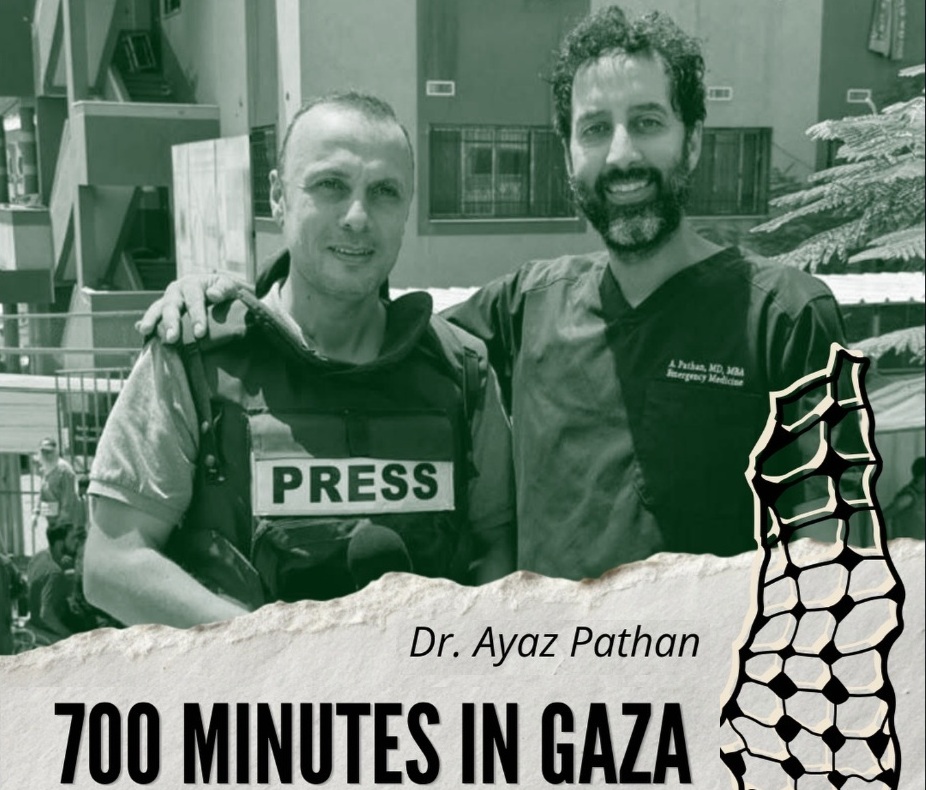
Presenter: Dr. Ayaz Pathan reported on his three weeks as an emergency doctor in Gaza. He spoke at the University of Oregon April 15, and KEPW’s Todd Boyle was there.
Dr. Ayaz Pathan: My name is Ayaz Pathan. I appreciate the opportunity to be able to speak to all of you. Honestly, you honor me by allowing me to get a chance to speak to you about this. And quite frankly, it’s a promise that I made to many, many people as I was exiting Gaza, that I would share their stories, that I would share what I saw and what I witnessed and bear witness to that with anybody that is willing to listen.
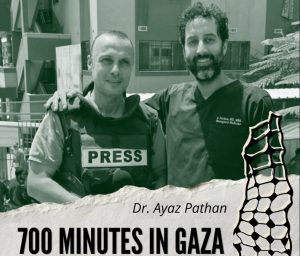
So, what I really want to do is talk about what’s been going on the past couple of years, through the lens of the last full day in Gaza where I looked back and happened to take a lot of pictures and started to timestamp them. And I noticed that it kind of added up to 700 minutes.
And I thought, ‘Oh, I can probably talk about basically everything that I witnessed there in three weeks’ time being on the ground, through just a single shift.’
There’s been about 20 ER board-certified doctors since October, 2024 till the ceasefire. And so what I like to tell people is that I’m not really unique in any way, but I will say that the experience is unique.
I had a chance to go to Northern Gaza at a time that it was not really an option for most NGOs and most groups basically because of the safety issue. It was a very different environment in Northern Gaza at the time, and only a couple of groups were able to go. So I had that opportunity.
I have no connection to this region of the world. Truth be told, my family’s originally from India. I was born in New York. I speak no real functional Arabic. Thankfully, the medical education in Gaza is in English, so the students would translate for me. I could communicate with the doctors pretty well.
At 2 a.m. one morning we got a greeting that, ‘Hey, this is what’s going to go on. The hospital you’re in is now considered an active military zone.’
A lot of times this type of warning comes as leaflets dropped from planes. Sometimes it comes via SMS text message.
And I asked the doctor who’s from there, and I said, ‘Hey, like, what is the amount of time that we have to exit?’ And he says, ‘Well, you really have no time. You need to exit.’
And I said, ‘Okay, well where are we going to do?’ And he said, ‘Well, we can’t abandon the patients, so we wait and see what the hospital says.’
And I said, ‘Okay. Once you get it, what are you typically looking at?’ And he said, ‘Sometimes it can be an hour, sometimes less.’ But he said, ‘Usually we wait till they drop the leaflets.’ This came by SMS texts.
And I said, ‘Okay, when they drop the leaflets by plane, what is that time period?’ And he told me that, ‘Well, you have maybe 10 minutes to get out at that time.’ And then he reassured me, saying, ‘Sometimes they drop the bombs and then they drop the leaflets.’
And he said this very calmly, because this is his life, right? This is not the first time he has gotten this. And after I left certainly was not the last time.
So needless to say, it is a situation which is chaotic, right?
One of the things that I always tell people when they ask me, ‘What was I surprised by?’ And I’ll tell you the level of destruction is what it is, and I know that we’ve all seen pictures but from the second I came in, I started taking pictures and it just got worse and worse in terms of the damage. And then obviously in Northern Gaza is even worse than that, and just kind of mind-blowing to see this level of just society and what it had been reduced to.
So we essentially lived in the hospital, right? There was no safe place to go. We were encouraged not to step outside of the hospital and certainly not outside the hospital grounds. Displaced people that are sleeping on the grounds, they consider this a safer area being close to a hospital.
I learned very quickly. You don’t stop talking when there’s a bombing, right? Like you hear the bomb, nobody stops talking because it’s so commonplace. It’s so regular. You only stop when maybe there’s a F-15 that flies right over the hospital or it shakes the ground because then you know it’s close enough to the hospital, you’re going to get casualties in.
So I’ll tell you a little bit about Nasser Hospital as we get started. So the hospital capacity running at 300%. This is pretty common in all of the Gaza hospitals and the math makes sense, where you went from an area which had about 36 functioning hospitals down to somewhere between eight to 12. So you do the math on that, and then you see what you got.
So we were seeing sometimes 1,000 patients a day. Just by comparison, at RiverBend, they’re seeing 240 patients a day, and that is a busy hospital. So, there’s not a hospital in this country that sees 1,000 patients a day. So as you can imagine, that is chaos. The only reason we’re able to do that is Doctors without Borders (MSF) were supplementing with tents outside to see a lot of patients.
We had only five operating rooms at Nassar Hospital, and as you can imagine, a lot of the patients needed to go to the operating room. RiverBend has 24 operating rooms.
Largest hospital in Gaza, always with an asterisk, right? Because hospitals are shut down. So you can go from the busiest hospital in Gaza to not functioning and then back up, which we saw here,
So I’ll start with my first hero profile here. So, Dr. (Mohammed) Abu Salmiya, he’s the head of al-Shifa Hospital, and he was taken into custody very early, and kept for months and months.
Well, what do they find? Well, they said that he was held by the unlawful combatant law. So it’s kind of a catch-all term to say, ‘This is why we’re going to hold this person.’ The evidence provided: none. They had zero evidence. That’s a little bit of a theme. What are the charges they filed? None, right?
But what happened to him? He was telling us all these stories about what he saw there, what he dealt with, the abuse that he had. Again, with no charges, no evidence.
The one thing I’ll point out about sort of. The three heroes that I profiled that, that I had the privilege of meeting, is these are all physicians with means. And early on, if you had enough money, you could probably exit through Egypt. All of these men chose not to leave. They chose to stay with their people. And these are the prices that they paid.
What I want to highlight here is really just about the children. So 20,000 children lost. And you know, loss is not a euphemism for dead or, or killed. It is. We don’t know where these kids are. That means they may be arrested and in prison they may be buried in the rubble or graves. Or they’re just simply separated, right?
Like, they’re just like, nobody knows where exactly this child is. That’s on top of the number of children that have been killed.
And all of you have probably read or heard stories about the amount of children amputees that we’re seeing, and these numbers are staggering, right? So multiple cases of children shot in the head or chest, right?
And what a good sniper will tell you is that these things don’t happen by mistake, especially in a child, right? To shoot a child in the head, you have figured out, ‘That is a child,’ and then to take that shot.
We would see things that were clearly intentional and some leaked information from the IDF suggests that they probably think all of this is true, right? You would see kind of a slew of children that were first shot in the right leg. The next day they’ll be in the left leg. And you almost wonder, like, ‘Are they just playing games?’
United Nations: ‘No child should grow up in fear,’ yet no child is free from fear, pain and hunger and Gaza. And then I think UNICEF really says it best. It’s the most dangerous place in the world to be a child when we talk about children and what they go through. So.
All right. Lunchtime in Gaza. The Prime Minister said there’s no starvation in Gaza. It’s like nonsense. The authority on it said that the highest level of famine, Phase 5, is present and that almost 40% are going days at a time without eating.
And even now since the ceasefire, my colleagues that I still talk to that are from there, tell me that some of it is better, but it’s still not what it should be. The stuff in the markets are extremely expensive.
In my experience, especially in Northern Gaza, there definitely is no lunchtime. We had privileged access to food, so the hospital would make sure that we had the ability to get food. That usually amounted to one meal a day, and sometimes not. So two of the weeks that I spent was in Northern Gaza, and I lost about 15 pounds when I was up there.
And that’s just kind of a fraction of what the people who have been there for like months and months and months were dealing with and what they lost.
Next hero profile: Dr. (Hussam Idris) Abu Safiya, head of Kamal Adwan Hospital. The hospital was raided at the end of 2024. I’m sure many of you know this story. This was a hospital that had the only functioning neonatal intensive care unit in Northern Gaza. He was abducted and still remains in prison today.
What was he charged with? Enemy combatant law. That’s how they’re holding him. What is evidence they provided? None.
Multiple organizations have said, ‘Hey, we’ve worked with this guy. We know this guy. We have health care workers that have worked alongside him. There’s no reason to be keeping him.’ And this is the most recent report of severe torture that he’s being put through.
Israeli Defense Forces basically are claiming that there are terror organizations in these hospitals, right? So what is the evidence? United Nations say it’s vague. Amnesty International say it’s no proof. And the New York Times has looked at the evidence and none of this has conclusively shown anything.
Most importantly, the health care workers who have worked there and lived in these hospitals, there are no assertions or no support to any of these claims, right?
At Nassar Hospital they found 300 bodies basically thrown in a mass grave. And this was after the IDF came into the area, raided the hospital, and you could tell that many of the deaths of those bodies were not natural, right? These were not just patients that passed away.
These were like people wearing scrubs with their hands bound and things like that. Of course, human rights observers had no access, so they couldn’t figure out what really happened. And what we know is that international humanitarian law says the burden of proof has to lie with the attacking force, right? You can’t shoot first, ask questions last. You need to know what you’re doing.
So one of my favorite people that I went to Gaza with is Capt. Willy Massay. So he’s actually in the U.S. Air Force and the Nebraska National Guard as well.
He’s close to my heart for a lot of reasons, but one of which is that the Israelis did not allow us in for several days, obviously gave us no reason. So I spent time in Jordan with him, just talking with him and checking out some things. He’s a critical care and emergency department nurse. He actually went to seminary school to be a Catholic priest.
And I still remember when we entered Gaza. He had been there a few times before, and this was like years ago, when the situation was better, so he knew people, so he had heavier bags because he had stuff he wanted to bring in to people.
So as we’re crossing the border, and this is like the high fences, so when we talk about open air prison, this is exactly what we’re talking about. So as we’re walking, he’s a little bit slower ’cause he’s got some bags, the rest of us kind of walk through the gate.
And then somebody comes on the speaker and they say something to him and they say, ‘Stop.’ So he stops. I turn around and then they say ‘Go.’ And then he walks and they say, ‘Stop.’ And they do that three or four times and then they start laughing at him and they call him a ‘Gaza slave.’
And if you ever get a chance to meet him, he’ll recount that story for you.
I’ll be honest with you, the media workers—so these guys are the real heroes as far as I’m concerned. Like none of us would know what is going on if it wasn’t for them, right?
And you know, when we hear a bomb, we go into the department to prepare to receive those patients. These guys, when they hear a bomb, they’re running to the location. And just (quite frankly), they are trying to document a genocide but they’re also trying to survive, right, because they don’t allow press in.
These are people from the area, their families are there, and yet they’re doing all this work. So, yes, I absolutely loved every time I saw one of these guys.
It’s like the number that are killed, injured, missing, arrested again, as you can imagine, without any real charges, directly targeted, and that’s just too numerous to count other things, right? Like cyberattacks or killing of family members or just these numbers become too staggering and too hard to figure out what’s going on.
But this is kind of the bottom line. It’s the deadliest period in history for journalists. This data comes from the CPJ. You know, these guys have done amazing, amazing things.
So, you know, what do the Israelis say about the press? They never target, purposely, journalists. Now, what do all the other organizations say? There’s ample evidence to show that they’re absolutely targeted.
And if you are interested, New York Times did an amazing video investigation of this balcony at Nassar Hospital. They were basically, with a camera, they were journalists, they were targeted, and then when people came to help them, they were targeted again, something known as a double-tap strike, which you probably are more familiar with.
Now, this +972, which is an Israeli magazine, did an expose on what they found with this.
So what we know about a double-tap strike is it’s a military tactic, right? So it is designed to essentially come after people that go to the area. And as we talked about, what does the press do when they hear bombing? They run to the site, right? They are there to document. So it’s journalists that you’re getting, first responders, medical personnel, other civilians, family members that are trying to help them.
And what they got is an IDF source, which basically said, ‘Yeah, I mean, we use this technique. I mean, this is a technique that is pretty useful if you’re trying to stop efforts to save other people.’ And as you can imagine, it’s considered a war crime.
But the Israelis are not alone, right? We as a country use this for the Venezuelan boats, like we are destroying the boats. People are going into the water, and we’re striking again.
We’ve seen this in Iran, very specifically. You’ve seen this at the Minab School where they struck the school. The children were taken to a prayer area and they struck that area. So, again, a war crime. And you’re seeing it used kind of over and over again.
Dr. Marwan Sultan, so my favorite, he is posted here. And as I mentioned, there were a lot of people that asked me to tell the story, which again is why I’m here. He was probably, I would say, the most forceful about it. He was like, ‘Hey, thanks for coming. You did great work while you’re here. It’s time for you to go.’
But he said, ‘Your real work now begins. You are exiting Gaza. Your plan is to exit Gaza. Now is when your real work begins. Not when you arrived here.’
Renowned cardiologist, one of two in Gaza. On the second, so a little less than a year ago, his home was targeted. It killed him, his wife, his daughter, sister.
And this hit hard. I was working in this hospital with this doctor, with Willy Massay. And (Dr. Sultan) is a guy who, again, even as a cardiologist, would come down to the ER when there were mass casualties, and do what he can to help us and try to save lives.
Unclear why he was targeted. They wouldn’t even admit that they targeted him, specifically, so they didn’t refer to him by name. And this is a quote that I personally am recounting that he told us and this is a hospital that had been raided in the past.
He said, ‘I told them if they want to come in any day of the week, just come in. We’re just running hospital operations here. We’re doing nothing else.’
And this is the hospital I did spend the most time in, and again, walked this entire hospital. So clearly there was no evidence that anything but hospital operations was going on. And then I think his 17-year-old son summed it up best: ‘He was just a doctor.’
So attack on health care workers. The Associated Press has documented this time and time again that disproportionately health care workers are killed. Multiple organizations say that there’s absolutely targeting.
And this New York Times video analysis is really, again, sort of a must-listen-to. It recounts where there was an attack on an ambulance. The second ambulance came in. Paramedics are walking away from where the IDF soldiers are and they’re fired upon.
They’re all wearing proper reflective gear. They’re not carrying anything that is concerning. The lights on their car were on to signal they’re an ambulance. And despite walking away from them, they’re fired upon for like seven or eight minutes straight, right?
And so the New York Times did a great job of taking the audio that they had of somebody who was trying to record, one of the paramedics was trying to record and doing an analysis of where that gunfire was coming from.
And then when you fire upon a bunch of paramedics and you have an ambulance that you have now destroyed, you would think it’s probably time to call in investigators and say, ‘Hey, I don’t know, we may have screwed up. These guys are not armed.’
But that is not what happened. What happened is they called in a bulldozer and they bulldozed the ambulance and the bodies into, essentially, it would be a mass grave, covered it up, and it wasn’t found till later.
Alright, let’s look at the data. So we’re at the University of Oregon. You guys believe in peer-reviewed research, so that’s what we should look at. This is obviously a lot of data here. Here’s the TLDR; it’s a collection of 14 peer-reviewed studies.
What I pointed out already is that the (reported) death tolls are certainly far less than what they really are. I think this point is just staggering, right, to basically, in 12 months, be able to drop the life expectancy of an entire population by 30 years, right? I mean, it’s just unthinkable, really. It really highlights sort of what has gone on.
And the indirect mortality, you know, the secondary causes of death:
If you have kidney failure, you need to have dialysis. About three times a week is usually the right number. What the soldiers did is they went in there and they specifically burned all of the dialysis machines.
These types of deaths that happen due to kidney failure patients that can’t get dialysis are not considered in the Ministry of Health’s register of deaths that are due to basically trauma or bombing or anything like that. It’s considered a secondary death, which is why most experts say that is way underestimated.
If you have a blockade on food, you have a blockade on medicine. That means that if you have diabetes or high blood pressure, any of those things, those things are going untreated as well, right?
All these things that are untreated and are dying because of a result of blockades and things like that. It rivals actual direct deaths, right? The actual bombings.
A hundred plus international aid organizations who are actually trying to get stuff in, every one of them will tell you that the thought that ‘There’s no restriction’ or ‘There’s no limit’ is complete nonsense. It is a complete lie.
And the health care system collapse is just sort of a major driver, right? You have, again, as I talked about, 36 hospitals that existed to begin with. You’ve taken that down to a third. I mean, in this country, if you close down a rural hospital, we know that mortality rises.
Now talk about if we were to drop, like, two-thirds of the hospitals in this country, you know, and forget about bombing, I’m just saying, just cut out that number of hospitals. You would see a lot more death.
And I would say almost all of my health care colleagues that were there during this time and that are now in the U.S. (probably are in the number of about 200), I will tell you that every one of us have testified to what we’ve seen to International Criminal Court.
The vast majority of people killed are just classified as civilians. That’s all they are. They’re not combatants. And then when you talk about who’s in prison, you know, they may be claiming that they’re being held under enemy combatant laws, but even their own statistics show that it’s just a fraction of who they’re holding.
The other thing I noticed is that one of the ER directors, like, ‘Hey, do you mind giving a lecture to the students?’ And I was like, ‘Yeah, I’ll give a lecture.’ And then all of a sudden they got this fancy flyer with my name on it. I’m like, ‘It’s not that big a deal guys. I’m just going to talk about stuff.’
And then what struck me is that all of their schools are destroyed. All these medical students are showing up to hear me talk about whatever topic. I just felt—I mean, I didn’t bring any specific books, but just topics that I knew that I could kind of speak to.
And they’re hungry for education. I mean, it is actually a population that before all this had like a 98% literacy rate and they just—it is something very important to them.
And so when the United Nations say it is systematically destroying the education system, there’s a reason that every school has been destroyed. And it’s not because there are people in there doing military stuff, right. There’s something more nefarious at play.
So I used to not use the term ‘genocide.’ And part of the reason why is that I worry about credibility, right? That like, hey, I’m just explaining what I saw and what I witnessed. And so I don’t want to throw around terms because I can’t speak to the depth of the work. That is for the journalist and the researchers.
But now there’s no way I can talk and not use the word ‘genocide.’ That would cause me to lose credibility. And the reason why is right here, right? It’s that Israeli-based organizations—multiple—have called it a genocide. Countries have declared or endorsing the designation.
There are many international NGOs—the International Association of Genocide Scholars—have a resolution affirming this is a genocide. And then shortly after, an independent United Nations inquiry came up with essentially the same conclusion, that the vast majority of the actual definitions are carried out.
This is a genocide by any stretch of the imagination.
Presenter: Dr. Ayaz Pathan was asked how he managed his mental health.
Dr. Ayaz Pathan: Yeah. I don’t know. I really, I honestly don’t have a good answer. I’ll tell you, as an ER doctor, I’ve seen horrific things in this country, even. I trained in downtown Atlanta.
I never saw anything obviously to this degree. And truth be told, I probably should be getting counseling for stuff like that. That’s probably the smart thing to do.
But honestly, in a lot of ways, this is kind of how I deal with it, right? Like I continue to share the story and tell what I saw and that, in whatever fashion, helped me at least to deal with the survivor guilt part of it.
Presenter: Dr. Ayaz Pathan reports on what he saw in Gaza. Field recordings by Todd Boyle for KEPW. You can see the entire presentation on Todd’s YouTube channel.