Police, Fire get the final word on CAHOOTS-like services
12 min read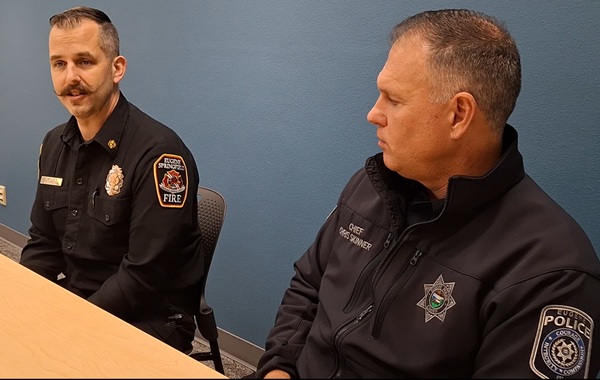
Presenter: In a long-running conflict with CAHOOTS, Police Chief Chris Skinner and Fire Chief Mike Caven get the last word. Speaking Nov. 6, Chief Caven:
Mike Caven (Eugene Springfield Fire, chief): We’re here because in early April of 2025, the city was notified that the White Bird Clinic wasn’t going to be able to keep the CAHOOTS program going forward.
[00:00:19] Presenter: Both chiefs have spoken openly about their issues with CAHOOTS, including this exchange at a Jefferson Westside neighborhood meeting in November, 2022. With a comment about the lack of detail in CAHOOTS reports, Duncan Rhodes:
[00:00:32] Duncan Rhodes (JWN): You at least ought to be capturing what actually happened rather than just, ‘CAHOOTS had a call.’
[00:00:38] Presenter: Chief Skinner:
[00:00:39] Chris Skinner (Eugene Police Department, chief): You’re absolutely correct. At this point, getting data from CAHOOTS has been hard at best. They provide an invaluable service to this community and fill a gap for us in the public safety system, there’s no question about that. But we have to get to a place where we better understand what it is they’re doing, where they’re doing it, and the details of that.
[00:00:59] In some cases, they refuse to share information with us, citing HIPAA, which is a very, very liberal definition of what protected health information is.
[00:01:10] Presenter: The two chiefs said much the same at a press conference Nov. 6. Fire Chief Mike Caven:
[00:01:15] Mike Caven (Eugene Springfield Fire, chief): There wasn’t data. That’s something we were working with them on for several years, is to understand what were the disposition and outcomes of those calls.
[00:01:23] And so you look at that and there were 14,000 individual calls that showed a CAHOOTS designator on it. Not all of those got a response. Not all those got a physical response and not all those had arrivals. But we don’t have good disposition information for those
[00:01:38] Presenter: Police Chief Chris Skinner:
[00:01:40] Chris Skinner (Eugene Police Department, chief): What I would say is: Over the course of the 30 years of CAHOOTS being in existence, that the mission of that particular organization and the way we utilized them got really, really broad. And we need to be really good about focusing back in on what the actual need is out on the street.
[00:01:55] Presenter: Sen. Ron Wyden sponsored a bill bringing street crisis services under the nation’s vast healthcare bureaucracy. But that also required extensive record keeping and reporting. In May, 2023, Eugene Intergovernmental Relations Manager Ethan Nelson:
[00:02:10] Ethan Nelson (Eugene IGR, manager): CAHOOTS does not meet the new federal guidelines. Those guidelines are something different than what CAHOOTS provides.
And so when we show up, we say, ‘Hey, we’re CAHOOTS,’ and they say, ‘Yeah, CAHOOTS was great, but it’s not mobile crisis response, statutorily defined, therefore, you’re not eligible.’
And the money that became available from Wyden in the Medicare system is not direct funding. It’s reimbursement. And so we have to then go through the process and many clients—community members CAHOOTS serves—do not give any information and therefore, if they’re not getting that information, then they can’t request reimbursement.
[00:02:50] Presenter: Asked to comment on the CAHOOTS services ending in Eugene, Sen. Wyden said: ‘The true measure for successful response to anybody anywhere in crisis is whether responders are providing effective, humane and timely aid — not what lettering happens to be on the side of the responding vehicle. ’
[00:03:07] Commenting on CAHOOTS at the City Club, December 2024, then-Mayor Lucy Vinis:
[00:03:13] Lucy Vinis (Eugene, former mayor): They’re, I suppose in some ways, a victim of their own success.
[00:03:18] Presenter: A volunteer member of the Police Commission suggested that not everyone in the Police Department was sad to see CAHOOTS go. William Parham:
[00:03:26] William Parham (Eugene Police Commission, former member): CAHOOTS—at the joy of certain members of the police force—has been gutted.
[00:03:33] Presenter: On Nov. 6, Chief Skinner said police officers appreciated the value of CAHOOTS and are recognizing the service gaps that are now appearing.
[00:03:41] Chris Skinner (Eugene Police Department, chief): My patrol officers every single day are responding to things or hearing about things or having something on their call screen that they can’t get to that they think is a nice fit for something to fill the gap. And we’re calling it ‘Peer Navigation,’ but really what it is, it’s a descriptor of, you know, a suite of services, or at least a delivery of services that we think is going to fill this gap.
[00:04:01] So, you know, as we talk with my police officers, they recognize the value that CAHOOTS brought at the time. And so my police officers are recognizing that some of those needs are not being met right now, and they’re embracing and excited about the opportunity to have something to fill those gaps.
[00:04:16] Because, ideally, what we’re trying to do is match the right resource with the right need. Police officers aren’t the right resource for some of the needs and neither are paramedics or the fire department in some cases. And so that’s really what we’re trying to do, is thread that needle on trying to match the right resource with the need.
[00:04:30] And when you hire a bunch of people that want to help community and their foundational value is, ‘I want to help people,’ they still, even as they’re going from call to call to call—and maybe in some instances, really dangerous calls—they still recognize that there’s people that are not getting their needs met.
[00:04:45] And so they’re totally open to trying to figure out who steps into that space that we can build a system where those needs are getting met, while freeing up your very professional police and fire—police officers and firefighters to go do what you, what this community really wants ’em to do, which is life and property safety.
[00:05:01] Presenter: At the end of October, a gap analysis report was shared with the mayor, and on Nov. 6, the two chiefs conducted a press conference with local media. Chief Caven said the gap is not acute mental health response.
[00:05:13] Mike Caven (Eugene Springfield Fire, chief): We’ve been evaluating our work on the street, both from the Fire Department’s perspective, the Police Department’s perspective, and then measuring that against what existed prior to the program as far as demand for service, and then what we had experienced out on the street following that program halting services.
[00:05:31] And one of the bigger things, and we talked about it during the Budget Committee process back in May, was: On that first month, we didn’t see a lot. We didn’t experience a surge in call volume, in particular in the Fire Department, and that has maintained throughout the last six months that, really, not a lot had changed for us.
[00:05:50] In fact, our call volume was down. Our call volume was down around certain call types, in particular, the acute mental health crisis or suicidal ideation. We have seen less in 2025, and there are various indicators of why that might be the case.
[00:06:05] But my team spent time working with the Police Department and their data analytics group getting input from patrol officers and in the field there, and we were able to put together a report that basically covers what we know, right?
[00:06:20] And the one thing that’s changed from, say, the inception of the CAHOOTS program over three decades ago, is the ecosystem itself. The amount of service providers that exist in Lane County, in particular, within Eugene, for various mental health social services programs is different.
[00:06:39] We now, obviously, we have the county operating mobile crisis response as well, and we have our own community kind of paramedicine alternative response programs that are growing from grant-funded initiatives to how we envision those in the future.
[00:06:56] So the task was to figure out with these other things that are in the space, where’s the gap still? And the gap that remains has a lot to do with the non-acute mental health crisis, the ‘check welfare,’ ‘subjects down’-type calls, and then this other suite of just more lifestyle or social service type issues that are existing in the community.
[00:07:20] And then a big one that we wanted to figure out was youth and their needs for crisis response, ’cause that’s something that the county doesn’t handle. We have a fantastic nonprofit here in Lane County,…and it maintains 24-hour access.
[00:07:34] Presenter: He was referring to youth services at the Riverview Center for Growth in Springfield.
[00:07:39] Mike Caven (Eugene Springfield Fire, chief): And so we look at these gaps around subject down, unknown, nonviolent, nonpersistent, like acute mental health crisis is, What’s the right resource to send to that? And what we’re seeing developing (and really as law enforcement has done a lot in downtown), is that having a peer navigator, people who are trained to address these calls that are not threatening, not crimes and help navigate them to the appropriate services.
[00:08:03] Like I mentioned earlier, there’s a tremendous amount of kind of individual nonprofits or other service providers that exist, but we don’t have a good way is connecting people to those and also doing the follow-up care.
[00:08:20] And that’s the unique component that the MCS program, the state requires follow-up within 72 hours of that. The community paramedic program, as we work on that, that is about complex case management and the programs, whether it’s the FITT team, the peer navigation program, they’re looking at downtown, all have a component of follow-up and connection with a goal of ending the persistent component of these needs is getting people the resources that they need, getting the follow-up.
[00:08:49] And ideally, if you’re doing it right, you want to put yourself out of business. You provide services, you make connections where people don’t need to call 911 or aren’t in a position where somebody else needs to call 911 to address their issues.
[00:09:04] Presenter: The city will define the new peer navigation service in what’s called a Request For Proposal, or RFP. The requirements will not be the same as the original CAHOOTS services. Chief Caven:
[00:09:15] Mike Caven (Eugene Springfield Fire, chief): Again, the Fire Department’s not seeing an overall call volume spike. The acute cases haven’t spiked at all. In fact, they’ve remained down. And the other calls for service that we’ve seen are more public assist types–significant increases as you’d see in the report by percentage, not significant increase by volume.
[00:09:35] And the police have seen similar and, and you’ll notice in the report where it talks about, it’s ‘check welfare’ calls, public assist calls, transporting people to, whether it’s (Lane County) Behavioral Services, whether it’s the Detox Center, things that they haven’t traditionally had to do, and that does take officers away from the overall core of services.
[00:09:54] Through that evaluation, we made the recommendations to expand a peer navigator-type social service response program, and stepping back into that space in the core areas where there’s high-volume utilization. That’s 6th, 7th Street downtown, and then out Highway 99. Like many of our programs, that might be geographically based, doesn’t mean that their supervisors can’t authorize response into other parts of the community if there’s a demonstrated need.
[00:10:24] Presenter: With data showing that Lane County Mobile Crisis Services is handling the acute crisis calls, the role for the next provider will be very different. Chief Caven:
[00:10:33] Mike Caven (Eugene Springfield Fire, chief): The CAHOOTS program in the past was responsible for acute mobile crisis, which again, legally is the county’s responsibility and they have a program to do it now, and there’s more stability in the system if we’re not relying on one single resource to do everything that’s out there. So that’s kind of how we’re looking at it at this point.
[00:10:52] There’ll be similarities between some of the types of calls, but more of those acute crisis calls that they (CAHOOTS) were known for, there is a service that’s there (LC-MCS). We had previously worked to pair those two together when the county was trying to decide what to do. Data collection and some other challenges prevented the White Bird or the CAHOOTS program from being the one that could service the county’s legal requirements.
[00:11:17] So the Fire Department, the Police Department will work closely on forming that up—the performance measures, oversight and all that. But the report calls for a 60- to 90-day time period around the RFP as an estimate. Our goal is to get it done in a reasonable amount of time.
[00:11:36] Presenter: A new program downtown may offer some clues into what’s coming: A peer navigator will handle low-acuity cases which don’t require a qualified mental health professional. Chief Skinner:
[00:11:46] Chris Skinner (Eugene Police Department, chief): We’re getting ready to roll out a peer navigator program in the downtown core that is going to be complementary to our co-responder, which is a QMHP, that’s a relationship with the county and their Forensic Intensive Treatment Team (FITT).
[00:12:00] We’d already been in this space with having a co-responder with a QMHP already downtown, and what we recognized is that there are certain things that we were having our QMHP respond to with all of the county resources wrapped around those individuals.
[00:12:12] And then there’s other more lower-acuity things that were kind of falling through the cracks. And so that’s why we switched. The original plan was to have a second QMHP and a second co-responder.
[00:12:22] We recognized we have a gap in our services, even downtown. And we felt like it could be filled with a peer navigation. So we had a little bit of a head start on this, and so I’m happy to say that I think by the end of this year, if not the first week of 2026, we’ll see our first peer navigator downtown.
[00:12:36] And what’s so beautiful about the downtown work that’s happening is, I think it can be a good indicator, hopefully a good indicator, and build upon the success, which is going to happen more and more citywide. I’m not going to speak for Chief Caven because he’s going to be the author and he certainly has a ton of support and help around this.
[00:12:52] What we’ll likely do is take a look at what we did and we’ll find the things that work for the needs in the broader sense of the community.
[00:12:58] But you never know. It might be a really nice blueprint for doing something bigger in the city and as always in public safety, what you do is you take the information, you do the very best job you can to fill the need as best you can, and then you have to be willing to adjust and we will constantly be adjusting based on the kind of the moving target of the need that we see in our community.
[00:13:19] Presenter: The new requirements will insist on rigorous reporting. Chief Caven:
[00:13:23] Mike Caven (Eugene Springfield Fire, chief): What we want to be is really thoughtful is how we step back into this. And one key initiative is that we have good data of what happens once those programs are back in service, ’cause that was the big thing missing.
[00:13:37] Presenter: Eugene Police Chief Skinner:
[00:13:38] Chris Skinner (Eugene Police Department, chief): Both Police and Fire keep really, really good statistical data to help us build a time-of-day, day-of-week type of structure, cause anytime you’re going to go to RFP, part of that cost driver is going to be: ‘Okay, how many people do we have available and how we’re going to pay those people?’
[00:13:54] And so we’re not going to be just throwing darts at the dartboard. It’ll be really, really drilled down and analytical in nature on kind of time-of-day, day-of-week that we feel like we need. Just based on experience, it’s going to be hard to justify 24-hour coverage, but we certainly can see times of day and days of week where we would like to have robust coverage and so we’ll make sure we build that into the RFP.
[00:14:16] Presenter: The fire chief and police chief get the final word, as they decide the performance measures and data collection required from all CAHOOTS-like service providers.